Neither floor wins outright. A ground-floor apartment usually costs less and is easier to get in and out of. A top-floor apartment usually gives you more privacy, light and views, but you carry the roof above you. What matters for a Sydney buyer is which trade-offs you can live with, and whether the specific building and unit have the problems that each level tends to hide. A buyers agent who inspects the building, reads the strata paperwork and negotiates on what turns up can make that judgement for you. That is the work we do at Sydney Property Buyers.
TL;DR
- Ground floor: usually a lower entry price, no lift dependence and often a courtyard, but more exposure to street and entrance noise, damp and break-in risk.
- Top floor: more privacy, light and views and no neighbours above, but a roof directly overhead, which means heat, leaks and insulation quality matter a great deal.
- Price gaps are real but vary by building. Overseas data points to ground-floor discounts of roughly 5 to 20 per cent, and a premium for each floor you climb.
- Inspect at different times of day and check the strata records, drainage and roof before you commit to either level.
- The floor number is never the investment. The view, the building and the price you pay are.
Table of Contents
- How the two floors differ in daily life
- Price: what each floor costs, and what it sells for
- What to check on a ground-floor apartment
- What to check on a top-floor apartment
- Which floor suits which buyer
- Where a buyers agent earns the fee
- Work with a Sydney buyers agent
- FAQ
- Sources
How the two floors differ in daily life
The differences show up in six places: noise, privacy, light, temperature, access and safety. Here they are side by side.
| Factor | Ground floor | Top floor |
|---|---|---|
| Noise | Closer to pedestrians, cars, entrances and shared corridors | Farther from street and entrance activity |
| Privacy | Passers-by can see in, depending on the setback | Generally more private |
| Natural light | Can be limited by neighbouring buildings and fences | Often more light and airflow, depending on orientation |
| Temperature | Often cooler in summer; can be damp or cold underfoot | Can run hot under a poorly insulated roof |
| Access | No lift waits, easy for prams, bikes and mobility needs | Depends on the lift; longest trip out in an emergency |
| Outdoor space | Frequently a courtyard or garden | Often a balcony or terrace, with wider views |
These points come from a comparison guide that sets out the same split: top floors are generally further from street and entrance activity and offer wider views, while ground floors sit closer to pedestrians, cars and shared circulation.
Noise
On the ground floor, where in the building you sit matters more than the floor itself. Brick Underground notes that a unit near the entrance hears the front door, one near the lift hears dings and conversation, and street-facing units get more outside noise than rear-facing ones. It also observes that older buildings tend to have better sound attenuation than newer developments. In Sydney terms, that is a reason to compare a solid brick walk-up in the Inner West with a recent lightweight build before you assume anything about quiet.
Top floors escape most street and corridor noise. The trade-off is what is above you: roof plant, a shared roof deck or air-conditioning equipment. Brick Underground’s top-floor guide suggests asking about the hours and use of any common roof deck above the unit.
Heat and cooling
The ceiling of a top-floor apartment is the roof. Apartment List lists no neighbours above and lots of natural light as top-floor pros, and hard-to-cool summers that lift air-conditioning bills as a con. Lower floors generally carry lower cooling loads, and Domira reports greater roof heat gain on top floors.
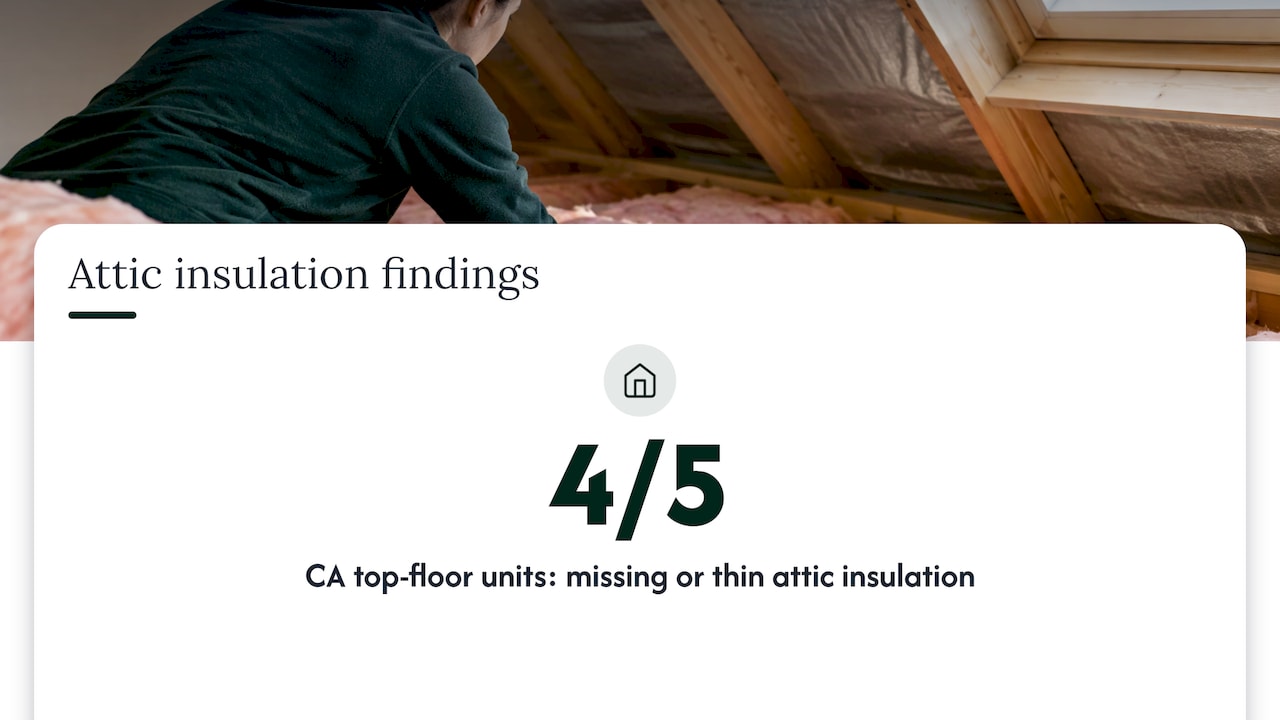
The insulation point is evidence-based. A Lawrence Berkeley National Laboratory study of California multifamily buildings found that in four of five top-floor apartments the attic insulation was missing or only a few centimetres thick. It identified upgrading it as one of the largest projected energy savings. The lesson for a Sydney summer is simple: a top-floor unit with good roof insulation and cross-ventilation is a very different purchase from one without.
Orientation interacts with floor level. A north-facing top-floor apartment catches winter sun and can cook in summer without shading. If that matters to you, our north-facing checklist shows how to judge aspect quickly, and the same logic applies to a unit.
Security
Ground-floor units are easier to reach for a burglar, especially when they sit out of passers-by’s sightlines. Brick Underground reports that secure-entry and virtual security systems reduce that concern significantly. When you inspect, look at the lock quality on sliding doors, the lighting around the courtyard and whether the unit is visible from a main path.
Access and emergencies
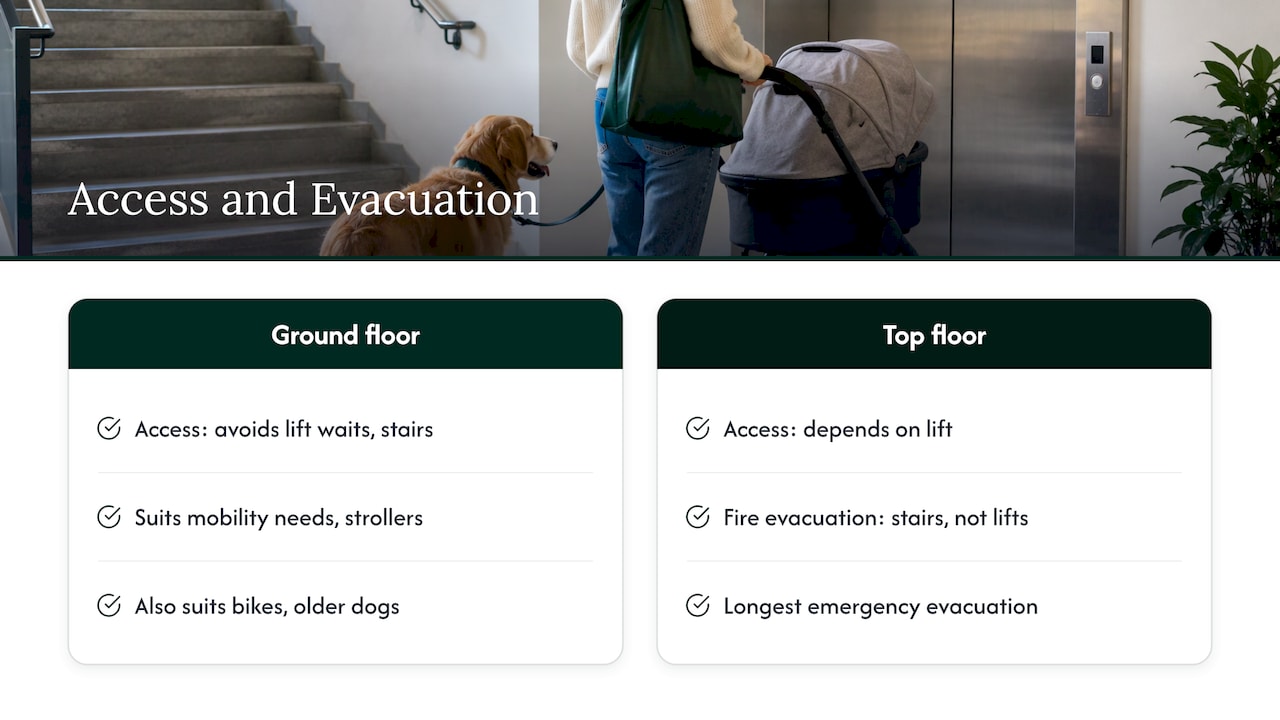
Ground-floor residents avoid lift waits and stairs. Realtor.com notes that the first floor suits buyers with mobility issues, strollers, bikes or older dogs. Top-floor residents depend on the lift, and Apartment List notes the longest emergency evacuation. Fire guidance summarised by MILLION stresses that lifts are not used in a fire, so higher floors mean longer exits by stairs. It advises confirming stairwell access, clear signage and how the building communicates evacuation procedures. In a walk-up block with no lift, the stairs also decide who can visit you, who can resell to you and how you will feel about them in ten years.
Price: what each floor costs, and what it sells for
This is where buyers most often get it wrong, because the premium or discount is not a fixed rule. Treat the figures below as overseas reference points, not Sydney quotes.
- In the United States, Brick Underground’s buyer guide says ground-floor units have conventionally sold at a 5 to 20 per cent discount to a comparable unit in the same building, mainly because of less natural light and sometimes lower ceilings. Garden duplexes with finished cellars or private outdoor space can sell above asking.
- A 2008 New York Times analysis of walk-ups found top-floor units with no outdoor space averaged well below first-floor units. That reflects the climb, not the view.
- For lifted buildings, an appraiser quoted by Brick Underground put the typical rise at about 1 per cent for each floor you go up on the same line.
- In Australia, a realestate.com.au feature quotes a property group chief executive saying higher-level apartments generally see greater capital growth because they appeal to investors, owners and tenants, while ground-floor units suit older buyers and offer larger courtyards but face privacy, security and noise concerns. That is one industry view from 2014, not a guarantee.
A worked example makes the logic concrete. Say two similar two-bedroom apartments sit in the same Inner West block, one on the ground floor and one on the top. If the ground-floor unit is priced 10 per cent lower, the question is not whether the discount is attractive in itself. It is whether the unit’s weaknesses (light, courtyard privacy, damp history) are priced in. A buyer who will not use the lift and wants a courtyard may rationally prefer it. A buyer who works from home and wants quiet may happily pay the premium upstairs.
Does floor level drive resale?
Not on its own. Moneycontrol’s buyer guide says a higher floor with an unobstructed view may justify a premium, but paying extra for a floor that will soon face another tower may not. MILLION frames the question as whether the premium buys something durable: a protected sightline, meaningful light, privacy or scarcity. In Sydney, a view over a heritage-listed park is more durable than a view over a vacant lot that a developer owns.
What to check on a ground-floor apartment
Ground-floor risk is mostly about water, light and boundaries.
- Moisture and drainage. Review the building’s maintenance history and ask about the drainage system. Brick Underground suggests having the inspector focus on drainage points and watching for dehumidifiers or recently painted or replaced baseboards, which can be warning signs of past moisture. Its flood guide adds mould or damp smells and water staining on baseboards. If you find any of these, a licensed tradesperson offering drain and sewer line repair shows the kind of work involved in tracing a recurring drainage fault.
- Flood exposure. Sydney buyers should look at council flood mapping and the property’s flood planning level. Our guide to NSW flood zones explains why the H1 to H6 ratings do not tell you everything.
- Courtyard rights. Confirm in writing whether the courtyard is exclusive-use or common property. A comparison guide makes the same point about ground-floor garden ownership and exclusive-use rights. In a NSW strata scheme, this is a matter for the strata plan and by-laws, so have it read properly.
- Light. Visit in the morning and late afternoon. Ground-floor discounts are often attributed to less natural light.
- Security. Check entry systems, sliding-door locks and sightlines.
What to check on a top-floor apartment
- The roof. Brick Underground warns that because the ceiling is the roof, top-floor units are more exposed to leaks and summer heat, and recommends buyers request a roof inspection. In NSW, that means asking for the strata inspection reports and any building defect records. Our guide to building defects in NSW strata covers what to look at first.
- Insulation and ventilation. Ask about ceiling insulation and whether the unit has cross-ventilation. Stand inside at the hottest part of the day.
- The view. A comparison guide advises basing any view premium on a protected, verified view, since future construction can change it. Check the planning controls for neighbouring sites.
- The lift and stairs. Ask how often the lift is out of service, and check stairwell access and signage.
- Levies. A building with lifts, a roof and shared systems often carries higher costs. Our piece on strata levies and property value shows how to read them.
For either floor, the practical test is the same: visit the specific unit at the hottest part of the day and again in the evening, as Domira advises. Our property inspection checklist gives you a list to take along. If the building is off the plan, the risks differ again, and we cover them in off the plan risks.
Which floor suits which buyer
- Downsizers, families with prams and buyers with mobility needs: the ground floor, with a courtyard, often fits best.
- Buyers with a tighter budget: a ground-floor unit can be the cheaper way into a good building, as long as moisture and light check out.
- Remote workers and light sleepers: a higher floor, away from street and entrance noise.
- Investors: look past the floor number. Capital growth and rental yield depend on location, building quality and the price paid. A well-priced practical apartment can be easier to resell than one bought at an excessive floor premium.
A middle floor is often a compromise: away from street noise and the roof, and close enough to the ground for a quick exit. Whether it suits you comes down to the unit’s aspect and the building’s condition.
Where a buyers agent earns the fee
The floor comparison is easy to read in a blog and harder to apply to a specific building on a Saturday morning with other buyers around you. The real value is in the paperwork and the negotiation.
A good example: the unit looks perfect, but the strata records show repeated roof repairs or a drainage complaint. That is a defect issue you can use at the negotiating table, not only a reason to walk away. We lay out how in our guide to negotiating with a building report.
Our view on the floor question
We act only for buyers, never sellers, so we have no stake in which floor you pick. What we see in practice is that clients ask the wrong question first. They ask which floor is better, when the better question is which building and which unit are priced fairly for what they carry.
Our approach is to treat the floor as one input in a wider appraisal. We look at the building’s records, the aspect, the capital growth potential and the rental yield. We inspect seven days a week, so we are not limited to open home times and can see a unit when the afternoon sun is at its worst or the street is at its loudest.
Access matters as well. More than 30 per cent of our purchases are secured off-market, which means the choice between a courtyard unit and a top-floor unit is sometimes made before most buyers have seen either. That is where a clear brief helps most.
Kristan
Work with a Sydney buyers agent
If you are weighing a ground-floor and a top-floor apartment in the Inner West, Eastern Suburbs, Lower North Shore or Eastern Beaches, our Complete Purchase Solution covers strategy, on-market and off-market search, independent appraisal, due diligence, negotiation, auction bidding and settlement. If you have already chosen the apartment, Negotiation Only gives you professional representation on the price. Our clients have saved about 9 per cent on average on purchase price, and the average time from engagement to settlement is 54 days.

You can see examples on our recent purchases page, or call 1800 676 177.
FAQ
Is the top floor always better than the ground floor?
No. Top floors offer more privacy, light and views, but sit under the roof, so heat and leaks matter. Ground floors suit buyers who want easy access, a courtyard or a lower entry price. Moneycontrol’s buyer guide says there is no universally better floor.
Are ground-floor apartments cheaper?
Often, though it depends on the building. Brick Underground reports a conventional discount of 5 to 20 per cent in US buildings. In Sydney, a courtyard, a quiet position or a renovated interior can narrow or close the gap. Compare against similar units in the same building.
Which floor is safest?
Ground floors are easier to access for thieves, but secure entry and security systems help considerably. Top floors have longer evacuation routes in a fire, because lifts are not used. Check the building’s fire safety measures and the unit’s locks rather than relying on the floor.
Do top-floor apartments grow in value faster?
Some industry commentary says they do. A realestate.com.au feature quotes a property group chief executive to that effect. The better indicator is whether the view and light are protected and whether you paid a fair price for them.
Sources
- Ground-Floor vs Top-Floor Apartment: Which Is Better?
- What Is the Best Apartment Floor to Live On?
- Considering a ground-floor apartment? Brick Underground
- Which Floor and Which Orientation, Domira Insights
- Pros and Cons of Living in a First-Floor Apartment, Realtor.com
- High-Floor vs Low-Floor Condos in South Florida, MILLION
- How can I tell if an apartment I’m buying has flooded, Brick Underground
- Pros and cons of living in a top-floor apartment, Brick Underground
- Lawrence Berkeley National Laboratory multifamily retrofits paper
- Apartments: should you buy upstairs or downstairs?, realestate.com.au
- Worth the Climb, The New York Times
- Ground floor or higher floor? Moneycontrol
Recommended
- How to Read a Floor Plan Before You Buy in Sydney
- What is a floor plan rating? A guide for buyers and investors
- Combustible Cladding in NSW Apartments: A Buyer’s Guide