Combustible cladding is external wall material that can burn quickly once it catches fire, and some NSW apartment buildings still have it. It does not automatically make a building unsafe, and it does not automatically rule out a purchase. What matters is which material was used, how it was installed, what the owners corporation has done about it, and what that means for your levies, insurance and resale. This guide shows you how to find out before you sign.
We are a Sydney buyers agency and we act only for purchasers. Many of our clients, including buyers based overseas, ask about cladding when they look at apartments in the Inner West, Eastern Suburbs, Lower North Shore and Eastern Beaches.
TL;DR
- Combustible cladding is a fire-risk issue on some apartment buildings. Its presence alone does not make a building unsafe, but it needs a proper check.
- NSW requires owners of certain buildings with external combustible cladding to register them. The register is not a public search tool, so buyers need to check through other channels.
- Ask for strata minutes, the Annual Fire Safety Statement, any façade assessment reports, council orders and the insurance details before exchange.
- Project Remediate offers support to eligible high-risk buildings, but it does not remove your need to understand the costs.
- You cannot identify cladding by looking at a wall. A specialist assessment is the reliable route.
Table of Contents
- What combustible cladding is and why it matters
- The NSW cladding register and what it means for you
- How to check a Sydney apartment building before you buy
- Red flags and reassuring signs in the paperwork
- Remediation, levies and insurance: the money side
- Resale and what it means for your plan
- Our perspective
- How Sydney Property Buyers can help
- FAQ
- Sources
What combustible cladding is and why it matters
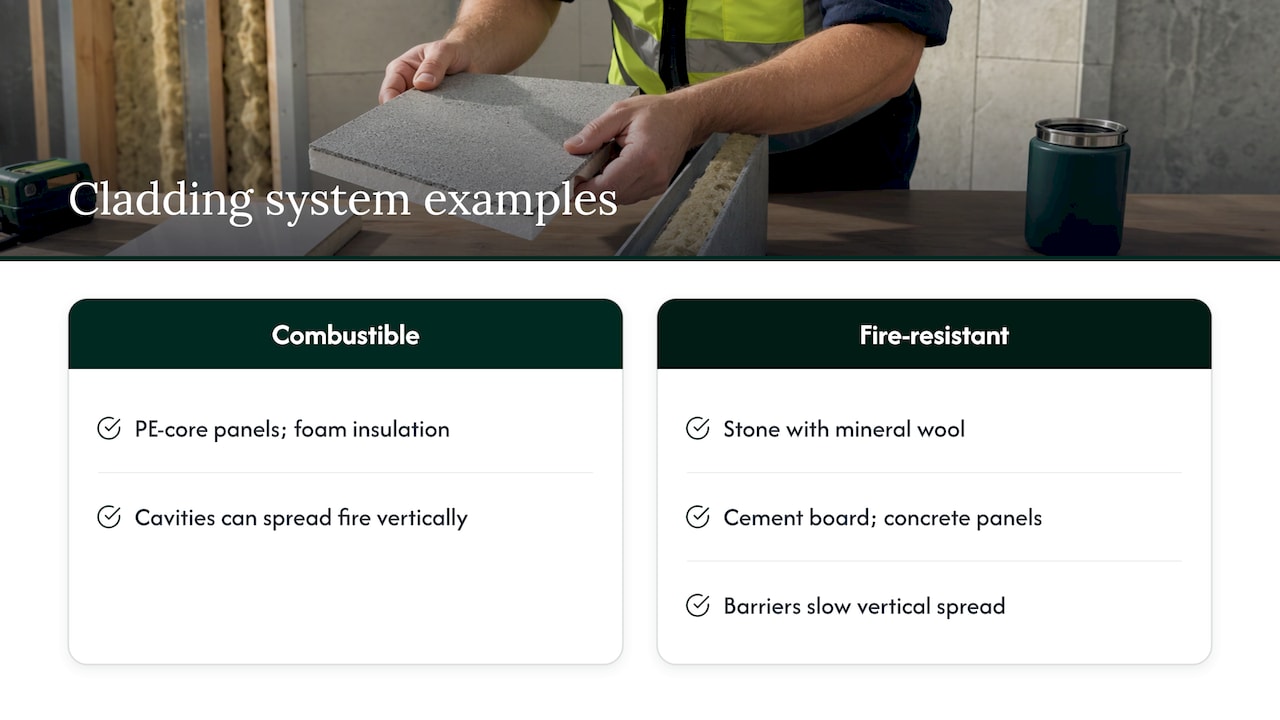
Cladding is the outer skin of a building. On many apartment blocks built in recent decades it is a mix of panels, insulation and fixings. The NSW Government explains that combustible cladding can burn rapidly if it is set alight. Metal composite panels can have a polyethylene core, and insulated systems may use foam such as polystyrene, polyurethane or polyisocyanurate.
The risk comes from how fire travels. Academic fire research on exterior cladding notes that cavities behind panels can let fire spread vertically, and that windows and other openings can let fire re-enter the building. That is why a fire that starts on one floor can climb the façade.
Some systems perform far better. The UK’s Fire Protection Association lists stone systems with mineral wool, cement board and concrete panels as fire-resistant examples. It also notes that mineral-based cavity barriers, often with intumescent strips, can seal a cavity during a fire and slow vertical spread.
The important point for a buyer is balance. According to one strata management resource, the presence of combustible cladding does not automatically make a building unsafe. Safety depends on installation, how materials were used and the building’s overall fire safety provisions. Your job is to find out where a particular building sits.
The NSW cladding register and what it means for you
NSW introduced a registration requirement for buildings with external combustible cladding. The Planning department states that owners of residential apartments, residential lodging buildings, aged-care buildings, hospitals, day surgeries and public assembly buildings of two or more storeys with external combustible cladding must register them.
People often search for the “cladding register” expecting a public list of addresses. That is not how it was designed. The NSW Government’s owner FAQs say the register holds point-in-time building information made available to Fire and Rescue NSW and local councils, and that the Government did not intend to make portal information public.
The practical result: you cannot rely on typing an address into a website and getting a clean answer. A building that is not visibly flagged is not proven clear. You need to ask the right people for the right documents.
The 2018 aluminium composite panel ban
A separate rule covers new work. The NSW Government’s aluminium composite panel ban took effect on 15 August 2018. It applies to specified Type A and Type B buildings, including Class 2 buildings of three or more storeys in Type A construction and two or more storeys in Type B construction.
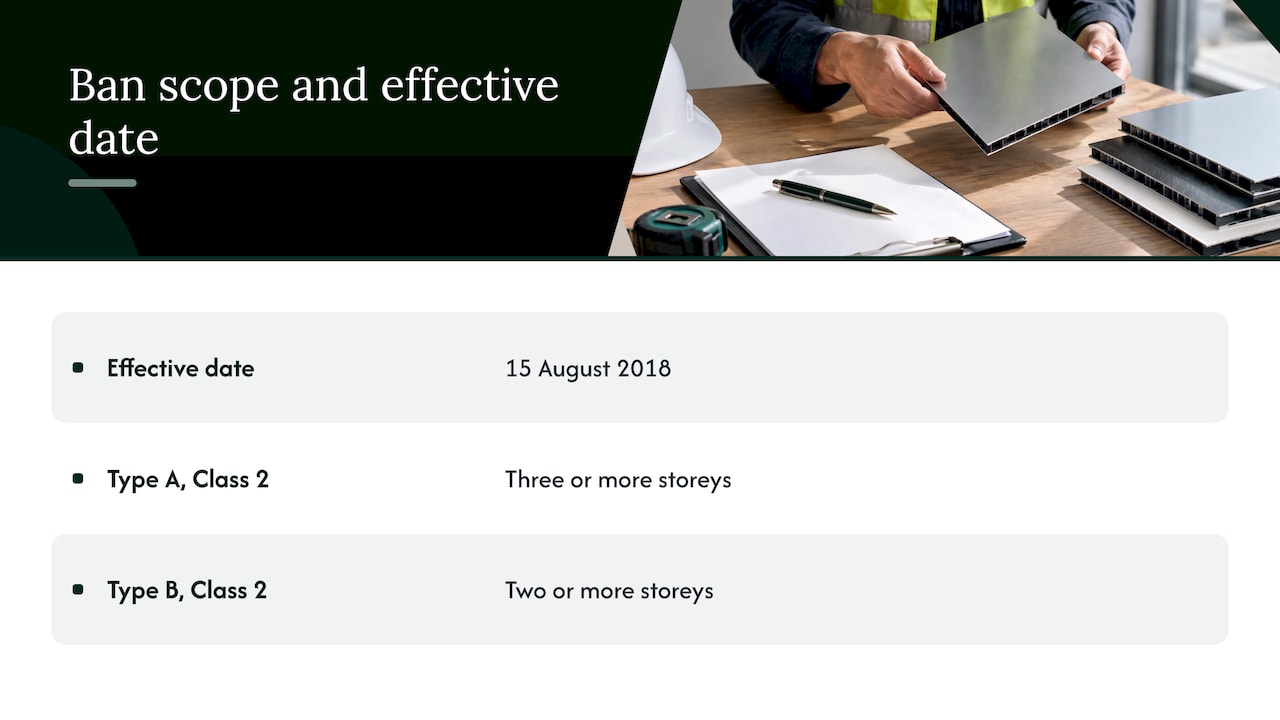
That date is a useful reference point when you read a building’s history. A block completed or re-clad well before it deserves closer questions about what was installed. It is not a guarantee either way, so the documents still decide the answer.
How to check a Sydney apartment building before you buy
The NSW Government’s guidance for owners points buyers to a few sources. They can ask strata and real estate agents about the building’s history and cladding assessments, inspect owners corporation records for investigations or compliance action, and ask the council about outstanding compliance or fire-safety orders.
Here is a practical order of work.
- Ask the selling agent directly, in writing. Ask whether the building has had a cladding or façade assessment and whether any remediation has been discussed or approved. Keep the reply on file.
- Order and read the strata report. It is where minutes, levies and capital works records sit. Our guides on what a strata report is and what a strata report costs explain what you get and what to look for.
- Request specific documents. One Sydney buyer-checks guide recommends asking for recent strata minutes, the current Annual Fire Safety Statement, cladding or façade assessment reports and details of outstanding council orders.
- Contact the council. Ask about outstanding fire-safety or compliance orders on the building.
- Read the Section 32 carefully. Our explainer on the Section 32 covers what the vendor must disclose.
- Get an expert opinion if anything is unclear. Visual identification is unreliable. Specialist assessments are needed to confirm materials such as PE-core panels or EPS. Where records of materials are missing, the Fire Protection Association notes a sample may need testing to determine the material and its fire risk.
Time matters here. In NSW the cooling-off period for residential contracts is short, and many auction purchases have none. Run these checks before you bid or exchange. Our Sydney due diligence checklist sets out the sequence, and our piece on a building inspection before bidding explains why timing is critical at auction.
Red flags and reassuring signs in the paperwork
Documents tell you more than a walk-through. Here is how we read them.
| What you find | What it can mean | What to do next |
|---|---|---|
| Minutes mention a cladding or façade report | The owners corporation has investigated | Ask for the report itself, not a summary |
| Minutes mention special levies or a loan for external works | Remediation may be approved or planned | Work out your share and the repayment timeline |
| Council fire-safety order is outstanding | Compliance work is required | Ask what is required and who pays |
| Annual Fire Safety Statement is out of date or missing | Maintenance gaps may exist | Ask the strata manager to explain |
| Report confirms non-combustible materials | Lower cladding risk | Keep the report with your purchase records |
| No documents at all on the façade | Unknown | Consider a specialist assessment before exchange |
A missing document is not proof of a problem, but it is a reason to ask more questions before you commit.
Remediation, levies and insurance: the money side
Remediation means removing or replacing unsafe cladding, and it is paid for by the owners. That is why the financial records matter as much as the fire engineering.
Levies and loans
Buyers should review strata meeting minutes and capital works fund records to see whether the owners corporation has approved special levies, secured loans or contracted remediation works. If a levy has already been raised, ask whether it falls on the current owner or on whoever owns the lot when it is due. Our guide to special levies in strata explains how they work and how to get clarity in the contract.
If you are borrowing, talk to your broker early about how a building with a known issue may be treated. Our finance clause checks cover how to protect yourself between contract and settlement.
Project Remediate
NSW runs a support program for some buildings. Project Remediate helps remove combustible cladding on high-risk Class 2 buildings known to the NSW Cladding Taskforce. It offers eligible owners corporations assurance and program-management services, and building owners a 10-year interest-free loan.
Eligibility is specific. A building must be confirmed by the Cladding Taskforce as having high-risk combustible cladding that requires remediation. If the building you like is in the program, ask for the owners corporation’s current position and what it means for your lot. Check the official page for the current terms, because programs change.
Insurance
Insurance is the cost many buyers overlook. Before exchange, you should investigate the building insurance policy, including premiums and any specific exclusions related to cladding. Strata management commentary also notes that underwriters see materials such as EPS as significant fire risks even on low-rise buildings, which can mean higher premiums or strict conditions for owners corporations.
The building policy is the owners corporation’s, but premiums are passed on through your levies. You will also hold your own contents or landlord cover, and reading how typical home insurance policy exclusions are worded helps you ask sharper questions of any insurer or broker. Ask the strata manager for the certificate of currency and the schedule so you see the actual conditions.
Resale and what it means for your plan
A building with an unresolved cladding issue can be harder to sell, and buyers and lenders will ask the same questions you are asking now. A building where the work is complete, documented and paid for tends to give you a cleaner story at resale. One where the outcome is uncertain adds risk to your timeline.
If you are buying to invest, think in terms of holding costs. Levies, insurance and any loan repayments reduce your net yield, so we model them alongside capital growth and rental yield rather than treating cladding as a separate issue.
Cladding is also only one item on the defect list. Our guide to building defects in NSW strata covers waterproofing, structural and fire-safety items that can show up in the same reports. Rules about alterations and common property also matter, so read the strata by-laws too.
Our perspective
We act only for buyers, so our view is simple: cladding is a pricing and risk question, not a reason to panic and not a detail to skip.
Most buyers we meet worry about the wrong thing. They ask whether a building is “on the list”. The better questions are what the building is made of, what the owners corporation has decided, and what you will pay over the next five to ten years. Those answers sit in minutes, reports and insurance schedules, and a buyers agent is built to find them.
When a building has an issue, we do not treat it as a dead end. A confirmed problem with a funded remediation plan can be priced into your offer, and our negotiation work is designed to turn documented risk into a better purchase price. Our clients have averaged around a 9% saving on purchase price, and we apply the same discipline to buildings with complications.
We also inspect seven days a week, independent of open home times, so you are not forced to decide inside a weekend rush. If a property is off-market, we apply the same checks before you commit.
Kristan
How Sydney Property Buyers can help
If you are shortlisting apartments and want the cladding, levy and insurance checks handled by a licensed team, our Complete Purchase Solution covers strategy, search (on-market and off-market), independent appraisal, due diligence, negotiation, auction bidding and settlement. Our average time from engagement to settlement is 54 days.
Already found an apartment? Our Negotiation Only service gives you professional representation on price once you have identified the property. You can also see recent purchases we have secured, or call us on 1800 676 177. Our NSW licence number is 20456819.
FAQ
Is there a public cladding register I can search by address?
Not in the way most buyers expect. The NSW Government has said the register holds point-in-time information for Fire and Rescue NSW and local councils, and it did not intend to make portal information public. Buyers should ask the agent and strata manager, read the strata records and contact the council instead.
Can I tell if a building has combustible cladding by looking at it?
No. Visual identification is not reliable, because panels that look the same can be made of very different materials. A specialist assessment is needed to confirm what a building has. If you are close to bidding, ask us to arrange the right checks quickly.
Should I avoid every apartment with combustible cladding?
Not necessarily. The presence of combustible cladding does not automatically make a building unsafe, because safety depends on installation, materials and overall fire safety provisions. The decision should rest on the documents, the remediation plan, the costs and the price you pay.
What is Project Remediate?
It is a NSW Government program supporting remediation of high-risk combustible cladding on eligible residential apartment buildings. It offers eligible owners corporations assurance and program-management services, and building owners a 10-year interest-free loan. Check the official page for current eligibility and terms.
Which documents should I ask for before exchange?
Ask for recent strata minutes, the current Annual Fire Safety Statement, any cladding or façade assessment reports, details of outstanding council orders and the building insurance schedule. Read them alongside your Section 32 and strata report, ideally with a conveyancer or solicitor.
Sources
- What is combustible cladding? NSW Government
- Combustible cladding, NSW Planning
- FAQs for apartment and building owners, NSW Government
- Aluminium composite panel ban, NSW Government
- Project Remediate, NSW Planning Portal
- Replace flammable cladding through Project Remediate, NSW Government
- What is cladding? Fire Protection Association
- Fire Risk Assessment of Combustible Exterior Cladding
- Combustible cladding: Is your building affected? Netstrata Learning
- Combustible cladding: Is your building affected? (insurance perspective)
- Sydney Apartment With Combustible Cladding: Buyer Checks
Recommended
- Building Defects in NSW Strata: What Buyers Must Check First
- Protect Your 5 Day Cooling Off: Sydney Due Diligence Checklist
- Strata by-laws in NSW: what buyers and owners need to know