In New South Wales the settlement period is the stretch between exchanging contracts and handing over the balance of the price. It is typically around six weeks, and it is negotiable. The right length is the one your finance, your own sale and the seller’s plans can all meet, written into the contract before you sign. Getting that term agreed is part of negotiating the purchase, which is why it belongs in your price negotiation and not as an afterthought once you have exchanged.
TL;DR
- The usual NSW settlement period is 42 days (six weeks) from exchange of contracts, but buyer and seller can agree to shorter or longer.
- Choose the date that your lender, your own sale (if any) and the seller’s move can all meet, then fix it in the contract before exchange.
- Missing the date costs you: default interest, usually about 8% a year in the standard contract, and in the worst case a notice to complete and loss of your deposit.
- A longer period can be a bargaining chip. A seller who needs time or certainty may value it as much as a few thousand dollars.
- Overseas buyers can settle remotely through electronic settlement, but your conveyancer must confirm signing requirements early.
Table of Contents
- What the settlement period actually is
- What happens during those six weeks
- The common settlement periods and who they suit
- How to choose the right period for you
- A worked example
- What happens if you miss the date
- Practical steps to keep settlement on schedule
- Buying from the United States
- Promo: one agent from search to settlement
- Our view: treat the settlement date as part of the price
- FAQ
- Sources
What the settlement period actually is
When you buy in NSW you sign and exchange contracts (the buyer’s and seller’s signed copies swap hands, binding both sides). Settlement is the day the rest of the price is paid, the title transfers and you become the legal owner. The settlement period is simply the time between those two events.
The NSW Government says settlement usually takes place around six weeks after exchange, and its selling guide confirms that a different timeframe may be negotiated between the parties. In the standard Law Society and Real Estate Institute contract, the completion date is the 42nd day after the contract date, according to Thornton + King. If the contract says nothing different, that is your date.
Two terms worth knowing if you are coming from the United States:
- Cooling-off period: a short window after exchange when you can withdraw. In NSW it is five business days, ending at 5pm on the fifth business day, and withdrawing costs 0.25% of the price (A$250 per A$100,000). Off-the-plan contracts get ten business days, and there is no cooling-off on auction purchases. The 42 days run alongside it, not after it. Our guide to the five-business-day cutoff shows what to finish inside that window.
- Conveyancer: a licensed professional (or a solicitor) who handles the legal transfer. NSW requires you to engage a lawyer or licensed conveyancer who can lodge documents electronically, because settlements now run through an electronic network and no longer use cheques and paper.
What happens during those six weeks
The period is not dead time. According to Thornton + King, your lawyers finalise the loan documents, prepare and verify the transfer and identity documents, order searches, calculate adjustments (council rates and water charges split between buyer and seller) and carry out final title checks close to settlement. Most settlements are now electronic via PEXA, the national digital settlement platform.
GKE Lawyers explains that six weeks is popular because it gives both sides room to handle searches, arrange mortgage documents and book settlement without cutting things too fine. The same firm notes that vendor mortgage discharge and council and water certificates can take two to four weeks of that time.
If you want a closer look at the preparation that keeps this timetable on track, see what to do before exchange to avoid settlement delays.
The common settlement periods and who they suit
The numbers you will see most often are 30, 42, 60 and 90 days. In NSW, 42 is the default. Here is how the choices tend to play out.
| Period | Who it usually suits | Watch out for |
|---|---|---|
| 28 to 30 days | Cash buyers, or buyers with unconditional finance approval and a seller who wants speed | Tight for searches and loan documents; any slip triggers default interest |
| 42 days (standard) | Most owner-occupiers with a standard mortgage | Little spare time if your own sale settles on the same day |
| 60 to 90 days | Buyers selling first, buyers relocating, sellers needing time to find their next home | Seller may want a higher price or a larger deposit in return |
A shorter period is possible: GKE Lawyers notes parties can agree 28 days or even less, and longer for complex transactions. Titlespace says conveyancing typically runs six to eight weeks, quicker for cash buyers or pre-approved finance with no search problems. Off-the-plan purchases are different again: settlement waits for a completion notice after construction finishes, so the date cannot be fixed the same way.
How to choose the right period for you
Start with your lender
A loan approval is not the same as loan documents ready to sign. Ask your lender or broker how long it needs from formal approval to settlement. Go Lott Solicitors points out the settlement clause must leave time for finance, building and pest inspections and your solicitor’s searches. If your finance is subject to valuation or other conditions, think about how those fit before exchange. Our checklist on finance clauses before exchange covers the points to confirm.
Line up your own sale
If you are selling one home to buy another, the two settlements need to meet. The Law Society of NSW advises buyers who are selling and buying at once to align both settlement dates to avoid expensive bridging finance (a short-term loan to cover the gap) or temporary accommodation. A longer period on the purchase can give your buyer’s settlement room to land first. Once dates are set, it also helps to book a move-out cleaning service for the home you are leaving, so the handover does not become a last-minute scramble.
Think about the seller’s position
Sellers have their own constraints: a purchase of their own, a tenant on a lease, or a wish to stay through a school term. Your offer is stronger when the date solves their problem. A seller who wants a quick, certain exit may accept a slightly lower price for a 28-day period. A seller who needs 90 days may give ground elsewhere if you can offer that time. This is where price and terms are traded against each other, and our guides on negotiating a house price in Sydney and setting an offer deadline show how.
Allow for tenants and special cases
Buying a tenanted property can affect timing and what you can inspect. See our legal checklist for tenanted purchases before you settle on a date. For auction purchases, you exchange on the day with no cooling-off, so the settlement period is normally already printed in the contract you reviewed beforehand. That makes reading the contract before auction day essential, because you cannot ask for a different term once the hammer falls.
A worked example
Say you are buying a Petersham terrace and your current Marrickville unit is under contract to sell. Your buyer settles on 20 February. If you exchange on the terrace on 2 January with the standard 42 days, you settle on 13 February, a week before your sale money arrives. You would need to bridge that gap.
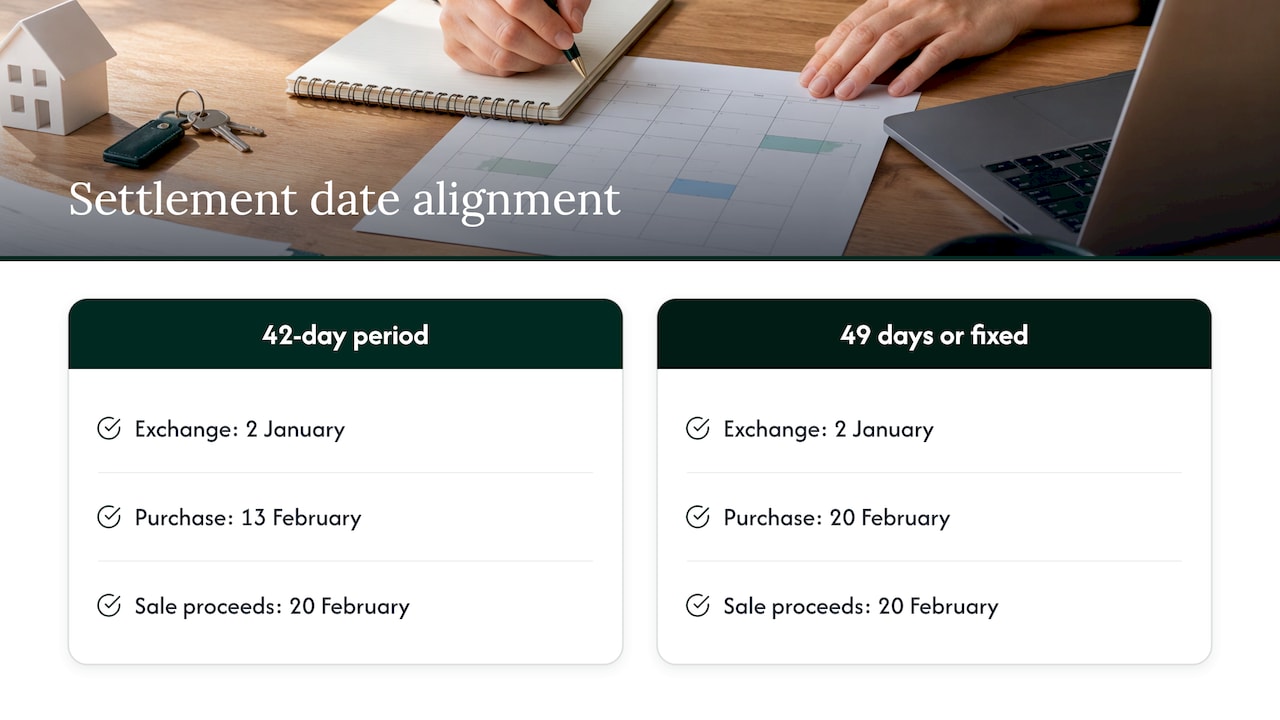
Instead, you ask for 49 days or a fixed date of 20 February, and offer the seller something in return, such as a slightly larger deposit or a firm price. Both settlements now land on the same day, with no bridging loan and no rented accommodation in between. The seller is asking for certainty and you are giving it.
The dates here are illustrations only. The real work is checking the actual dates against business days, since settlement can only happen on a day when the electronic system and banks are open.
What happens if you miss the date
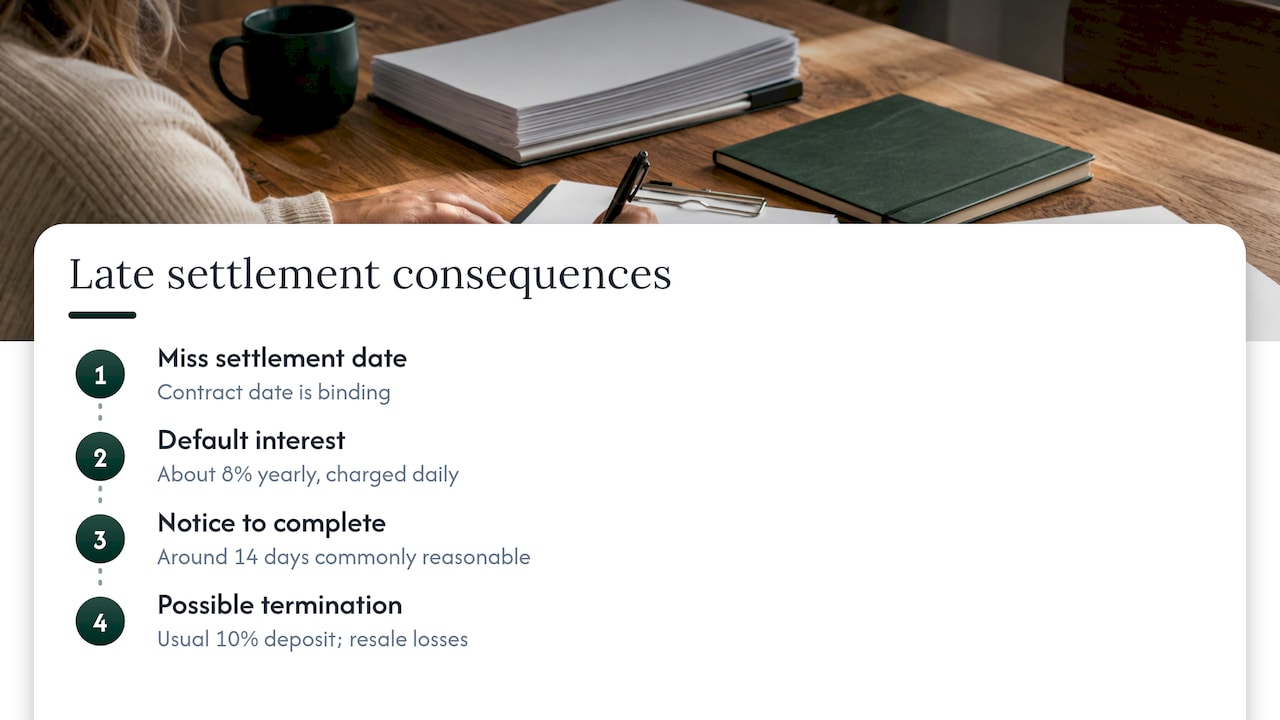
The date in the contract is binding, so treat it as a strict timetable. Once cooling-off ends, the contract is unconditional and both parties must perform. Completion dates change only by agreement.
If you are late, the standard contract commonly sets default interest of about 8% a year, charged daily on the unpaid balance from the settlement date until completion, plus the seller’s reasonable costs. That figure can be raised by a special condition, so the number in your signed contract is the one that counts.
If the delay continues, the seller can serve a notice to complete. Around 14 days is commonly treated as a reasonable period, after which the seller may terminate, keep the usual 10% deposit and claim resale losses. & Legal adds that the notice must be correctly worded and served, and should be prepared on legal advice.
If you can see a delay coming, Westpac’s guidance is to tell all parties early, ask your conveyancer for a formal extension, be ready to negotiate things like reduced default interest, and put any agreement in writing. Do this with your solicitor or conveyancer, since the legal wording matters.
Practical steps to keep settlement on schedule
- Agree the period before exchange. Once exchanged, the term is fixed. Settle it while you still have negotiating leverage.
- Have your lender confirm its timeline in writing. Include time for valuation and loan documents.
- Stay in touch with your conveyancer. NSW Fair Trading advises regular contact with your solicitor or conveyancer throughout the period to keep things on track.
- Do a final inspection on settlement morning. Confirm the property is in the same condition as at exchange.
- Plan the day itself. Settlement takes about 30 minutes from the appointed time, but it does not always start exactly then, and funds usually clear within hours though sometimes days, so book removalists with some slack.
Until settlement, the risk of damage to the property generally stays with the seller under section 66K of the Conveyancing Act 1919 (NSW), so you do not carry the building’s risk in the gap. Ask your solicitor how that applies if you take early possession.
Buying from the United States
You do not need to fly to Sydney to settle. Odin Mortgage explains that overseas buyers can complete through digital settlement, remote signing or a power of attorney. A power of attorney signed abroad typically needs notarisation and sometimes an apostille, and signing formats differ by state, so confirm them with your conveyancer at the start. Allow for time zones and for international bank transfers when you choose the date, and favour a period long enough for documents to travel and funds to arrive.
Promo: one agent from search to settlement
Our Complete Purchase Solution covers strategy, on-market and off-market search, independent appraisal, due diligence, negotiation, auction bidding and settlement. If you have already found the property, Negotiation Only puts a licensed agent across the price and terms. Our average purchase runs 54 days from engagement to settlement, and more than 30% of our purchases are secured off-market.

If you want to see how a buyers agent keeps the post-exchange period on track, read how we oversee settlement in Sydney. You can also call 1800 676 177 or email hello@sydneypropertybuyers.com.au.
Our view: treat the settlement date as part of the price
Most buyers negotiate the price hard and then accept whatever date is on the contract. We think that leaves value on the table.
A settlement period is a term the seller cares about. Some want speed, some want time, and some want certainty above all. When we negotiate for a client, we look at what the seller actually needs and shape the offer around it, because the date and the dollar figure work together.
That is also why we like to be involved from the start. As a licensed Sydney buyers agency that represents purchasers only, never sellers, we work on the strategy, the due diligence and the negotiation before exchange, so the period you sign suits your finance and your plans. Our clients have saved about 9% on average on purchase price, and a sensible settlement term is part of how we structure a deal.
If you are weighing a 42-day standard against something longer or shorter, talk to us before you sign.
Kristan
FAQ
What is the typical settlement period in NSW?
It is typically 42 days, or six weeks, from exchange of contracts. That is the default in the standard NSW contract, and the NSW Government describes settlement as usually about six weeks after exchange.
Can I choose my own settlement date?
Yes, if the seller agrees. The date is negotiated and then written into the contract, and a different timeframe can be agreed between the parties. It must fall on a business day, and you should agree it before you exchange.
Does the cooling-off period add to the settlement period?
No. The five business days of cooling-off run inside the settlement period, starting at exchange. There is no cooling-off on auction purchases.
How long does the whole purchase take from offer to keys?
GKE Lawyers says an established-home buyer in Sydney with a standard mortgage should expect roughly eight to ten weeks from offer accepted to keys, and up to 12 in some cases.
Sources
- Contracts and deposits when buying property in NSW, NSW Government
- Steps to selling a property, NSW Government
- Cooling-Off and Settlement Periods in NSW Conveyancing, Thornton + King
- Property Settlement Process in NSW, Thornton + King
- Conveyancing Timeline NSW, GKE Lawyers
- How Long Does Conveyancing Take In NSW, Titlespace
- Contract of Sale Key Clauses Explained, Go Lott Solicitors
- Selling a home: Finalising the sale, The Law Society of NSW
- Penalty Interest on Late Settlement, Switchboard Finance
- Property contract disputes in NSW, & Legal
- Delayed Settlement guide, Westpac
- From Offer Accepted to Settlement, Odin Mortgage
Recommended
- Do This Before Exchange to Avoid NSW Property Settlement Delays
- How a Buyers Agent Oversees Property Settlement in Sydney
- Five Business Days: What NSW Buyers Must Do Before the 5pm Cutoff