Yes, a foreign person can buy residential property in Sydney, but the field is narrower than most overseas buyers expect. You are generally restricted to new or near-new dwellings, off-the-plan apartments, and vacant land earmarked for development, and you must apply to the Australian Taxation Office (ATO) for approval before you exchange contracts. Skip that step and you risk a divestment order further down the track.
Before you go anywhere near a contract, work through this:
- Confirm whether you actually meet the ATO’s definition of a “foreign person” — the answer is not always obvious for temporary visa holders or dual nationals.
- Lodge your Foreign Investment Review Board (FIRB) application through the ATO’s online portal before you make a binding offer, not after.
- Keep your deposit and purchase funds in accounts you can document clearly. Anti-money-laundering checks on international transfers are routine, not exceptional.
- Engage a Sydney-based conveyancer and, ideally, a buyers agent who has actually managed a FIRB-conditioned settlement before, rather than one who has only read about it.
The rest of this guide walks through eligibility, property types, fees, financing, the purchase timeline, and what happens if any of it goes wrong.
Key Takeaways
Foreign buyers can purchase Sydney property, but only within specific categories, and only after securing ATO approval before exchanging contracts.
| Point | Details |
|---|---|
| Confirm foreign person status first | Check the ATO’s definition before assuming you need, or don’t need, FIRB approval. |
| Apply to the ATO before exchange | Approval must come before you sign, not after, to avoid divestment risk. |
| Budget for NSW surcharges | Stamp duty, surcharge purchaser duty, and surcharge land tax all add to the headline price. |
| Watch off-the-plan sunset clauses | Construction delays can push settlement past your FIRB approval’s 12-month validity window. |
| Engage local specialist representation | Sydney Property Buyers manages search, negotiation, and settlement for remote foreign buyers, with over 30% of purchases secured off-market. |
Table of Contents
- Foreign buyer purchase Sydney property: who actually needs FIRB approval?
- Which Sydney property types can foreign buyers actually purchase?
- How does the FIRB and ATO approval process actually work?
- What does buying property in Sydney as a foreigner actually cost?
- Can non-residents get a mortgage to buy property in Sydney?
- What’s the step-by-step timeline for buying property in Sydney remotely?
- What happens if you buy without FIRB approval?
- How a licensed Sydney buyers agent protects foreign purchasers
- How to choose a conveyancer, broker, and buyers agent from overseas
- What foreign buyers get wrong most often
- Ready to purchase property in Sydney? Here’s how we help
- Sources
Foreign buyer purchase Sydney property: who actually needs FIRB approval?
Not every overseas-born buyer is a “foreign person” under Australian law, and not every foreign person needs approval for every property. The ATO’s definition catches individuals who are not Australian citizens, not permanent residents, and not one of the small number of exempt New Zealand citizens, along with foreign corporations and the trustees of foreign trusts. A New Zealand citizen who has lived in Australia for years and holds a Special Category Visa can, in some circumstances, sit outside this definition entirely.
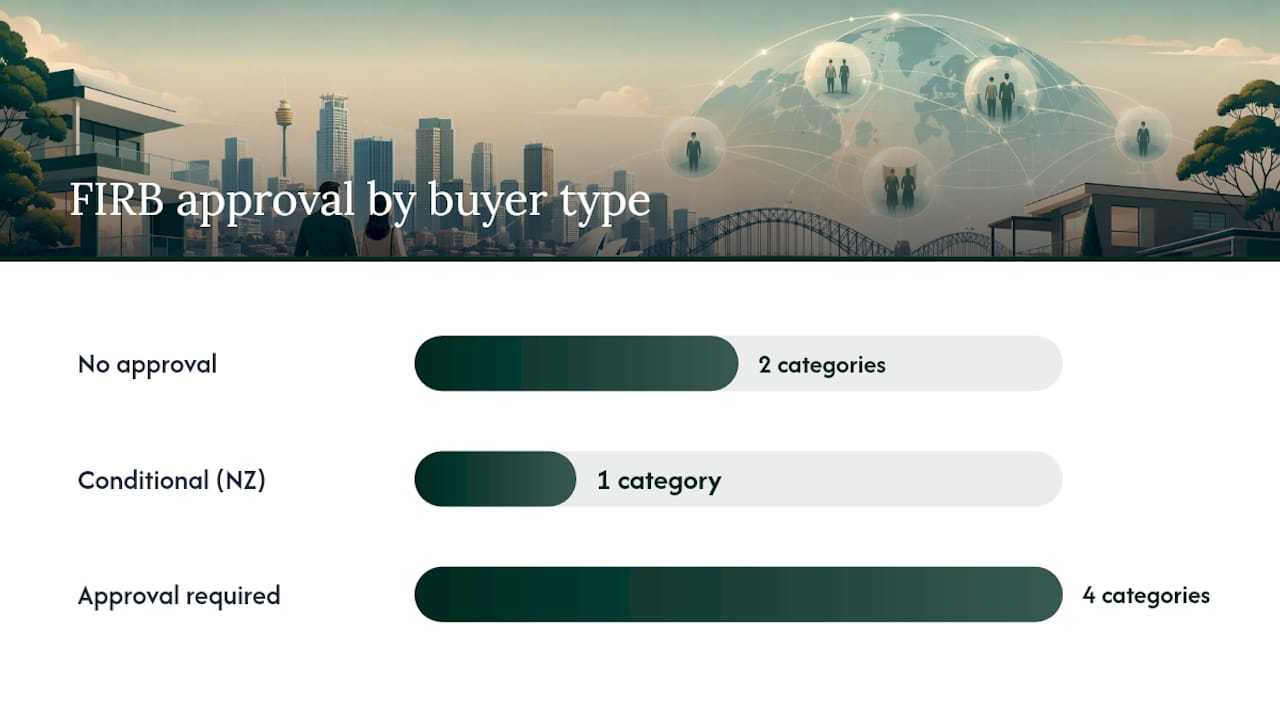
Temporary residents (someone here on a skilled work visa or student visa, for example) are treated as foreign persons and do need approval, even though they are physically living in Sydney. This surprises a lot of people who assume “resident” means what it sounds like. It doesn’t, in this context. Corporate and trust structures add another layer: a company incorporated in Australia can still count as foreign if foreign persons hold a substantial interest in it, and family trusts with even one foreign beneficiary are often caught too.
| Buyer category | FIRB approval generally required? |
|---|---|
| Australian citizen (living anywhere) | No |
| Australian permanent resident | No |
| New Zealand citizen (most cases) | No, subject to specific exemptions |
| Temporary visa holder (student, skilled worker) | Yes |
| Foreign citizen with no Australian visa | Yes |
| Foreign company or foreign-controlled Australian company | Yes |
| Trust with a foreign beneficiary | Usually yes |
A few things worth flagging before you assume you’re in the clear:
- Dual citizens who hold Australian citizenship alongside another passport are not foreign persons, regardless of where they currently live.
- Permanent residents buying with a foreign spouse may need to apply jointly, depending on how the title is structured.
- Trust and corporate purchasers should get specific legal advice early. The rules on “substantial interest” thresholds are technical, and getting the structure wrong can mean an invalid purchase months into the process.
Which Sydney property types can foreign buyers actually purchase?
The ATO permits foreign buyers to purchase new or near-new dwellings, off-the-plan apartments, and vacant residential land intended for development within a set timeframe. Established dwellings, meaning anything previously lived in, are effectively off the table for most foreign buyers right now.

That restriction isn’t new, but it has recently been extended. The temporary ban on foreign purchases of established dwellings now runs from 1 April 2025 to 30 June 2029, a longer window than many overseas buyers realise when they start researching. There are narrow exceptions, mostly for redevelopment projects that will demolish an existing dwelling and replace it with additional housing stock, and for some employer-sponsored housing arrangements. These exceptions require their own approval and are assessed case by case, not assumed.
In practice, here’s how this plays out across Sydney:
- A brand-new two-bedroom apartment in a completed development in Zetland or Waterloo generally qualifies, since it is new stock rather than a previously occupied dwelling.
- An off-the-plan apartment in a development still under construction in Erskineville or Marrickville also qualifies, subject to the FIRB conditions attached to that specific approval.
- A block of vacant land in the outer growth corridors, purchased with the intention to build, is permitted, but usually comes with a development condition attached to the approval.
- A charming, previously-occupied Federation-era terrace in Paddington or Balmain is off-limits to most foreign buyers under the current ban, no matter how appealing the street is.
This is one of the biggest gaps between what overseas buyers picture (a heritage terrace with a wrought-iron balcony) and what the rules currently allow. It shapes property strategy from day one, and it’s worth discussing with a local buyers agent before you fall in love with a listing you can’t legally pursue.
How does the FIRB and ATO approval process actually work?
Apply before you exchange contracts, or make sure you’re relying on a valid exemption certificate that already covers the property you want. This is the single most important timing rule in the entire process, and it is where most avoidable mistakes happen.
Applications are lodged through the ATO’s online services for foreign investors portal. The process generally follows this sequence:
- Register for an account on the ATO’s online portal and gather your identification documents, visa details, and property information.
- Submit the application for the specific property, including the purchase price, well before you intend to sign a contract.
- Pay the application fee, which is tiered according to the property’s value. Higher-value purchases attract higher fees, so check the current fee schedule before budgeting.
- Wait for processing. Straightforward applications are often resolved within weeks, though complex cases involving trusts or corporate structures can take longer.
- Receive a “no objection notification,” which is the formal approval letter confirming you can proceed with that specific purchase.
A few practical points that trip people up:
- Approvals are property-specific and price-specific. If you negotiate the price down after receiving approval, or switch to a different property, the original approval may no longer apply.
- Exemption certificates, which allow you to bid on a range of properties without a fresh application each time, are valid for 12 months.
- Off-the-plan purchases carry a particular risk here. If construction runs late and settlement is pushed beyond your approval’s validity window, you may need to reapply, and there’s no guarantee the second application is approved on the same terms.
Pro Tip: Build a FIRB condition into your contract that ties the approval to the exact purchase price and settlement date. If either changes materially, you want the right to rescind or renegotiate, not a contract that assumes an approval that no longer holds.
What does buying property in Sydney as a foreigner actually cost?
Budget for considerably more than the sticker price. Foreign buyers face a stack of costs that Australian residents don’t, and NSW applies some of the highest surcharges of any state.
The one-off costs at purchase typically include:
- FIRB application fee, tiered by property value and payable when you lodge your application with the ATO.
- Conveyancing and legal fees, generally a few thousand dollars for a standard residential purchase, higher for complex trust or off-the-plan contracts.
- NSW transfer (stamp) duty, calculated on a sliding scale based on the purchase price.
- Surcharge purchaser duty, an additional NSW charge applied specifically to foreign buyers on top of standard stamp duty.
Ongoing costs continue well after settlement:
- Surcharge land tax, an annual NSW levy charged to foreign owners in addition to standard land tax.
- Standard land tax, which applies once your landholding exceeds the relevant threshold.
- Council rates and, for apartments, strata levies, which function the same way for foreign and local owners alike.
- Capital gains tax (CGT) reporting and withholding obligations when you eventually sell, since foreign resident sellers face a withholding regime that Australian resident sellers do not.
To put this in perspective: on an illustrative $1.2 million off-the-plan apartment purchase, a foreign buyer might reasonably expect standard NSW stamp duty, plus the foreign buyer surcharge duty on top, plus the FIRB application fee, before conveyancing costs are even added. Treat this as a rough illustrative scenario rather than a quote. Actual figures depend on the property value, your specific circumstances, and rates current at the time of purchase, so check the NSW state revenue office and the ATO directly before committing to a number.
Pro Tip: Ask your conveyancer for a full settlement cost breakdown before you exchange, not after. Surcharge duty catches out more foreign buyers than any other line item because it’s easy to overlook when you’re comparing headline prices against your home market.
Can non-residents get a mortgage to buy property in Sydney?
Financing is harder for non-residents, but it isn’t impossible. Australian lenders generally apply lower loan-to-value ratios (LVRs) to foreign buyers than to citizens and permanent residents, and some lenders exclude non-resident applicants from their lending books entirely.
Where non-resident lending is available, expect:
- Maximum LVRs commonly sitting well below the 80% many local buyers take for granted, meaning a larger deposit is required upfront.
- More extensive documentation requirements, including proof of overseas income, tax returns from your home country, and sometimes a larger cash buffer held in an Australian account.
- Higher scrutiny of the source of funds, tied directly into the anti-money-laundering checks mentioned earlier.
If Australian lending proves difficult, some buyers arrange finance through an international lender in their home country and complete the Sydney purchase in cash, or use a private lender who specialises in foreign-buyer transactions. A useful external comparison of how lenders approach temporary and non-permanent residents illustrates how variable this appetite can be across different markets, and it’s worth having that conversation with a mortgage broker early rather than after you’ve fallen in love with a property.
Currency transfer timing matters more than most buyers expect. FX rates move, and a shift of even a few cents against you between exchange and settlement can add thousands of dollars to what you actually need to transfer.
Pro Tip: Lock in your currency transfer, or at least agree a forward contract with your FX provider, as soon as your settlement date is confirmed. Waiting until the week of settlement to convert funds exposes you to volatility you have no control over, and international transfers already take longer than most buyers assume once compliance checks are added.
What’s the step-by-step timeline for buying property in Sydney remotely?
The rough sequence runs: property search, offer or auction bid, FIRB condition satisfied, contract exchange, cooling-off period (if applicable), then settlement. For a non-resident managing this from overseas, the practical windows matter as much as the legal steps.
- Property search and shortlisting. This can take anywhere from a few weeks to several months, and is where a local buyers agent earns their keep for a remote buyer who can’t attend inspections in person.
- Offer or auction. Private treaty purchases typically include a cooling-off period in NSW; auction purchases generally don’t, so your FIRB position needs to be settled before you bid, not during the auction.
- FIRB condition and exchange. Contracts are usually exchanged subject to a FIRB approval condition, giving you a defined window to secure the no objection notification.
- Settlement. For established off-the-plan stock, settlement dates are fixed. For new off-the-plan developments, settlement is tied to construction completion, and sunset clauses can extend that timeline in ways that stress-test your FIRB approval’s validity.
For remote buyers, add these to your checklist well before settlement day:
- Arrange a power of attorney authorising someone in Australia, often your conveyancer or buyers agent, to sign documents on your behalf.
- Factor in international notarisation requirements for the power of attorney document itself, which can take longer than expected depending on your country of residence.
- Allow at least ten working days for couriered settlement paperwork to move between jurisdictions, rather than assuming digital signatures alone will cover everything.
- Confirm who is verifying the “practical completion” notice on an off-the-plan property, since this triggers your final settlement obligations.
A buyers agent who manages settlement day to day on your behalf removes a lot of this friction, particularly when time zones mean you’re asleep during half the working day in Sydney.
What happens if you buy without FIRB approval?
Buying residential property without the required approval isn’t a paperwork technicality you can quietly fix later. It’s a breach that can trigger a forced sale, known as a divestment order, along with financial penalties.
Enforcement has genuinely tightened. Regulators have become noticeably more active in identifying non-compliant purchases, and the assumption that a foreign buyer can sign first and sort out FIRB approval afterwards is now a far riskier bet than it might have been a few years ago.
The safest position is always to treat FIRB approval as a precondition of any offer, not an administrative step you slot in after the excitement of winning a property. A contract signed without a valid approval or exemption certificate in place is a contract you may be forced to unwind, at cost, on a timeline you don’t control.
To reduce your exposure:
- Keep your approval or exemption certificate current and property-specific, and never assume an old approval covers a new property.
- Insist your solicitor builds a FIRB condition directly into the contract, tied to the exact purchase price and settlement date.
- Check the fine print of any exemption certificate before relying on it. Certificates are time-limited and can be property-type specific.
- Document the source of your purchase funds thoroughly from the outset. This isn’t optional paperwork; it’s the first thing scrutinised if a compliance question ever arises.
If you discover, after the fact, that a purchase went ahead without proper approval, get specialist legal advice immediately rather than waiting to see if it surfaces on its own. Voluntary disclosure is treated very differently from a purchase uncovered through an audit.
How a licensed Sydney buyers agent protects foreign purchasers
Specialist local representation reduces the three risks that catch overseas buyers most often: regulatory timing, settlement logistics, and simply not knowing which Sydney properties are even eligible before falling for one that isn’t. Sydney Property Buyers works exclusively for purchasers, never sellers, which means every recommendation is made with your outcome in mind rather than a vendor’s.
The agency’s full-service offering covers the entire purchase journey: strategy and property search across both on-market and off-market listings, independent appraisal, due diligence, negotiation, auction bidding, and settlement management. For buyers who have already found a property and simply need skilled negotiation, a negotiation-only service is also available.
A remote buyer’s biggest disadvantage isn’t distance. It’s not being able to walk through a property on a Tuesday afternoon or read the room at an auction. That’s the gap a local buyers agent closes.
Kristan Johnson, who directs Sydney Property Buyers, was named 2024 Outstanding Buyers Agent of the Year by the Inner West Local Business Awards, with a background in negotiation, auction bidding, and off-market acquisition.
If you’re weighing up whether representation is worth it from overseas, that off-market access alone is often the deciding factor: you simply cannot inspect a property that isn’t publicly advertised unless someone local already has the relationship to find it.
How to choose a conveyancer, broker, and buyers agent from overseas
Picking the right local team matters more when you can’t easily meet them in person. A generalist conveyancer who has never handled a FIRB-conditioned contract is a genuine liability, not just a minor inconvenience.
Before engaging anyone, ask:
- How many FIRB-conditioned purchases have you personally handled in the last twelve months?
- Have you managed a remote settlement involving an overseas power of attorney before, and what went wrong the last time?
- What are your total fees, and are any of them contingent on the deal proceeding to settlement?
- How will you communicate with me across time zones, and how quickly do you respond to urgent queries?
- Do you owe me a fiduciary duty, or do you also act for vendors in other transactions?
Watch for these red flags during that conversation:
- Vague or uncertain answers about FIRB timing and exemption certificates. This is core knowledge, not a niche specialty, for anyone working with foreign buyers regularly.
- Standard contract templates with no willingness to insert a FIRB-specific rescission clause.
- Limited or no experience coordinating international notarisation for a power of attorney.
- Reluctance to explain their fiduciary obligations to you as the buyer, particularly if they’re also connected to the selling agent.
A licensed buyers agent who genuinely specialises in interstate and international buyers should be able to answer all five questions without hesitation, and should be able to point to settlements they’ve managed for clients who never set foot in Australia during the process.
What foreign buyers get wrong most often
The mistake I see most often isn’t ignorance of the rules. It’s timing. Buyers get emotionally invested in a property, verbally agree terms, and only start the FIRB conversation once they’re mentally committed to the purchase. By then, they’re negotiating against their own excitement, not just the vendor.
The second common error is underestimating surcharge duty. Buyers budget carefully for the headline purchase price and the standard stamp duty they’ve read about online, then get blindsided by the NSW foreign buyer surcharge on top. The fix here is simple: get a full cost breakdown, including every surcharge, before you make an offer, not after you’ve exchanged.
The third is treating off-the-plan sunset clauses as boilerplate. They’re not. If a development runs late and settlement slips past your FIRB approval’s 12-month window, you can find yourself needing to reapply for approval on a purchase you thought was already locked in. Read that clause before you sign, and ask your solicitor exactly what happens if the builder misses the date.
Ready to purchase property in Sydney? Here’s how we help
Sydney Property Buyers exists for one purpose: representing purchasers, never sellers, through every stage of buying property in Sydney, including the added complexity foreign buyers face with FIRB conditions, remote settlement, and NSW surcharge duty.

Engagement starts with a modest retainer, which is deducted from the final fee once your purchase settles, so the bulk of what you pay is tied to a completed outcome rather than hours billed along the way. From there, the agency runs the full search-to-settlement process: identifying on-market and off-market opportunities across the Inner West, Eastern Suburbs, Lower North Shore, and Eastern Beaches, conducting independent due diligence, negotiating or bidding at auction on your behalf, and coordinating settlement logistics including power of attorney arrangements for buyers who can’t be in Sydney in person.
If you’re weighing up whether professional buyers agent representation makes sense for your situation, get in touch on 1800 676 177 or hello@sydneypropertybuyers.com.au to talk through your FIRB position, budget, and target suburbs before you make an offer.
Sources
- Apply to buy residential property as a foreign person | Australian Taxation Office
This article is general information, not a substitute for advice from a qualified financial advisor. Consult a qualified financial professional about your own circumstances before acting on anything here.
Recommended
- How to research Sydney suburbs property in 2026
- Why missed properties frustrate buyers: the 2026 Sydney guide
- Why a buyer’s agent suits interstate buyers in Sydney
- Johnson Property Co alternatives for Sydney buyers: 2026 guide