Unit entitlement is the percentage share of a strata scheme’s common property allocated to each lot, and it decides your levies, your voting power and your payout if the building is ever sold or terminated. There are three lawful ways to change it: the developer sets or revises it at plan registration (or shortly after completion), the owners corporation can pursue a change using a registered valuer’s certificate and a special procedure, or an owner can apply to the NSW Civil and Administrative Tribunal under section 236 of the Strata Schemes Management Act 2015.
- Developer allocation at registration, or a revised schedule lodged shortly after completion
- Owners corporation special procedure supported by a valuer’s certificate
- NCAT order under s.236 SSMA, where an owner argues the allocation was unreasonable
Check your registered strata plan first. That single document tells you where you stand before you spend a dollar on valuations or legal fees.
Key Takeaways
Unit entitlement fixes your levies, voting power and termination payout, and changing it lawfully requires either developer action, an owners corporation valuer-backed process, or an NCAT order under s.236 SSMA.
| Point | Details |
|---|---|
| Entitlement drives three things | Levy shares, voting weight and termination payout all follow the schedule on your strata plan. |
| Three routes to change it | Developer revision post-completion, owners corporation valuer-led process, or NCAT application under s.236 SSMA. |
| Valuation evidence is scheme-wide | NCAT and the registry generally expect market valuations for every lot, not just disputed ones. |
| NCAT relief isn’t guaranteed | The Tribunal can refuse reallocation even where figures support it, if governance or voting control would be destabilised. |
| Buyers should check entitlement pre-purchase | Sydney Property Buyers reviews strata records and coordinates valuation checks before clients negotiate or bid. |
Table of Contents
- What unit entitlement means in NSW and what it affects
- How unit entitlements are set when a strata plan is registered
- The lawful routes to change unit entitlements
- Step by step: changing unit entitlements in practice
- What the valuer’s certificate needs to show
- How NCAT decides unit entitlement disputes
- What a change in unit entitlement actually means for owners
- Checking unit entitlement before you buy
- Where a buyer’s agent adds value on entitlement issues
- Frequently asked questions
- Sources
What unit entitlement means in NSW and what it affects
Unit entitlement is the proportionate share of common property recorded against each lot on the registered strata plan, expressed as a number set against an aggregate total for the whole scheme. Say a 20 lot building has an aggregate of 2,000 and your unit carries 120. You hold 6% of the scheme, and unless the by laws say otherwise, that percentage sets your levy contribution and your voting weight at general meetings.
That single figure ripples through almost every financial and governance decision an owner will face:
- Levy shares — administrative and capital works fund contributions are split by entitlement, not by headcount
- Voting weight — polls (as opposed to a show of hands) are decided by entitlement, so higher entitlement means more say
- Termination payout — if the scheme is wound up or sold under collective sale provisions, proceeds are distributed by entitlement
- Rates and land tax apportionment — some councils and the apportionment of certain charges follow the same schedule
How unit entitlements are set when a strata plan is registered
The developer prepares the initial schedule of unit entitlements when lodging the strata plan for registration, and for plans registered since 30 November 2016, that allocation generally has to reflect market value, backed by a qualified valuer rather than floor area alone.
- The schedule sits on the registered strata plan itself, showing the aggregate unit entitlement for the whole scheme and each lot’s individual number
- Bigger, higher floor, better aspect lots typically carry higher entitlement, though the valuation basis (not size alone) is what technically governs it
- For staged or strata development contract schemes, the owners corporation can lodge a revised schedule based on market values within two years of completion, a narrower window than most owners realise
The lawful routes to change unit entitlements
Three main paths exist, and picking the right one depends on timing and who’s driving the change.
- Developer or owners corporation revision after completion — used within the statutory window following a strata development contract, where the original apportionment needs correcting to reflect finished lots rather than plans.
- Owners corporation special procedure with a valuer’s certificate — the scheme itself initiates a change, supported by a registered valuer’s market value assessment across all lots.
- NCAT application under s.236 SSMA — an individual owner (or the owners corporation) asks the Tribunal to reallocate entitlements it considers unreasonable.
A fourth mechanism worth flagging separately: strata renewal or collective sale schemes use unit entitlement to divide sale proceeds, but that process corrects outcomes rather than the entitlement figures themselves.
Step by step: changing unit entitlements in practice
Whichever route applies, the mechanics are broadly similar and start with evidence, not paperwork.
- Instruct a registered valuer to assess market value for every lot in the scheme, not just the one you think is under or over allocated.
- Use those figures to prepare a revised schedule of unit entitlements, cross checked against the existing aggregate.
- If the owners corporation is driving the change, put a motion to a general meeting and secure the resolution threshold the scheme’s process requires.
- Lodge the application, whether that’s with NSW Land Registry Services for an administrative revision, or with NCAT for a contested reallocation.
- Once approved or ordered, register the outcome so the strata plan reflects the new schedule.
Expect to encounter several standard forms along the way, most commonly Approved Form 11 (dealing with strata plan amendments), Form 15SO and Form 15CD, which relate to lodging schedules and consolidations with the registry. The owners corporation or its solicitor usually lodges these; an individual owner pursuing an NCAT order typically has the Tribunal’s order registered on their behalf once made.
Pro Tip: Keep meeting minutes airtight. NCAT and NSW Land Registry Services both scrutinise whether a resolution met the correct threshold and whether owners were given proper notice, and a defective process can unwind months of valuation work.

Before lodging anything, gather: the current registered strata plan, valuation reports for all lots, meeting minutes recording any resolution, and (for NCAT) a statement setting out why the existing allocation is unreasonable.
What the valuer’s certificate needs to show
NCAT and the registry both expect rigorous valuation evidence, and a thin report is one of the most common reasons applications stall.
- Market value for every lot in the scheme, dated to a consistent valuation point, not just the lots in dispute
- A methodology section showing comparable sales or rental evidence used to reach each figure
- A formal Certificate of Value or valuer’s certificate, signed by a registered valuer, that the Tribunal or registry can rely on as evidence
Pro Tip: Choose a valuer who has specifically prepared unit entitlement reports before, not just standard residential valuations. Tribunal decisions frequently turn on whether the valuation methodology withstands scrutiny under cross examination.
Many applicants under-scope this step, assuming they only need valuations for the lots they believe are wrongly weighted. In practice, both NCAT and the registry generally expect scheme-wide valuations, because entitlement is inherently relative between lots.
How NCAT decides unit entitlement disputes
Section 236 SSMA lets an owner apply where they believe the original allocation was unreasonable, or where a change in permitted land use has made the existing schedule unfair. The Tribunal has discretion, not an obligation, to reallocate, and case law describes a staged approach: ascertain each lot’s current value, decide whether the original allocation was unreasonable, then consider whether reallocation is warranted.
Crucially, NCAT can refuse to make an order even where an allocation looks unreasonable on the numbers, if reallocation would destabilise scheme governance or hand disproportionate voting control to one owner. Applicants carry the onus of proof throughout.
- Budget for valuation costs across all lots, legal fees if represented, and NCAT filing fees
- Expect a timeline running from initial valuation instruction through filing, directions, hearing and decision, often stretching several months
Do I need a lawyer to apply to NCAT for a unit entitlement change?
You’re not required to have one, but given the evidential burden and the way Tribunal decisions turn on valuation methodology, most owners engage a strata lawyer alongside their valuer.
Can NCAT force an owners corporation to accept a reallocation?
Yes, where it makes an order under s.236, that order is binding once registered, though the Tribunal retains discretion to refuse relief even with strong valuation evidence.
What a change in unit entitlement actually means for owners
A shift in entitlement isn’t abstract. Recalculate a scheme with an aggregate of 1,000: a lot moving from 80 to 100 entitlement jumps its levy share from 8% to 10%, its voting weight rises accordingly, and its slice of any termination payout grows in step.
- Levy shares and special levy contributions move immediately once a new schedule is registered
- Voting power on polls shifts, which can change the balance on contentious motions
- Termination or collective sale proceeds are redistributed under the new figures
- Insurance premium apportionment and, in some councils, rates apportionment follow the same schedule
Where an allocation was never properly valued in the first place, owners may be entitled to compensation or back payments under s.236(6), though claims for overpayment are subject to a six-year limit — a detail that catches out owners who wait too long to challenge a historic figure.
Checking unit entitlement before you buy
Buyers should treat unit entitlement as a pricing and risk variable, not a footnote. It’s printed on the registered strata plan and cross referenced on title, so it’s one of the easier things to verify before exchange.
- Pull the strata plan and confirm the lot’s entitlement against the scheme aggregate
- Request recent owners corporation minutes and check for any pending NCAT applications or disputed reallocations
- Ask whether any lot recently went through a valuer-led reallocation, and request that report if so
Red flags include an entitlement well below what comparable lot size and aspect would suggest, an active NCAT dispute, or a pattern of special levies concentrated on a handful of lots. If any of these show up, order a full strata report, ask the vendor for formal disclosure, and treat the entitlement question as a genuine pricing factor in negotiation, not a technicality to wave through.
Where a buyer’s agent adds value on entitlement issues
We’ve seen negotiations shift meaningfully once a buyer understood that a lot’s low entitlement, relative to its size, meant future levy increases were coming regardless of the asking price. That kind of detail rarely surfaces from a standard contract review, but it changes what a property is actually worth to hold.
A buyer’s agent can help with:
- Independent checks on whether entitlement figures line up with comparable market valuations
- Negotiating a price adjustment where entitlement creates a levy or voting disadvantage
- Reviewing strata records for pending disputes or reallocation history
- Coordinating valuers and strata lawyers when a formal NCAT application is genuinely warranted
None of this is legal advice, and any actual application to NCAT needs a solicitor with strata expertise. A buyer’s agent’s role is due diligence and negotiation, not representation before the Tribunal.
A recommendation on prioritising evidence over process
Get the valuation evidence sorted before you touch a form or a resolution. Most owners who pursue a change without solid comparables first end up paying for a process that stalls on the numbers, not the law.
How Sydney Property Buyers supports owners and buyers on entitlement questions
If you’re buying into a scheme where entitlement looks out of step with comparable lots, or you’re an owner weighing whether a formal change is worth pursuing, that’s exactly the kind of detail we dig into before you commit. Our Full Service covers due diligence, independent appraisal and negotiation from search through to settlement, while Negotiation Only suits buyers who’ve already found a property and need someone to push back on price using exactly this sort of leverage.

Visit our services page to see which option fits your situation, or call 1800 676 177 to talk through a specific property before you make an offer.
Frequently asked questions
What is unit entitlement in NSW strata schemes?
It’s the proportionate share of common property allocated to each lot, recorded on the registered strata plan, and it sets levies, voting power and termination payout.
Can I change my unit entitlement without going to NCAT?
Yes, where the owners corporation pursues a change supported by a registered valuer’s certificate, or where a post-completion revision applies under the applicable development contract provisions.
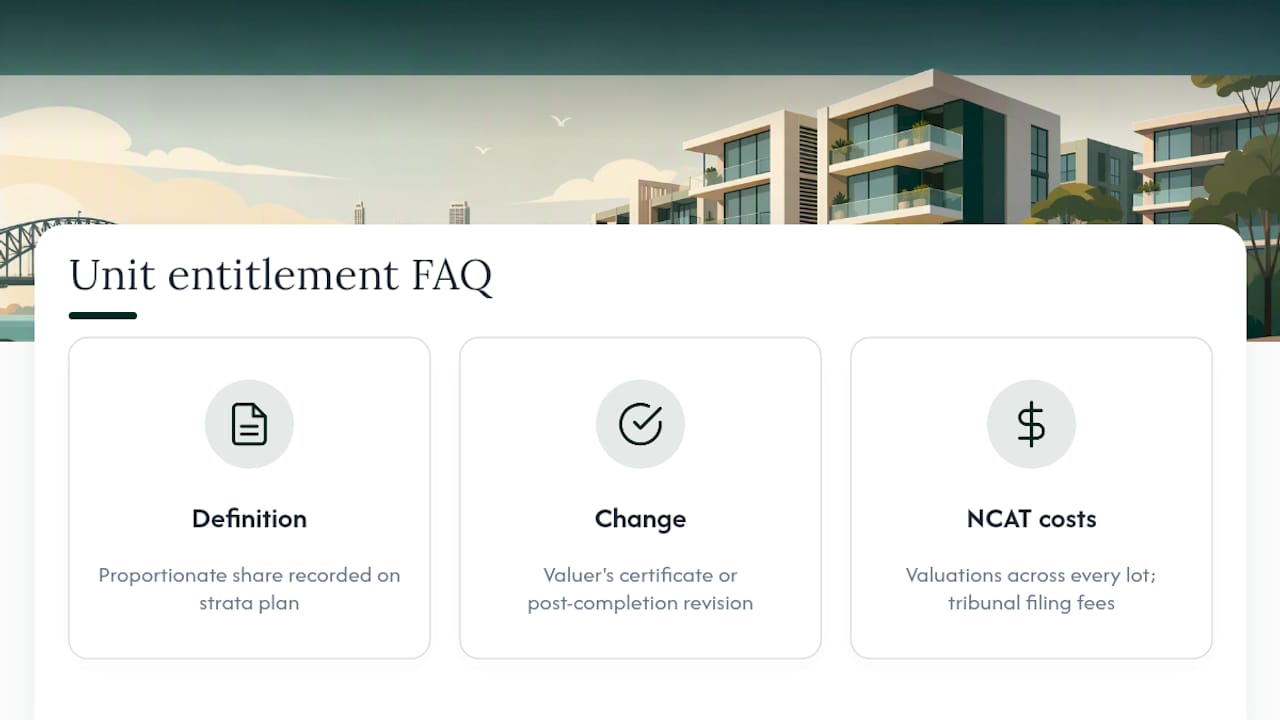
How much does an NCAT unit entitlement application cost?
Costs vary by scheme size, but budget for valuations across every lot, tribunal filing fees, and legal fees if represented, plus several months for the process to run its course.
Sources
- When Can Unit Entitlements Be Changed? – Bannermans Lawyers
- The Owners — Strata Plan 675 v York and Edwards (NSWCATAP judgment)
- NSW: How to change unit entitlements in a NSW strata scheme – LookupStrata
- What is Unit Entitlement? – Owners Corporation Network (OCN) guide
- Your strata levies, finances and insurance | NSW Government
Recommended
- Strata schemes in Australia: what every buyer must know
- Why a licensed buyer’s agent matters in Sydney
- Unconditional exchange: what Sydney buyers must know
- What does the first home buyer grant mean in NSW?