A vendor’s agent is legally bound to act solely in the seller’s best interests, which means every interaction with a buyer carries an inherent conflict of interest. This is not a matter of individual ethics or poor conduct. It is a structural reality built into Australian real estate law. Understanding why a vendor’s agent works against buyer interests is the single most important thing a Sydney homebuyer can do before entering any negotiation. The agent sitting across from you at an open home is not your adviser. They are the seller’s advocate, paid by the seller, and obligated to maximise the seller’s outcome.
Why does a vendor’s agent work against buyer interests by law?
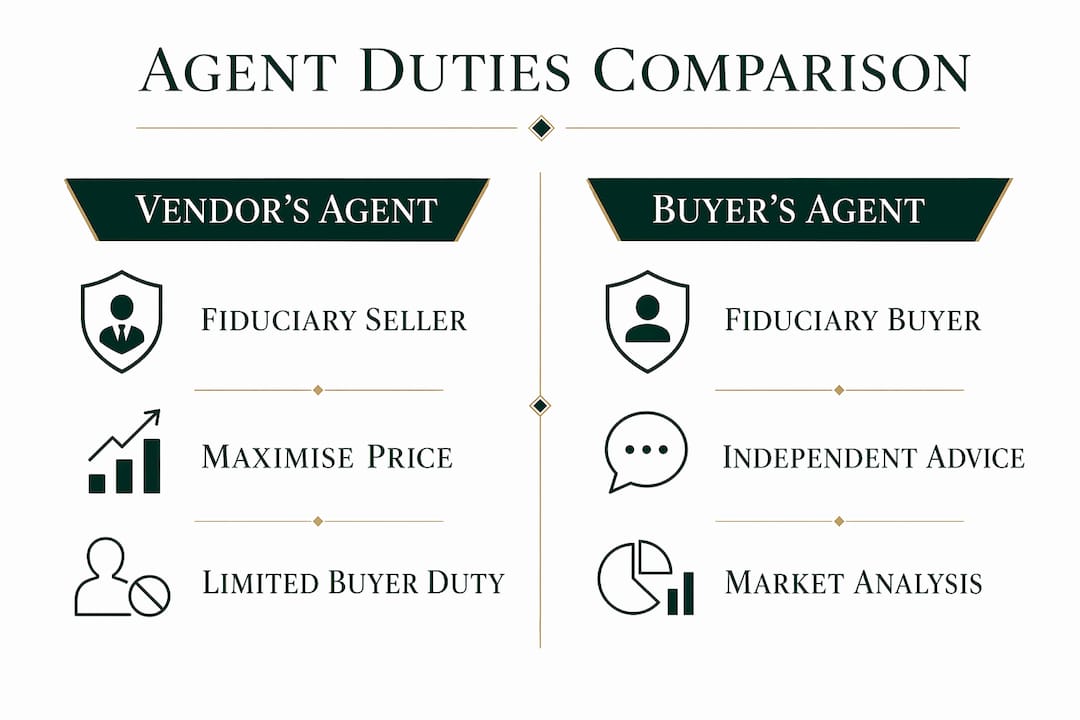
A vendor’s agent holds a fiduciary duty exclusively to the seller. That duty requires them to act in the seller’s best interests at all times, including during every conversation they have with a buyer. The term “fiduciary duty” sounds technical, but the practical meaning is straightforward: the agent must prioritise the seller’s financial outcome above all else, including your interests as a buyer.
This legal obligation shapes every aspect of how a vendor’s agent behaves. Listing agents are legally barred from advising buyers on pricing, repairs, or negotiation strategy. That restriction is not optional. It applies regardless of how friendly or helpful the agent appears.
The key restrictions on vendor agents include:
- They cannot advise you on what price to offer or whether the asking price is fair.
- They cannot recommend which contract terms to push back on.
- They cannot tell you about known defects unless legally required to disclose them.
- They cannot act as your negotiator, even informally.
- They must pass any information you share, including your budget or urgency, directly to the seller.
Pro Tip: Never tell a vendor’s agent your maximum budget or your personal deadline to purchase. That information goes straight to the seller and weakens your negotiating position immediately.
Dual agency, where the same agent or brokerage represents both buyer and seller, creates an even sharper conflict. Written disclosure and informed consent are legally required before any dual agency arrangement proceeds. Failure to disclose can invalidate the transaction entirely, as established in cases such as Partners Realty Ltd. v. Morrow. Even with disclosure, dual agency fundamentally limits the advice a buyer can receive.
How does vendor agent bias show up in real Sydney transactions?
The conflict of interest in real estate does not stay abstract. It plays out in specific, costly ways during the purchase process.

Consider the most common scenario: you attend an open home, ask the agent whether the price guide is realistic, and they give you a vague answer designed to encourage competition rather than inform your decision. That is vendor agent bias in action. The agent’s job is to generate the highest possible price for the seller, and giving you accurate pricing intelligence would work against that goal.
The financial consequences of this dynamic are significant. Dual agency arrangements have been linked to sellers losing $1.49 billion over a three-year period, with private listings connected to dual agency selling for 1.3% less on average. That figure reflects the distortion dual agency creates in transaction pricing. When the same agent controls both sides of a deal, the market mechanism that produces fair pricing breaks down.
The ways vendor agent bias affects buyers in practice include:
- Withheld pricing intelligence. The agent knows comparable sales data and the seller’s reserve. You do not. That information gap costs buyers money at auction and in private treaty negotiations.
- Pressure tactics at auction. Vendor agents are trained to create urgency and competition. Their job is to push the price up, not to help you bid wisely.
- Selective disclosure on property condition. Agents disclose what they are legally required to disclose. They do not volunteer information that might reduce the sale price or cause you to walk away.
- Commission incentives to close quickly. Listing agents are incentivised to close deals within their own buyer pool to secure the full commission rather than sharing it with a buyer’s agent. This can reduce market exposure and limit your ability to compete fairly.
The Sydney market amplifies these dynamics. Auction clearance rates in Sydney remain high, and the competitive environment gives vendor agents significant leverage over unrepresented buyers.
What risks do Sydney homebuyers face without independent representation?
Relying solely on a vendor’s agent leaves buyers exposed across every stage of the purchase process. The risks are financial, legal, and emotional.
The most immediate risk is overpaying. Without independent pricing analysis, buyers have no reliable benchmark for what a property is actually worth. Vendor agents present price guides that are often set to attract interest rather than reflect market value. Buyers who accept those guides without independent verification regularly pay above what the market supports.
Independent buyer representation directly addresses the emotional dimension of buying property. Purchasing a home is one of the largest financial decisions most people make, and emotional attachment to a property is a genuine risk. Without an advocate whose job is to keep you objective, buyers accept unfavourable contract terms, skip building and pest inspections, and waive cooling-off periods under pressure.
The risks of proceeding without a buyer’s agent include:
- No independent appraisal of market value before making an offer.
- No professional review of the contract of sale before exchange.
- No negotiation support on price, inclusions, or settlement terms.
- No access to off-market properties that never appear on Domain or realestate.com.au.
- No protection against emotional decision-making at auction.
Pro Tip: Before attending any auction in Sydney, obtain an independent appraisal of the property from a licensed buyer’s agent or valuer. Auction conditions in New South Wales mean contracts are unconditional on the fall of the hammer, so overpaying has no remedy.
Many buyers also underestimate the risk of choosing the wrong representation or assuming the vendor’s agent will fill the gap. They will not. A vendor agent acting as a transaction facilitator can process paperwork and communicate offers, but they cannot provide strategic advice on offer pricing, market analysis, or negotiating repairs. That gap leaves buyers making six and seven-figure decisions without professional guidance.
How does a buyer’s agent protect you where a vendor’s agent cannot?
A buyer’s agent holds a fiduciary duty to the buyer, not the seller. That single distinction changes everything about how the transaction unfolds. Buyer’s agents provide independent pricing analysis, inspection negotiation, contract review, and risk management, all aligned exclusively with the buyer’s interests.
The practical difference between working with a buyer’s agent versus dealing directly with a vendor’s agent is substantial:
| What you need as a buyer | Vendor’s agent | Independent buyer’s agent |
|---|---|---|
| Independent market appraisal | Cannot provide | Provided as standard |
| Negotiation on your behalf | Legally prohibited | Core service |
| Contract review and advice | Cannot advise | Included in full service |
| Access to off-market properties | Not available | Active off-market sourcing |
| Auction bidding strategy | Works against you | Bids on your behalf |
| Objective pricing guidance | Conflict of interest | Independent and unbiased |
Sydney Property Buyers, directed by Kristan Johnson (2024 Outstanding Buyers Agent of the Year, Inner West Local Business Awards), operates exclusively on the buyer’s side. The agency has secured 100+ properties for clients, with an average saving of approximately 9% on purchase price and more than 30% of purchases completed off-market. That off-market access matters because properties sold before public listing often attract less competition and more favourable terms.
Pro Tip: Ask any buyer’s agent you consider engaging whether they ever act for sellers. A genuine buyer’s agent works exclusively for purchasers. Any agency that represents both sides has a structural conflict that cannot be fully resolved.
Industry regulators stress that buyers must insist on written representation agreements to protect their interests. A signed buyer agency agreement confirms the agent’s duty to you and sets out the terms of their engagement. Without it, you have no formal protection.
Key takeaways
A vendor’s agent is legally obligated to serve the seller, which means buyers who rely on them for guidance are operating without an advocate in one of the most financially significant transactions of their lives.
| Point | Details |
|---|---|
| Fiduciary duty favours sellers | Vendor agents are legally bound to maximise the seller’s outcome, not protect the buyer. |
| Dual agency amplifies risk | When one agent or brokerage represents both parties, buyers lose access to confidential advice and fair negotiation. |
| Buyers face real financial exposure | Without independent pricing analysis, buyers regularly overpay or accept unfavourable contract terms. |
| Buyer’s agents fill the gap | A licensed buyer’s agent provides independent appraisal, negotiation, and contract review that vendor agents cannot legally offer. |
| Written agreements protect buyers | A signed buyer agency agreement is the only formal confirmation that an agent’s duty runs to you, not the seller. |
What I’ve seen working with Sydney buyers over the years
The most common mistake I see Sydney buyers make is assuming the vendor’s agent is a neutral party. They are not, and the law does not ask them to be. The agent is doing exactly what they are paid and legally required to do: get the best result for the seller. The problem is that buyers often interpret friendliness and helpfulness as impartiality. Those are not the same thing.
What surprises me most is how many buyers share sensitive information with vendor’s agents without realising the consequences. Telling an agent you have been searching for eight months, or that this property is perfect for your family, or that you can stretch to a higher price if needed, is the equivalent of handing the seller a negotiating advantage before talks have even begun. That information does not stay with the agent. It goes directly to the person you are trying to negotiate against.
The buyers who achieve the best outcomes in Sydney are the ones who treat the purchase as a business transaction from the start. They engage independent representation early, they do not attend open homes without a clear strategy, and they never confuse the vendor’s agent’s role with their own interests. The Sydney market is competitive enough without giving the other side free intelligence.
My honest view is that buyer education on this issue is still well behind where it needs to be. Many buyers do not realise they have the right to independent representation, or that a buyer’s agent costs them nothing in terms of access to properties. The conflict of interest in real estate is not hidden. It is built into the system. Knowing that changes how you approach every open home, every negotiation, and every auction.
— Kristan
How Sydney Property Buyers protects you from vendor agent conflicts
Buying property in Sydney without independent representation means negotiating against a professional whose legal obligation is to work against your interests.

Sydney Property Buyers works exclusively for purchasers, never sellers. The agency’s full buyer agency service covers independent market appraisal, property search across on-market and off-market listings, contract review, negotiation, and auction bidding. For buyers who have already found a property, the Negotiation Only service provides professional representation at the point where vendor agent bias is most acute. With a 5.0 Google rating and an average purchase time of 54 days from engagement to settlement, Sydney Property Buyers gives buyers the independent advocacy the vendor’s agent is legally prohibited from providing. Contact the team on 1800 676 177 or at hello@sydneypropertybuyers.com.au.
FAQ
What is a vendor’s agent’s legal duty to buyers?
A vendor’s agent has no legal duty to buyers. Their fiduciary obligation runs exclusively to the seller, which means they are legally prohibited from advising buyers on price, contract terms, or negotiation strategy.
Can a vendor’s agent represent both buyer and seller?
A vendor’s agent can act in a dual agency arrangement, but written disclosure and consent are legally required before proceeding. Even with consent, dual agency significantly limits the advice and confidential support a buyer can receive.
How does vendor agent bias affect what I pay for a property?
Vendor agent bias affects pricing directly. The agent’s job is to achieve the highest possible price for the seller, so price guides, negotiation tactics, and auction management all serve that goal rather than yours.
Do I need a buyer’s agent in Sydney?
Independent buyer representation is not legally required, but it is the only way to access professional advice, independent pricing analysis, and negotiation support that is legally aligned with your interests rather than the seller’s.
What is the difference between a buyer’s agent and a vendor’s agent?
A buyer’s agent holds a fiduciary duty to the purchaser and provides services including market appraisal, negotiation, and contract review. A vendor’s agent holds that duty to the seller and cannot legally advise buyers on any of those matters.
Recommended
- Why a buyer’s agent suits interstate buyers in Sydney
- Service Areas Archive – Welcome
- Common buyers agent selection mistakes Sydney buyers make
- Why a buyer’s agent reviews contract: Sydney guide