Negative gearing occurs when the costs of owning an investment property, including loan interest, exceed the rental income it generates, producing a net loss that you can deduct against your other assessable income under Australian tax law. According to Treasury’s policy analysis, this has long been one of the most widely used tax strategies in Australian property investment.
The quick version:
- Your rental property runs at a loss each year (expenses exceed rent)
- That loss reduces your taxable income, cutting your annual tax bill
- You accept a short-term cashflow shortfall in exchange for an expected long-term capital gain
- The 2026–27 Budget reforms change the rules significantly for new purchases from 1 July 2027
The strategy only makes financial sense if the eventual capital gain outweighs the cumulative losses. Tax savings reduce the cost of holding the property, but they do not make a poor investment good.
Table of Contents
- Why do investors use negative gearing?
- Positive versus negative gearing: how do they compare?
- Tax rules, deductible items and ATO guidance you must know
- What did the 2026–27 Budget change about negative gearing?
- What are the main risks of negative gearing?
- Is negative gearing right for you? A practical checklist
- Practical next steps and where to get help
- Key takeaways
- The buyers agent view: what the reforms actually change
- Sydney Property Buyers helps investors find the right property post-reform
- Authoritative sources and primary references
Why do investors use negative gearing?
The tax saving is only part of the rationale. The underlying logic is that you accept a controlled annual loss now in exchange for a larger capital gain later. The tax deduction reduces how much that annual loss actually costs you, making the strategy more affordable while you wait for the asset to appreciate.
Leverage amplifies this. By borrowing to buy a property worth far more than your deposit, you gain exposure to capital growth on the full asset value, not just your equity. If a property grows at a solid rate annually, the capital gain can significantly exceed the net annual holding cost in the example above. That asymmetry is what makes the strategy attractive to long-horizon investors.
Depreciation adds another layer. It is a non-cash deduction, meaning you claim it without spending money in that year, which improves your tax position without worsening cashflow. As ABC News explains, the combination of negative gearing and the CGT discount has historically made property one of the more tax-effective asset classes in Australia, though the 2026 Budget changes alter that calculus for future purchases.
The critical caveat: tax outcomes should never be the primary reason to buy a property. A poorly located property with weak capital growth prospects remains a poor investment regardless of the annual tax saving.
Positive versus negative gearing: how do they compare?
Positive gearing is the opposite position: rental income exceeds all expenses, producing a net profit. That profit is assessable income and you pay tax on it, but you receive more cash each month than you spend.
| Dimension | Negative gearing | Positive gearing |
|---|---|---|
| Definition | Expenses exceed rental income; net loss | Rental income exceeds expenses; net profit |
| Effect on taxable income | Loss reduces assessable income | Profit adds to assessable income |
| Cashflow | Negative each year; requires top-up from wages | Positive each year; property pays for itself |
| Primary return driver | Capital growth over time | Ongoing rental yield |
| Who it suits | Higher earners with long time horizons and buffers | Income-focused investors; retirees; lower-risk profiles |
| Policy sensitivity | High: 2026 Budget reforms restrict new purchases | Lower: income treatment unchanged by 2026 reforms |
| Typical strategy | Buy-and-hold in growth suburbs | Regional or high-yield properties; commercial property |
A retiree living off investment income generally prefers positive gearing: the property generates cash each month without requiring a wage to subsidise it. A 35-year-old professional targeting long-term wealth accumulation may accept the annual shortfall of a negatively geared inner-city property if the suburb’s capital growth track record justifies it. Neither approach is universally superior; the right choice depends on income, time horizon, and risk tolerance.
Tax rules, deductible items and ATO guidance you must know
The ATO draws a firm line between deductible repairs and non-deductible capital improvements. Replacing a broken hot water system is a repair; adding a second bathroom is a capital improvement. Getting this wrong is one of the most common audit triggers for rental property investors.
Recordkeeping is not optional. The ATO expects you to retain receipts, bank statements, loan documents, and depreciation schedules for at least five years after lodging the relevant return. If you claim a deduction you cannot substantiate, it will be disallowed.
Capital gains tax interaction
When you eventually sell, any capital gain is assessable income. Under the rules that applied before the 2026 Budget, assets held for more than 12 months attracted a 50% CGT discount, meaning only half the gain was included in your assessable income. This discount was central to the investment case for negatively geared property: you absorbed annual losses taxed at your full marginal rate, then paid CGT on only half the gain at sale.
The ATO’s page on the 2026 reforms sets out how the CGT treatment changes for gains accruing after 1 July 2027. For properties already held at the announcement date, the existing 50% discount continues to apply to gains accrued up to that point.
Deductible rental expenses under current ATO guidance include:
- Advertising costs for tenants
- Body corporate fees and charges
- Borrowing expenses (spread over five years or the loan term, whichever is shorter)
- Cleaning and gardening
- Council rates
- Depreciation (capital works and plant and equipment)
- Insurance premiums
- Interest on investment loans
- Land tax
- Legal expenses related to the tenancy (not the purchase)
- Pest control
- Property management fees
- Repairs and maintenance (not improvements)
What did the 2026–27 Budget change about negative gearing?
The 2026–27 Federal Budget announced two significant reforms that reshape the investment case for residential property. The ATO’s legislative detail page is the authoritative source for the specifics.
Reform 1: Negative gearing restricted to new builds
From 1 July 2027, negative gearing deductions for residential property will be limited to newly constructed dwellings. Investors who purchase an established property after the effective date will no longer be able to offset rental losses against their other income.
Grandfathering: Properties held at 7:30pm AEST on 12 May 2026 (the Budget announcement) retain full access to negative gearing under the existing rules. This means existing investors are not immediately affected, but the rules for any new purchase of an established property change from 1 July 2027.
Reform 2: CGT discount replaced
The 50% CGT discount for individuals will be replaced by cost base indexation and a 30% minimum tax on capital gains. This applies to gains accruing after 1 July 2027. For properties held at the announcement date, gains accrued up to 1 July 2027 remain eligible for the existing 50% discount.
Implications for investors
- Established properties purchased after 1 July 2027 lose the negative gearing offset
- New builds purchased after that date retain access to negative gearing deductions
- The CGT treatment of future gains changes for all investors, not just new purchasers
- Investors holding properties at the announcement date are grandfathered on both negative gearing and CGT for existing holdings
Treasury FOI analysis and Parliamentary Budget Office references have been cited in the policy debate around the fiscal cost of these concessions, providing context for why the government moved to reform them.
The Mozo industry guide notes that the reforms make the strategy more selective: the tax case for new builds strengthens relative to established stock, and investors need to model their position carefully given the changed CGT treatment.
What are the main risks of negative gearing?
The tax saving is real, but it does not protect you from a bad property decision or a deteriorating market. The risks that most commonly turn a tax strategy into a financial loss are:
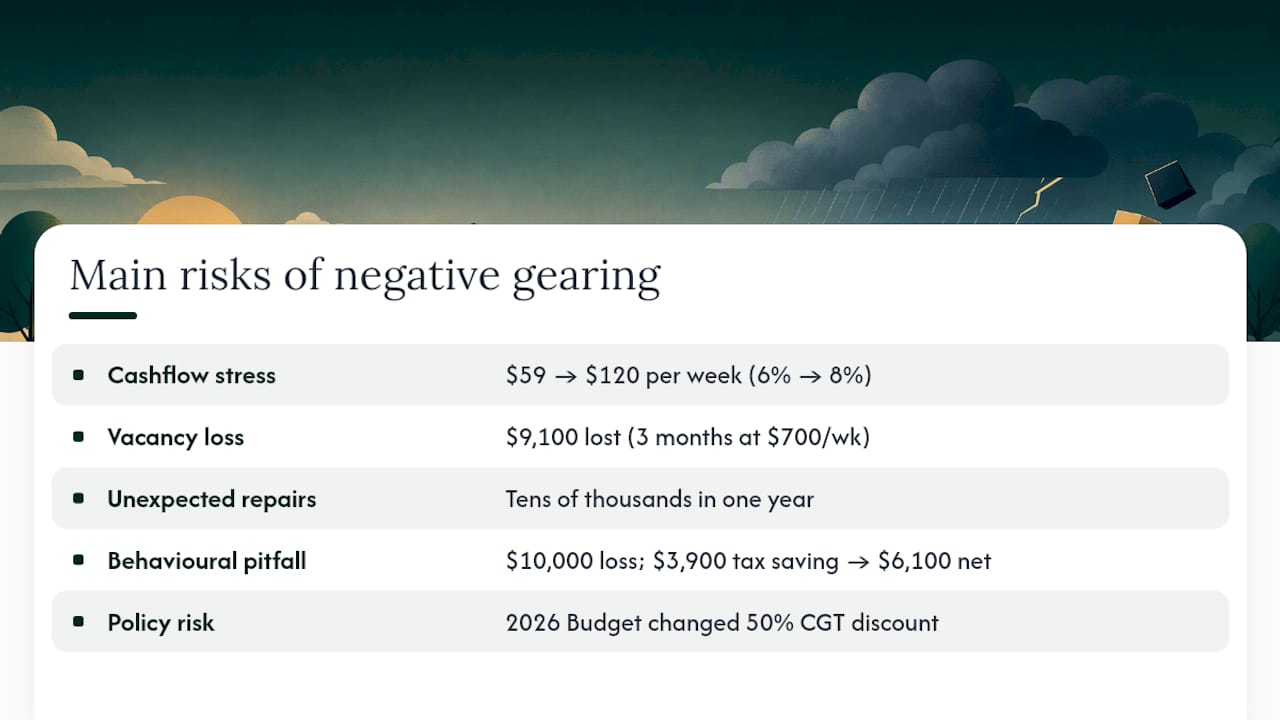
Cashflow stress: if interest rates rise sharply, your annual shortfall widens. A property that cost $59 per week to hold at 6% interest may cost $120 per week at 8%. Multiply that over a year and the buffer requirement becomes substantial.
Vacancy: an empty property still incurs interest, rates, and insurance. A three-month vacancy on a $700-per-week property is $9,100 in lost income with no corresponding reduction in expenses.
Unexpected repairs: a failed roof, plumbing failure, or structural issue can cost tens of thousands of dollars in a single year, far exceeding any tax saving.
Overpaying for the property: if you pay above market value, the capital growth needed to break even is higher from day one. The tax deduction does not compensate for overpaying.
Policy risk: the 2026 Budget changes illustrate that the tax rules underpinning the strategy can change. Investors who built their entire financial case on the 50% CGT discount now face a different outcome on future gains.
Behavioural pitfalls: treating the tax deduction as the strategy itself, rather than as a cost-reduction mechanism within a sound investment thesis, is the most common mistake. A property that generates a $10,000 annual loss and a $3,900 tax saving at 39% still costs you $6,100 per year. If capital growth does not materialise, you simply lose money more slowly.
Pro Tip: Before committing, stress-test your cashflow at an interest rate 2–3 percentage points above your current rate, with a 10-week vacancy and a $15,000 repair bill in year two. If those scenarios would force a sale, your buffer is insufficient.
Is negative gearing right for you? A practical checklist
Work through these steps before making a decision. They are a framework for thinking, not a substitute for professional advice.
- Confirm your marginal tax rate. The benefit of negative gearing scales directly with your rate. If you are in the 32.5% bracket or below, the tax saving may not justify the cashflow risk and complexity.
- Run a 3–5-year cashflow stress test. Model your annual shortfall at your current interest rate, then at rates 2% and 3% higher. Include a 10-week vacancy in at least one scenario. Confirm you can fund the shortfall from savings or income without selling.
- Assess capital growth assumptions honestly. What is the suburb’s 10-year median price growth? Is that growth driven by fundamentals (infrastructure, employment, population) or by speculative demand? A property investment brief can help you formalise these criteria before you search.
- Check the property quality and location. A tax-effective property in a low-growth suburb is still a poor investment. Prioritise location and asset quality over tax outcomes.
- Evaluate your financing terms and buffer. How much cash do you hold in reserve after settlement? A minimum of three to six months of holding costs is a reasonable starting point.
- Confirm the purchase timing relative to the reforms. If you are buying an established property, understand that negative gearing deductions will not be available for purchases after 1 July 2027. If you are buying a new build, the deductions remain available. Check how to research Sydney suburbs to identify which areas have new supply meeting your criteria.
- Get personalised tax modelling. A registered tax agent can model your specific income, proposed property, and the post-reform rules to show you the actual after-tax cost of holding the property. This step is not optional.
Practical next steps and where to get help
Once you have worked through the checklist, the following actions move you from analysis to execution:
- Prepare your financial documents. Gather your last two tax returns, current payslips, and a summary of existing investment income. Your tax agent needs these to model your marginal rate and the impact of a rental loss.
- Engage a registered tax agent for scenario modelling. The Tax Practitioners Board maintains a public register at tpb.gov.au where you can verify that an agent is licensed. Ask specifically for a cashflow model under the post-2026 rules, not just a generic negative gearing calculation.
- Consider a PAYG withholding variation. If your tax agent confirms you will receive a refund at year end due to negative gearing, you can apply to the ATO to reduce the tax withheld from your wages throughout the year. This converts a lump-sum refund into improved monthly cashflow, which helps manage the annual shortfall without waiting until July.
- Engage a buyers agent to find properties that meet your criteria. A buyers agent evaluates properties against yield, capital growth potential, and quality, not just price. Sydney Property Buyers conducts independent property assessments covering capital growth and rental yield, and can access off-market stock that never appears on public listing portals.
- Verify contract timing relative to the grandfathering dates. If you are purchasing an established property and want to retain negative gearing access, your contract must be unconditional before 1 July 2027. Confirm the exact legislative position with your tax agent and solicitor.
Note that buyers agents do not provide tax or financial advice. Sydney Property Buyers’ role is property selection, negotiation, and acquisition. Tax strategy is your registered tax agent’s domain.
Key takeaways
Negative gearing reduces your annual tax bill by offsetting a rental loss against other income, but the strategy only pays off if capital growth eventually exceeds the cumulative losses you absorb along the way.
| Point | Details |
|---|---|
| Core definition | Rental expenses exceed income; the net loss is deductible against other assessable income in Australia. |
| 2026–27 Budget reforms | From 1 July 2027, negative gearing is restricted to new builds; the 50% CGT discount is replaced for future gains. |
| Grandfathering rule | Properties held at 7:30pm AEST on 12 May 2026 retain existing negative gearing and CGT treatment. |
| Who benefits most | Higher-income earners with long time horizons, cash buffers, and realistic capital growth expectations. |
| Sydney Property Buyers | Helps investors find properties aligned with post-reform criteria through off-market access and independent appraisal. |
The buyers agent view: what the reforms actually change
The 2026 Budget reforms do not kill negative gearing. They redirect it. For investors who were already focused on new builds in high-growth corridors, the legislative change largely confirms the direction they were already heading. The investors who face the sharpest rethink are those who relied on established properties in established suburbs, using the 50% CGT discount and full negative gearing to justify a purchase that was marginal on yield.
What I see repeatedly in the Sydney market is investors buying on tax logic rather than property logic. They find a property, calculate the tax saving, and treat that saving as validation for the purchase price. The reform forces a more honest conversation: if you remove the CGT discount from the return calculation, does the property still make sense? For well-located new builds with genuine rental demand, the answer is often yes. For overpriced established stock in suburbs with slowing growth, the answer is frequently no.
The shift toward new builds also changes the search process. Off-market access matters more, not less, because the pool of qualifying stock is narrower. Developers and vendors of new stock do not always list publicly, and competition for the best new builds in growth suburbs is intensifying. Investors who can access pre-market opportunities and move quickly are better positioned than those relying solely on public portals.
One thing that has not changed: the need for a credible capital growth thesis before you commit. Tax rules change. Good locations do not.

Sydney Property Buyers helps investors find the right property post-reform
The 2026 Budget changes mean property selection now carries more weight than ever. A negatively geared new build in the right suburb can still deliver a strong investment outcome; an established property purchased without understanding the new rules can leave you with a cashflow problem and no tax offset to soften it.

Sydney Property Buyers works exclusively for buyers across the Inner West, Eastern Suburbs, Lower North Shore, and Eastern Beaches of Sydney. The service covers the full acquisition process: strategy, off-market property search, independent appraisal for capital growth and rental yield, negotiation, auction bidding, and settlement. A significant share of purchases are secured off-market, giving investor clients access to stock that never reaches public listing portals.
For investors recalibrating their search criteria after the reforms, Sydney Property Buyers can identify new builds and pre-market opportunities that meet revised yield and growth requirements, and negotiate the best available price. Tax modelling remains your registered tax agent’s responsibility; property selection and acquisition is ours.
Call 1800 676 177, email hello@sydneypropertybuyers.com.au, or learn more about exclusive buyers agent representation to discuss your investment brief.
Authoritative sources and primary references
The following sources provide the primary legislative, regulatory, and policy detail referenced in this article. Always check publication dates and seek professional advice for your specific circumstances.
- Tax reform – Boosting home ownership – Reforming negative gearing and capital gains tax (ATO)
- Rental expenses – how to claim (ATO)
- Negative gearing (Treasury)
- How do negative gearing, capital gains tax and trusts work? – ABC News
- Negative gearing: what it is, how it works and the 2026 Budget changes | Mozo
- Treasury FOI release – negative gearing (FOI‑3456)
- Negative gearing in Australia: how it works (2026) | Your Property Guide
This article is general information only and does not constitute tax, financial, or legal advice. Tax rules change and individual circumstances vary. Confirm your position with a registered tax agent or licensed financial adviser before making any investment decision.
Recommended
- Buyer fatigue in the property market: a 2026 Sydney guide
- Why missed properties frustrate buyers: the 2026 Sydney guide
- Fixed fee vs percentage buyers agent: Sydney guide
- What is a property investment brief? Your 2026 guide