Loan portability means you can move your existing home loan to a new property by swapping the security that sits behind the mortgage. Lenders call this a substitution of security or security swap: your lender discharges the mortgage over the property you are selling and registers a new charge over the one you are buying, while your loan account, interest rate, and features stay intact. The practical upshot is straightforward. If you are selling and buying simultaneously and you are happy with your current loan terms, porting is often faster and cheaper than refinancing from scratch. Lenders including Westpac and St.George both offer the feature under their own product terms, though eligibility rules vary by product.
Table of Contents
- How does loan portability work in practice?
- Why borrowers choose to port their home loan
- When porting can work against you
- What does porting a mortgage actually cost?
- Worked examples: upsizing, downsizing, and topping up
- Should you port or refinance? How to decide
- Key takeaways
- What lenders check before approving a port
- Timing and settlement coordination matter more than most buyers realise
- Sydney Property Buyers can help you coordinate your settlement
- Useful sources and further reading
How does loan portability work in practice?
Portability is legally a substitution of security. Your lender does not transfer the original loan contract to a new one; it discharges the mortgage over the sold property and registers a fresh charge over the replacement. Most internal bank systems treat this as a security swap rather than a new loan.

Standard same-time substitution (simultaneous settlement)
This is the cleanest version. Both settlements occur on the same day, so the security swap happens in a single coordinated step.
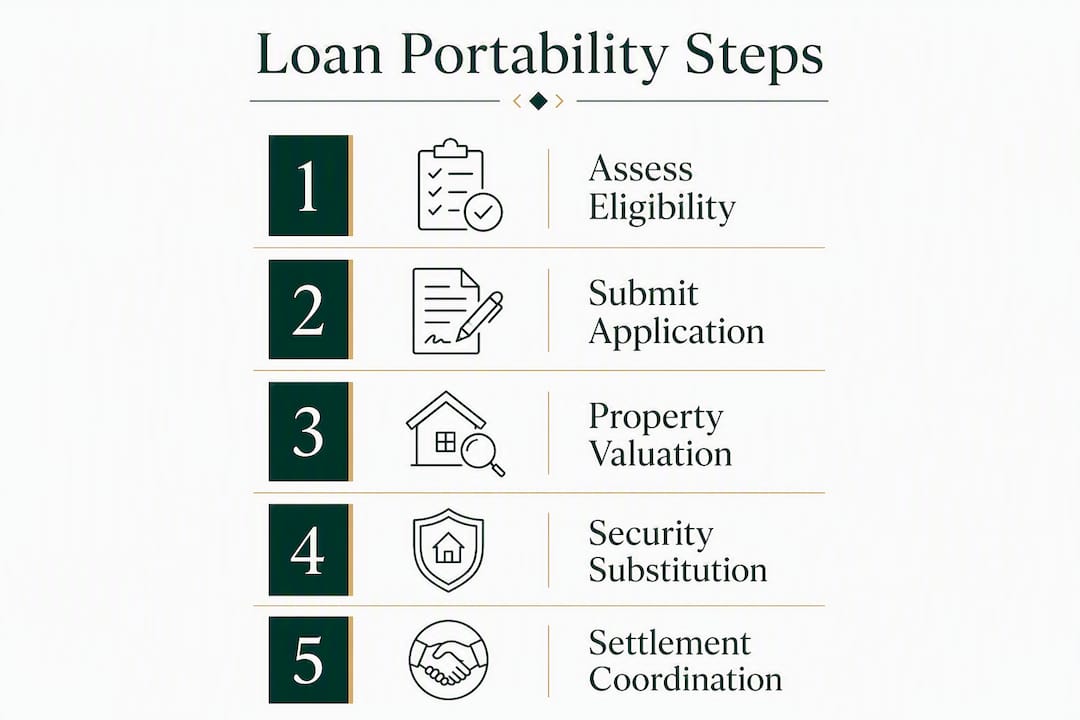
- You notify your lender of your intention to port, usually in writing.
- The lender orders a valuation on the new property.
- Your solicitor or conveyancer coordinates with the lender to discharge the old mortgage and register the new one at settlement.
- Your loan account number, rate, offset account, and redraw facility carry across unchanged.
Deferred substitution (sold but not yet purchased)
When your sale settles before you have found a new property, lenders commonly accept a term deposit funded by the sale proceeds as temporary security. Westpac’s guidance notes this arrangement can run for up to six months, subject to conditions. Where Lenders Mortgage Insurance is involved, the window is up to three months. Bank of Melbourne confirms this shorter limit in LMI scenarios.
Documents and lender checks
| Item | What the lender assesses |
|---|---|
| Valuation | New property must meet the lender’s security criteria |
| LVR | Loan-to-value ratio must stay within the approved limit |
| Borrower identity | At least one borrower named on the loan must appear on the new title |
| Income verification | Required if loan amount increases |
| Loan eligibility | Product must support portability (check PDS) |
Like-for-like substitution means the new property is of equal or greater value and the title includes at least one borrower named on the existing loan contract. If neither condition is met, the lender will typically decline the port or require a full application.
Bridging loans interact with portability differently. If you choose bridging finance rather than a term deposit as temporary security, you carry two loans simultaneously, which adds cost and complexity. Bridging is sometimes unavoidable, but it removes most of the fee-saving advantage of porting.
Why borrowers choose to port their home loan
The case for porting comes down to three things: cost, speed, and preserving something you already have.
- Avoid establishment and application fees. Porting can save you typical application and establishment fees, often between $500 and $1,000, that a new application would attract. Finder notes that loan application and establishment fees are common, and porting can help you avoid these costs.
- Keep your existing interest rate. If you locked in a competitive fixed rate, porting preserves it. Starting a new loan means accepting whatever the market offers today.
- Retain loan features. A portability arrangement typically preserves features such as your offset account and redraw facility, though exact feature transfer depends on the product.
- No new credit assessment (in most cases). Where the loan amount stays the same, you avoid the full application process and the credit enquiry that comes with it.
- Retain your account number and direct debits. Practical, but genuinely useful when you have automated payments tied to the account.
Porting is most valuable when two things align: your existing rate and features are genuinely competitive against current market offers, and your settlements can be coordinated to happen simultaneously. If either condition is missing, the maths often favours refinancing instead.
The note about property equity matters here too. If you have built substantial equity in your current home, porting lets you carry that equity position directly into the new loan without resetting the structure.

When porting can work against you
Portability sounds frictionless. In practice, several common scenarios turn it into a more complicated proposition than refinancing.
- LVR limits. If the new property is worth less than the current one, or if you are downsizing significantly, the existing loan balance may push the LVR above the lender’s maximum. The lender will not approve the port until you reduce the loan or the property value supports it.
- Ineligible loan types. ANZ’s security swap guidance confirms that construction loans, some government-assisted low-deposit products, non-resident loans, and certain green or specialised products are commonly excluded. Always check your Product Disclosure Statement.
- Upsizing triggers a full credit assessment. If you need to borrow materially more to fund the new purchase, the lender will require a full credit assessment. At that point you are effectively going through a new application regardless of the portability label.
- Name and title restrictions. If you are adding or removing a borrower, or if the new title does not include at least one existing borrower, the port will be blocked. Buyers downsizing and changing ownership structure simultaneously face this regularly.
- Break costs on fixed-rate loans. Porting does not automatically waive break costs. If the loan is fixed and the lender treats the security swap as a variation, break costs may still apply.
- Capped time windows. Deferred substitution windows are finite. Miss the deadline and the lender may require you to refinance anyway.
Pro Tip: Before assuming you can port, ask your lender specifically whether your product is eligible and whether a top-up or LVR change will trigger a full reassessment. Get the answer in writing.
What does porting a mortgage actually cost?
The fee picture is more nuanced than “porting is free.” Several cost items are worth checking before you commit.
- Valuation fee. The lender will order a valuation on the new property. This is typically charged to you and is non-refundable if the port does not proceed.
- Discharge or exit fees. Some older loan products still carry exit fees. Check your loan contract.
- Break costs. On a fixed-rate loan, a security swap may trigger break costs depending on how the lender calculates the variation.
- Application or administration fees. Some lenders charge a portability processing fee even when no new application is required.
- Bridging loan costs. If settlements cannot align and you need bridging finance, the interest cost can quickly exceed the fees you saved by not refinancing.
Realistic timeline
- Simultaneous settlement: The security swap happens on the same day. Processing time depends on the lender, but coordinated settlements can be completed within a standard conveyancing window.
- Deferred substitution: The term deposit arrangement can run for up to six months, or up to three months where LMI applies. You must find and settle on a new property within that window.
Timing risks that can add cost:
- Misaligned settlement dates between sale and purchase contracts
- Delayed valuations holding up lender approval
- Conditional contracts that extend beyond the term deposit window
Worked examples: upsizing, downsizing, and topping up
1. Upsizing: borrowing more to buy a larger property
You owe $600,000 on your current home, which sells for $900,000. You want to buy a property for $1,200,000 and need to borrow $900,000.
- The lender will require a full credit assessment because the loan amount increases materially.
- Your income, expenses, and credit file will be reviewed as if this were a new application.
- The speed advantage of porting largely disappears. Refinancing to a better rate may be worth comparing at this point.
2. Downsizing: buying a cheaper property
You owe $500,000 on a property that sells for $1,000,000. You want to buy a property for $600,000 and keep the loan at $500,000.
- The LVR on the new property would be approximately 83%, which may exceed the lender’s maximum for a port.
- You would need to reduce the loan balance or find a lender whose LVR cap accommodates the position.
- If the new title changes borrower names, the port may be blocked entirely.
3. Topping up: a small increase to the loan
You owe $400,000 and want to borrow $430,000 on a property of equivalent value.
- A modest top-up may be possible without triggering a full reassessment, depending on the lender’s policy.
- The lender will still require a valuation and may check income if the increase crosses an internal threshold.
- Confirm the top-up amount and process with your lender before signing contracts.
Pro Tip: Check the lender’s maximum LVR for a ported loan before you exchange contracts on the new property. If the numbers are borderline, get written confirmation that the port will be approved at that LVR before you are committed.
Should you port or refinance? How to decide
The decision is a financial one, not just a logistical one. Treat portability as a deliberate choice rather than a default.
Decision checklist
- Compare your current interest rate against the best rates available today. If the market has moved significantly since you took out your loan, refinancing may save more than porting preserves.
- Calculate break costs on any fixed-rate component. If break costs are high, porting becomes more attractive.
- Confirm your loan product is eligible for portability. Check the PDS.
- Assess whether your LVR will be within the lender’s limit on the new property.
- Consider whether your settlements can realistically be aligned. Misaligned dates add cost.
Questions to ask your lender or mortgage broker
- Is my specific loan product eligible for a substitution of security?
- What is the maximum LVR you will accept for a ported loan?
- Will a top-up trigger a full credit assessment, and if so, what documents will you need?
- Can I use a term deposit as temporary security if settlements do not align, and for how long?
- Will I need bridging finance, and what will it cost?
- Are there any break costs associated with the security swap on my fixed-rate component?
- What is your processing time from application to settlement approval?
- What documents do I need to provide, and who coordinates with my conveyancer?
A mortgage broker can run the numbers across multiple lenders and tell you whether porting or refinancing produces the better outcome. A buyers’ agent adds value at the settlement coordination layer, managing the timing between sale and purchase contracts to avoid the bridging costs that arise when dates slip.
Key takeaways
Loan portability is most useful when your existing loan terms are competitive and your sale and purchase can settle simultaneously.
| Point | Details |
|---|---|
| Definition | Portability is a substitution of security: the lender swaps the property securing your loan, keeping your account intact. |
| When it helps most | Simultaneous settlement with no loan increase and a competitive existing rate. |
| Common limits | LVR caps, ineligible loan types, name/title restrictions, and break costs can all block a port. |
| Key cost items | Valuation fee, potential break costs, and bridging finance if settlements do not align. |
| Sydney Property Buyers | Coordinates settlement timing and lender deadlines to reduce the risk of bridging costs for Sydney buyers. |
What lenders check before approving a port
Eligibility for portability is not automatic. Lenders run a structured assessment before approving a security swap, and the criteria are tighter than many buyers expect.
Loan-to-value ratio (LVR) is the primary filter. The new property must support the existing loan balance at an LVR within the lender’s approved limit, typically 80% without LMI and up to 90–95% with it, though the exact threshold varies by product. If the new property is worth less than the old one and the loan balance stays the same, the LVR rises and the port may be declined.
Income and serviceability come into play whenever the loan amount increases. Even a modest top-up can trigger a serviceability check. Lenders assess current income, existing liabilities, and living expenses against their own floor rate, the same process as a new application.
Property value and type matter independently of LVR. The new property must meet the lender’s security criteria: standard residential properties in acceptable locations are generally fine; rural, high-density, or unusual properties may be declined as security regardless of value.
Guarantees and third-party security complicate portability. If a guarantor is involved in the existing loan, the lender will need to confirm the guarantee extends to the new security or require a new guarantee arrangement.
Borrower name and title. As Bank of Melbourne’s portability guidance confirms, the new title must include at least one borrower named on the existing loan contract. Changing the ownership structure at the same time as porting is a common reason applications are declined.
Timing and settlement coordination matter more than most buyers realise
The single most underappreciated aspect of loan portability is not the rate or the fees. It is the timing.
Most portability problems in the Sydney market come down to settlement dates that do not align. A vendor who will not move on their settlement date, a delayed valuation, or a conditional contract that runs long can all push you outside the lender’s term deposit window and force bridging finance. At that point, the cost advantage of porting evaporates.
For many Sydney buyers, the real value a buyers’ agent brings to a portability scenario is managing exactly this: coordinating lender, conveyancer, and vendor deadlines so that simultaneous settlement is achievable rather than aspirational. When you are buying in competitive inner-city suburbs where vendors have leverage over settlement terms, having someone who can negotiate settlement dates as part of the contract conditions is not a luxury. It is what keeps the port viable.
A mortgage broker handles the lender side of this equation. A buyers’ agent handles the vendor and contract side. The two roles are complementary, and in a simultaneous settlement scenario, both matter.
Sydney Property Buyers can help you coordinate your settlement
Timing a simultaneous sale and purchase in Sydney is genuinely difficult. Vendors set their own settlement preferences, lenders have processing queues, and valuations do not always come back quickly. When any one of those elements slips, the cost of bridging finance lands on the buyer.

Sydney Property Buyers works exclusively for buyers across the Inner West, Eastern Suburbs, Lower North Shore, and Eastern Beaches. The agency manages the full purchase process, including settlement coordination and lender liaison, so that your portability window stays intact. With an average purchase time of 54 days from engagement to settlement and a track record of over 100 properties secured, the team understands how to negotiate contract terms that align with your lender’s timeline. To see how the process works, visit the Our Process page or read more about the benefits of exclusive buyer representation. Call 1800 676 177 to speak with the team directly.
Useful sources and further reading
The following lender pages and industry guides are the most reliable starting points for confirming product-specific portability rules and reading full PDS documents.
- Portability | Westpac — Westpac’s product page covering simultaneous and deferred substitution, including the term deposit option and its conditions. Best for understanding how a major lender operationalises the feature.
- Substitution of Security | St.George Bank — Explains the industry terminology (substitution of security, security swap, portability) and confirms that lenders use these terms interchangeably. Good first read for terminology clarity.
- Portability and your home loan | Bank of Melbourne — Covers like-for-like substitution requirements and the LMI-related term deposit limit. Useful for understanding title and name requirements.
- Security swap | ANZ — ANZ’s practical guide to the security swap process, including ineligible loan types and borrowing amount rules.
- Loan portability | Finder — Independent broker and comparison guide explaining fee savings, practical steps, and when to consider refinancing instead. Good for a side-by-side cost perspective.
Recommended
- Benefits of a local area buyers agent in Sydney
- North Shore Buyers Agent | Sydney Property Buyers
- Sydney Property Buyers Buyers Agent | Experts in Buying Property
- What does the first home buyer grant mean in NSW?