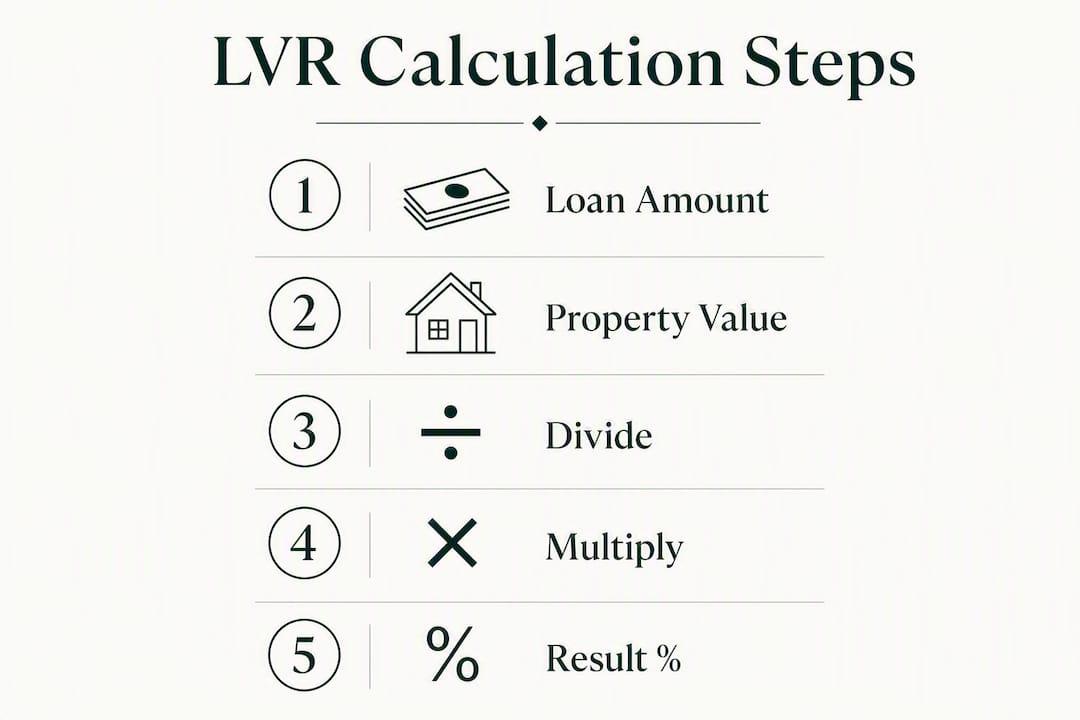
LVR stands for loan-to-value ratio (sometimes called loan-to-valuation ratio), and it answers one simple question: what percentage of the property’s value are you borrowing? The formula is: Loan amount ÷ Property value × 100 = LVR%. Lenders use this figure to assess risk before approving a home loan, and MoneySmart confirms that 80% is the widely recognised threshold for avoiding Lenders Mortgage Insurance.
Two things to keep in mind:
- The 80% LMI threshold. Borrow more than 80% of the property’s value and most lenders will require you to pay Lenders Mortgage Insurance, a cost that protects the lender, not you.
- Lower LVR, better terms. A lower LVR generally unlocks more competitive interest rates, broader product choice, and fewer conditions on your loan.
Table of Contents
- What does LVR mean for a mortgage, and how do you calculate it?
- How do lenders decide which property value to use?
- When does Lenders Mortgage Insurance apply?
- Why your LVR affects more than just LMI
- Practical ways to lower your LVR
- How to use an LVR calculator: two worked examples
- What do common LVR bands mean for your loan?
- How a buyers agent can improve your effective LVR outcomes
- Key takeaways
- LVR matters most at the moment you least expect it
- How Sydney Property Buyers reduces LVR risk for Sydney purchasers
- Useful Australian sources and calculators
What does LVR mean for a mortgage, and how do you calculate it?
The formula is straightforward. Divide the loan amount by the property value, then multiply by 100. ABC News explains it plainly: a $450,000 loan on a $600,000 property produces a 75% LVR.
Here is a step-by-step example using a realistic Sydney purchase:
- Property value: $600,000
- Deposit: $120,000 (20%)
- Loan amount: $480,000
- LVR: $480,000 ÷ $600,000 × 100 = 80%
At exactly 80%, this borrower sits at the LMI threshold. Drop the deposit to $60,000 (10%) and the loan rises to $540,000, pushing LVR to 90%.
You will see both “loan-to-value” and “loan-to-valuation” used interchangeably. CommBank notes that LVR stands for either, with “valuation” emphasising that the figure used is the lender’s assessed value of the property, not necessarily what you paid for it.
One common confusion: LVR is calculated on the loan, not the deposit. Your deposit is simply what remains after subtracting the loan from the purchase price. Equity is the portion of the property you own outright, which grows as you pay down the principal or as the property value rises.
How do lenders decide which property value to use?
This is where many borrowers get caught out. The “value” in the LVR formula is not automatically the price you agreed to pay. Westpac explains that lenders use either the contract purchase price or an independent bank valuation, and they typically apply whichever figure is lower.
How this plays out in practice:
- The lender orders a valuation from an independent valuer, usually at the application stage or after you have made an offer.
- If the valuer assesses the property at $580,000 but you agreed to pay $620,000, the lender calculates LVR on $580,000.
- On a $500,000 loan, that shifts LVR from 80.6% to 86.2%, potentially triggering LMI you had not budgeted for.
The timing matters too. A valuation ordered at pre-approval may differ from one ordered after exchange, particularly in a moving market. Refinancing also triggers a fresh valuation by the new lender, which can reset your LVR entirely.
Pro Tip: Ask your lender or broker when the valuation will be ordered and whether it is before or after you exchange contracts. A lower-than-expected valuation after exchange can leave you scrambling to increase your deposit before settlement.

When does Lenders Mortgage Insurance apply?
NAB’s guidance is clear: loans above 80% LVR are typically considered higher risk and usually attract LMI. The critical point most borrowers miss is that LMI protects the lender, not you. If you default and the property sells for less than the outstanding loan, LMI covers the lender’s shortfall. You still owe any remaining debt.
LMI is a one-off, non-refundable premium, as QBE’s LMI fact sheet confirms. It is typically added to the loan balance, so you end up paying interest on it for the life of the loan.
Mozo notes that on a $750,000 purchase with a 10% deposit (90% LVR), LMI premiums can run to several thousand dollars. The exact figure depends on the lender, the insurer, and the LVR band.
Finder confirms that some lenders will insure loans up to 90–95% LVR, though product choice narrows considerably at those levels.
Ways to avoid or reduce LMI:
- Save a deposit of at least 20% to stay at or below 80% LVR.
- Negotiate the purchase price down, which reduces the loan required.
- Use a guarantor (a family member who offers equity in their own property as additional security).
- Check whether you qualify for a government scheme such as the First Home Guarantee, which allows eligible buyers to purchase with a 5% deposit without paying LMI.
Why your LVR affects more than just LMI
LVR shapes the entire cost and structure of your loan, not just whether LMI applies. Loans for First Homes explains that lenders use tiered pricing inside the 80% threshold, meaning a 70% LVR can attract a meaningfully different rate from a 79% LVR. The difference might be 0.1–0.2 percentage points, but on a $600,000 loan that compounds over 25 years.
Beyond rates, a high LVR can:
- Restrict which loan products are available to you (some fixed-rate and offset products are reserved for lower-LVR borrowers).
- Increase upfront fees and ongoing charges.
- Tighten the lender’s serviceability assessment, reducing how much you can borrow overall.
LVR is one factor among several. Lenders also assess your income, employment stability, credit history, existing debts, and living expenses. A strong income and clean credit record can sometimes offset a higher LVR, but it will not eliminate the LMI requirement or unlock the best rate tiers.
Pro Tip: Before applying, use a bank calculator to check which LVR band you fall into. Even a small increase in deposit, say $10,000–$15,000, can shift you into a lower pricing tier and save more than the extra saving costs.

Practical ways to lower your LVR
The most direct lever is the deposit, but it is not the only one. Beyond Bank’s guide lists several practical strategies:
Before settlement:
- Increase your deposit by saving more or receiving a gift from family.
- Negotiate the purchase price down, which reduces the loan needed for the same property.
- Use a guarantor to provide additional security without increasing your cash deposit.
- Consider a lower-priced property that achieves the same LVR with a smaller deposit.
After settlement:
- Make additional principal repayments to reduce the outstanding loan balance.
- Use an offset account or redraw facility to reduce the effective loan balance.
- Wait for capital growth: as the property value rises, LVR falls naturally.
- Refinance once LVR drops below 80%, potentially accessing better rates and dropping LMI on the new loan.
Pro Tip: Negotiating the purchase price is often the most cost-effective way to improve LVR before settlement. A $20,000 reduction in price on a $700,000 purchase shifts LVR from 88.6% to 85.7% on a $620,000 loan, potentially reducing LMI by more than the negotiating effort costs.
How to use an LVR calculator: two worked examples
Most major Australian lenders and MoneySmart offer online LVR calculators. The inputs are simple: purchase price, deposit amount, and loan amount. The output tells you your LVR, whether LMI is likely, and which rate band you may fall into. Mortgage Choice also provides a calculator that estimates LMI costs alongside LVR.
Here are two scenarios showing how the numbers shift:
| Scenario | Property value | Deposit | Loan amount | LVR | LMI likely? |
|---|---|---|---|---|---|
| Example A | $600,000 | $120,000 | $480,000 | 80% | No |
| Example B | $600,000 | $60,000 | $540,000 | 90% | Yes — several thousand dollars |
To use a calculator:
- Enter the property purchase price.
- Enter your available deposit (or the loan amount you need).
- Read the LVR output.
- Check whether the result sits above or below 80%.
- If above 80%, use the LMI estimator to see the likely premium.
- Test different deposit amounts to find the threshold where LMI disappears.
Testing multiple scenarios is worth the five minutes. Small changes in deposit or purchase price can shift LMI costs by thousands of dollars and move you into a better rate band.
What do common LVR bands mean for your loan?
Lenders do not treat all borrowers below 80% the same way. Here is how the bands typically work:
- ≤60% LVR: Very low risk. Access to the most competitive rates, broadest product range, and minimal conditions. Refinancers with significant equity often sit here.
- 61–80% LVR: Low risk. Good rate access and full product choice. Most owner-occupiers with a standard 20% deposit land in this band.
- 81–90% LVR: Higher risk. LMI required. Rate premiums apply. Product choice narrows, particularly for investment loans.
- 91–95% LVR: Very high risk. LMI premiums are significantly larger. Some lenders will not lend at this level without a guarantor or government scheme support.
Investment loans typically attract tighter LVR limits than owner-occupied loans. Many lenders cap investment lending at 80–90% LVR, and some apply a lower maximum for interest-only investment loans. If you are purchasing an investment property, confirm the lender’s maximum insured LVR before you commit to a deposit amount.
How a buyers agent can improve your effective LVR outcomes
The purchase price is the single biggest variable in your LVR calculation, and it is the one a buyers agent directly influences. Sydney Property Buyers is a fully licensed buyers agency that exclusively represents purchasers in Sydney’s Inner West, Eastern Suburbs, Lower North Shore, and Eastern Beaches.
Three services directly affect LVR outcomes:
- Negotiation. Sydney Property Buyers achieves notable savings on purchase price for clients. On a mid-to-high priced property, such savings reduce the loan required and can shift LVR below the 80% LMI threshold entirely.
- Off-market access. More than 30% of purchases secured by the agency are off-market, meaning buyers avoid competitive bidding that inflates prices. Off-market access removes the auction premium that pushes purchase prices, and LVR, higher.
- Independent appraisal. The agency provides an independent property appraisal before any offer is made. If a bank valuation comes in lower than the contract price, having an independent appraisal on file gives you a basis to challenge the lender’s figure or renegotiate with the vendor.
A licensed buyer’s agent also understands valuation timing. Knowing when to exchange contracts relative to when the lender orders its valuation can prevent a last-minute LVR surprise before settlement.
Sydney Property Buyers operates on a fee-for-service model: a small retainer at engagement, deducted from the final fee upon completion of a purchase.
Key takeaways
LVR is the loan amount expressed as a percentage of the property value, and keeping it at or below 80% avoids LMI and unlocks better rates.
| Point | Details |
|---|---|
| LVR formula | Loan amount ÷ property value × 100; a $480,000 loan on a $600,000 property = 80% LVR. |
| The 80% threshold | Borrowing above 80% LVR typically triggers LMI, a non-refundable cost that protects the lender. |
| Lender valuations | Lenders use the lower of contract price or bank valuation, so a low valuation can increase your LVR mid-transaction. |
| Lowering LVR | Negotiate the purchase price, increase your deposit, or use a guarantor to reduce LVR before settlement. |
| Sydney Property Buyers | Achieving notable savings on purchase price and off-market access can directly reduce effective LVR for Sydney purchasers. |
LVR matters most at the moment you least expect it
Most buyers focus on LVR when they are calculating their deposit. The real risk arrives later: when the bank valuation comes back lower than the contract price, or when a refinance triggers a fresh assessment and LMI appears again on a loan you thought was clean.
The valuation timing issue is genuinely underappreciated. In a fast-moving Sydney market, a property can be valued conservatively by a bank even when comparable sales support the purchase price. That gap, sometimes $20,000–$50,000 on a $700,000 property, can push a borrower from 80% LVR to 87% LVR overnight, adding thousands in LMI and changing the loan structure entirely.
The other thing buyers consistently underestimate is how much tiered pricing inside the 80% band matters. Getting from 79% to 70% LVR is not just about avoiding LMI. It can mean a materially lower rate for the life of the loan. That is worth running the numbers on before you decide how much deposit to put down.
How Sydney Property Buyers reduces LVR risk for Sydney purchasers
Negotiating a lower purchase price is the fastest way to improve your LVR before settlement, and it is precisely what Sydney Property Buyers does for every client. Directed by Kristan Johnson, 2024 Outstanding Buyers Agent of the Year (Inner West Local Business Awards), the agency combines professional negotiation, off-market sourcing, and independent appraisal to give buyers a structural advantage on price.

The agency’s full purchase service covers strategy, property search, independent appraisal, due diligence, negotiation, auction bidding, and settlement management across Sydney’s Inner West, Eastern Suburbs, Lower North Shore, and Eastern Beaches. For buyers who have already found a property, the Negotiation Only service provides professional representation to secure the best possible price, directly reducing the loan amount and improving LVR. The agency holds NSW Licence 20456819 and operates on a transparent fee-for-service model with a small engagement retainer.
Call 1800 676 177 or email hello@sydneypropertybuyers.com.au to discuss your purchase.
Useful Australian sources and calculators
These resources let you verify figures and test your own LVR scenarios:
- MoneySmart LVR glossary — ASIC’s consumer finance regulator; plain-language definition and calculator links.
- CommBank LVR guide — explains LVR, LMI, and government scheme options for first-home buyers.
- ANZ LVR guide — covers the lender-assessed value concept and the 80% tipping point.
- Mozo LVR guide — includes illustrative LMI cost examples at different LVR levels.
- NAB LVR explainer — summarises risk bands and LMI application.
- QBE LMI fact sheet — the insurer’s own explanation of how LMI works and when it applies.
Save the MoneySmart and major bank calculators before you make an offer. Running your numbers under two or three deposit scenarios takes minutes and can prevent a costly LMI surprise at settlement.
This article provides general information about LVR and Australian mortgage lending. It is not financial or legal advice. Confirm current rates, LMI thresholds, and eligibility rules with your lender or a qualified mortgage broker before making any borrowing decisions.
Recommended
- Why missed properties frustrate buyers: the 2026 Sydney guide
- Why a licensed buyer’s agent matters in Sydney
- Why local knowledge matters when choosing a buyer’s agent
- Lower North Shore apartment buying: market snapshot and how to secure one