A property investment brief is a written, structured document that translates an investor’s financial situation and goals into specific acquisition criteria for real estate. Think of it as the blueprint that sits between your bank balance and your buying decisions. Without one, you are essentially browsing listings and hoping something feels right. That approach costs investors time, money, and often results in purchases that look good emotionally but underperform financially. This guide explains what a property investment brief contains, why it matters for your property investment strategy, and how to build one that actually works in the 2026 Australian market.
What is a property investment brief and why does it matter?
A property investment brief is defined as a decision-making framework that filters out properties not aligned with an investor’s growth or cash flow targets. The industry also refers to this document as an investment mandate or acquisition brief, though “investment brief” is the most widely used term among Australian buyers agents and financial advisers. Its core purpose is to convert broad ambitions like “build wealth through property” into measurable, testable criteria you can apply to every listing you assess.
The brief matters because emotional decisions cost investors real money. Starting to look at property listings before creating a brief leads to emotional buying and poor strategic alignment. This is sometimes called “shiny object syndrome,” where a well-presented property in the wrong suburb or at the wrong yield pulls you off course. A brief prevents that by establishing your rules before you ever open a listing portal.

For Sydney investors specifically, the stakes are high. Gross rental yields in Sydney typically range from 3–5% depending on property type, and net yields are lower once all outgoings are deducted. That narrow margin means a single poor decision, such as buying a property with a vacancy rate above your modelled assumptions, can turn a neutral investment into a cash flow drain within months.
What essential components make up a property investment brief?
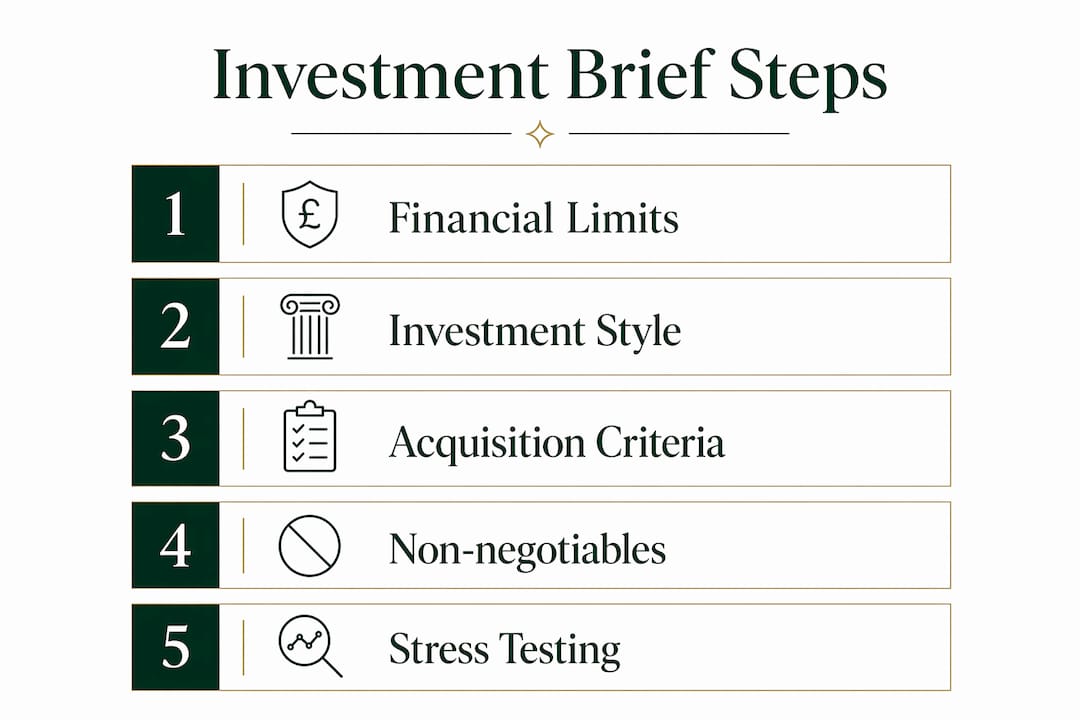
A well-constructed investment brief covers five core areas: financial parameters, investment style, acquisition criteria, non-negotiables versus bonuses, and stress-testing assumptions.
Financial parameters
Your brief must open with your borrowing capacity and your actual comfort level. These are not the same figure. Australian Property Podcast experts identify the gap between capacity and comfort as one of the most critical distinctions in writing an effective brief. Your bank may approve you for $1.2 million. Your comfort level, accounting for lifestyle costs and risk tolerance, may sit at $950,000. Your brief should reflect the lower number.
Investment style and acquisition criteria
Define whether you are targeting capital growth, rental yield, or a balance of both. Houses in Sydney’s Inner West and Eastern Suburbs tend to offer stronger capital growth but lower yields. Units often produce higher yields but with greater variability. Your brief should state your preference clearly, along with your preferred property type, target suburbs, minimum land size if applicable, and any structural requirements such as off-street parking or a second bathroom.
Non-negotiables versus bonuses
Listing non-negotiables explicitly prevents emotional overbidding, particularly at auction. A non-negotiable might be “minimum 500 square metres of land in a flood-free zone.” A bonus might be “north-facing rear garden.” Keeping these separate stops you from treating a nice-to-have as a must-have under pressure.
Stress-testing assumptions
Every brief should include a stress-test section. Stress-testing scenarios for interest rate rises and tenant vacancies safeguard financial resilience. Model what happens if your interest rate rises by 2%, or if the property sits vacant for four weeks. Vacancy rates below 3% are considered healthy in Australian markets, but your brief should account for periods above that threshold.
The table below summarises the key components and their purpose.
| Component | Purpose |
|---|---|
| Borrowing capacity and comfort level | Sets the outer and inner financial boundaries for your search |
| Investment style (growth vs yield) | Defines the financial outcome you are targeting |
| Acquisition criteria | Narrows the search to specific property types, suburbs, and features |
| Non-negotiables vs bonuses | Maintains discipline under negotiation and auction pressure |
| Stress-test assumptions | Protects cash flow against rate rises and vacancy periods |
| Core financial metrics | Benchmarks gross and net yield against your targets |
Pro Tip: Include a gross yield target in your brief. Effective investment briefs aim for 4%+ gross rental yield in Sydney, with net yield calculations deducting council rates, insurance, strata levies, management fees, and repairs from rental income.
How does a property investment brief improve decision-making?
A brief improves decisions by replacing gut feel with objective filters. Investor briefs support portfolio growth by fostering disciplined buying, ensuring consistency, and enabling systematic scaling rather than ad hoc purchases. That consistency is what separates investors who build genuine portfolios from those who own one property they are not sure about.
The practical benefits are concrete:
- Properties that do not meet your criteria are ruled out before inspection, saving hours of wasted time.
- Your brief gives you a clear basis for researching Sydney suburbs without being distracted by properties outside your parameters.
- At auction, your maximum bid is already calculated and documented. You do not negotiate against yourself.
- When a buyers agent works from your brief, they can search off-market and pre-market stock with precision, not guesswork.
A property investment brief is not a wish list. It is a financial filter. Every property that does not pass the brief’s criteria is a property you do not inspect, do not bid on, and do not lose sleep over. That discipline, applied consistently, is what builds a portfolio rather than a collection of compromises.
The margin of safety argument is equally important. Stress-testing builds a margin of safety that protects portfolios from forced liquidation. Investors who skip this step often discover their financial limits only when rates rise or a tenant vacates, at which point their options are limited and expensive.
Pro Tip: Review your brief against every property you inspect, not just the ones you are serious about. The discipline of applying it consistently sharpens your judgement over time.
How to create your own property investment brief
Building an effective brief takes roughly two to three hours of focused work. The result is a document you will use for every purchase decision over the next several years.
-
Clarify your financial position. Calculate your borrowing capacity with a mortgage broker, then identify your comfort level. Write both figures into the brief. Your search budget should reflect the comfort level, not the maximum approval.
-
Define your investment outcome. Decide whether you prioritise capital growth, rental yield, or a specific balance of both. State your target gross yield, your acceptable vacancy allowance (industry standard is approximately two weeks per year), and your maintenance budget (typically 1–2% of property value annually).
-
Set your acquisition criteria. List your preferred property types, target suburbs or corridors, minimum and maximum property sizes, and any structural requirements. Be specific. “Inner West Sydney, two-bedroom house or townhouse, minimum 300 square metres, off-street parking” is a workable criterion. “Something in a good suburb” is not.
-
Separate non-negotiables from bonuses. Write two columns. Non-negotiables are criteria that, if absent, mean you do not proceed. Bonuses are features that add value but do not determine whether you buy. This distinction is what maintains negotiation discipline under auction pressure.
-
Build your stress-test scenarios. Model your cash flow at your current interest rate, then at 2% above it. Model a four-week vacancy. If either scenario creates a cash flow problem you cannot sustain for six months, revise your budget or yield target before you start searching.
-
Set a review schedule. Your brief is not a static document. Review it every six months, or after any significant change to your financial position, interest rates, or market conditions. A brief written in early 2024 may need updating for 2026 lending conditions and rental market dynamics.
Pro Tip: Pair your brief with a property search criteria guide to translate your brief’s parameters into a practical shortlisting process. The brief sets the rules; the search criteria apply them.
Common mistakes to avoid when using an investment brief
Most errors with investment briefs fall into a small number of predictable patterns.
- Browsing listings before writing the brief. This is the single most common mistake. Once you have seen a property you like, your brief tends to be written around it rather than independently of it.
- Confusing capacity with comfort level. Many investors fail to stress-test their brief against economic risks like interest rate changes or vacancy periods. Buying at your maximum approval leaves no buffer.
- Omitting the non-negotiables list. Without it, every feature becomes negotiable under pressure. You end up buying a property that ticks six of your eight criteria and telling yourself the other two do not matter.
- Treating the brief as permanent. Market conditions change. Your financial position changes. A brief that is never updated becomes a liability rather than a tool.
- Underestimating ongoing costs. Maintenance budgets of 1–2% of property value annually, plus management fees, council rates, insurance, and strata levies, can significantly reduce net yield. Investors who model only gross yield are routinely surprised by actual returns.
- Skipping cash flow stress-testing entirely. A property investment brief that does not model vacancy or rate rises is incomplete. It tells you what you want to buy but not whether you can sustain it.
Pro Tip: Write your brief before you speak to a selling agent or attend an open home. Once you are emotionally engaged with a specific property, objectivity becomes much harder to maintain.
Key takeaways
A property investment brief is the single most effective tool for keeping your buying decisions objective, consistent, and aligned with your long-term financial goals.
| Point | Details |
|---|---|
| Core definition | A brief translates financial goals into specific, measurable acquisition criteria. |
| Financial parameters | Distinguish borrowing capacity from comfort level and model both in your brief. |
| Non-negotiables vs bonuses | Separating these two categories maintains discipline at auction and in negotiation. |
| Stress-testing | Model vacancy periods and rate rises before committing to any purchase. |
| Living document | Review and update your brief every six months or after major financial changes. |
Why I think most investors underestimate the brief
The investors I work with who struggle most are rarely short of capital or market knowledge. They struggle because they start looking before they start thinking. A brief forces you to answer the hard questions before the market does it for you, usually at a cost.
What surprises people is how much clarity the process creates. Sitting down to write a brief often reveals that an investor’s stated goal (capital growth) and their actual behaviour (chasing high-yield units) are pointing in opposite directions. The brief surfaces that contradiction before it becomes an expensive mistake.
I have also seen briefs save clients from themselves at auction. When your maximum bid is already documented and the reasoning behind it is written down, the adrenaline of a competitive auction does not override your financial logic. That is not a small thing in Sydney’s market.
The other insight worth sharing: a brief is not a constraint. Investors sometimes resist writing one because they fear it will rule out too many properties. The opposite is true. A clear brief makes every inspection faster and every decision easier. You spend less time on unsuitable properties and more time moving decisively on the right ones. Sydney Property Buyers’ average purchase time of 54 days from engagement to settlement reflects exactly that kind of disciplined, brief-driven process.
Treat your brief as a living document. The version you write today should look different in 18 months. Markets shift, lending conditions change, and your own risk appetite evolves. The investors who build strong portfolios are the ones who update their brief as their circumstances change, not the ones who write it once and file it away.
— Kristan
How Sydney Property Buyers can help you build and execute your brief
Developing a property investment brief is one thing. Applying it with discipline across Sydney’s competitive market is another. Sydney Property Buyers works exclusively for purchasers, never sellers, and every client engagement begins with a detailed brief development session to define financial parameters, acquisition criteria, and stress-test assumptions.

From there, the team applies your brief across both on-market and off-market property access, with more than 30% of purchases secured through pre-market and off-market channels. Inspections run seven days per week, independent of open home schedules, so suitable properties are assessed the moment they become available. To understand the full scope of support available, visit the services page or call 1800 676 177.
FAQ
What is a property investment brief in simple terms?
A property investment brief is a written document that defines your budget, target yield, preferred property type, and acquisition criteria before you begin searching. It acts as a filter to keep every purchase decision objective and aligned with your financial goals.
How long should a property investment brief be?
A brief does not need to be lengthy. One to two pages covering financial parameters, investment style, acquisition criteria, non-negotiables, and stress-test assumptions is sufficient for most investors.
How often should I update my investment brief?
Review your brief every six months, or after any significant change to your financial position, interest rates, or personal circumstances. A brief that reflects last year’s conditions may lead you to the wrong decisions in the current market.
What is the difference between gross and net yield in a brief?
Gross rental yield is annual rent divided by purchase price. Net yield deducts all outgoings including council rates, insurance, strata levies, management fees, and repairs. Your brief should target a specific net yield, not just a gross figure, to reflect actual returns.
Do I need a buyers agent to create an investment brief?
You can write a brief independently, but a licensed buyers agent adds value by stress-testing your assumptions against current market data and applying the brief to off-market stock. Sydney Property Buyers includes brief development as part of its full purchase service.
Recommended
- Buyers agent investment property search: Sydney guide
- Our Process — From Search to Settlement | Sydney Property Buyers
- Types of properties buyers agents specialise in: 2026 guide
- Eastern suburbs property buying guide: 2026 edition