Property search criteria are the specific attributes and filters buyers use to identify properties that meet their personal and investment needs. In Australian real estate, this process is also called defining your property selection criteria or setting your real estate search parameters. Getting this right before you start viewing properties is the single most effective way to reduce wasted time and avoid costly emotional decisions. For first-time buyers and investors in Sydney’s competitive market, a structured set of property purchasing criteria is not optional. It is the foundation of every successful purchase.
What is a property search criteria and how does it work?
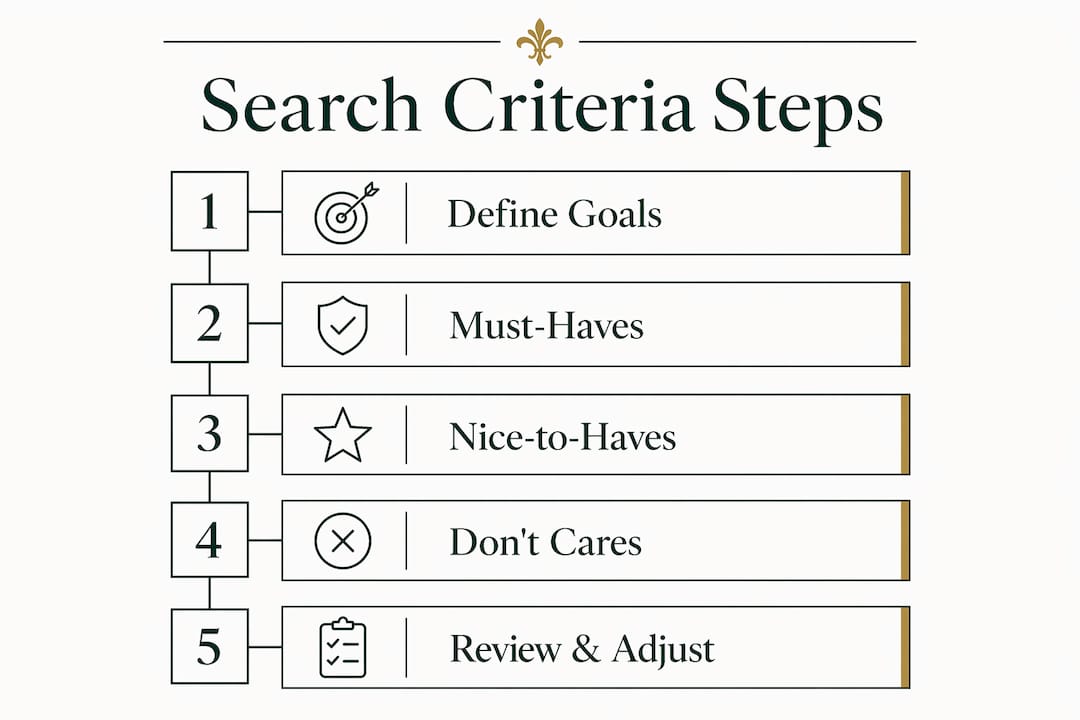
Property search criteria are a defined list of features, conditions, and filters that a buyer applies to every property they consider. The 3-step hierarchical structure organises these into must-haves, nice-to-haves, and don’t cares. This framework keeps buyers objective and reduces decision fatigue, which is particularly valuable for first-timers facing dozens of listings at once.
Must-haves are non-negotiable. They are features that are expensive or impossible to change, such as location, land size, school zone, or structural integrity. A buyer targeting the Inner West Sydney market might list proximity to a specific train line, a minimum of two bedrooms, and a price ceiling as absolute requirements. If a property fails any one of these, it is eliminated immediately.

Nice-to-haves are features a buyer would welcome but can live without or add later. A renovated kitchen, a second bathroom, or off-street parking all fall into this category. Separating must-haves from nice-to-haves based on cost and modifiability prevents emotional decisions and keeps focus on genuine deal-breakers.
Don’t cares are features that have no bearing on the decision. Carpet colour, light fittings, and garden landscaping are typical examples. Acknowledging these explicitly stops buyers from unconsciously penalising a property for something trivial.
Pro Tip: Apply the 80/20 rule when building your list. Focus 80% of your attention on the five or six criteria that genuinely matter, and treat the rest as background noise. Most buyers who struggle to commit have too many items in the must-have column.
How do advanced search filters refine your property selection criteria?
Modern property search tools go far beyond price and suburb. Over 130 search filters are now available to buyers, covering property type, zoning, owner motivation, estimated equity, and demographic data. That breadth means a buyer can move from a broad wish list to a tightly targeted shortlist without physically inspecting dozens of unsuitable properties.
For Sydney buyers, the practical applications are significant. An investor searching the Lower North Shore can filter by rental yield potential, zoning classification, and land-to-asset ratio simultaneously. A first-time buyer in the Eastern Suburbs can filter by school catchment zone, flood overlay, and strata levy range in a single search. These filters translate abstract criteria into concrete, searchable parameters.
AI-powered conversational search tools add another layer. A buyer can type a natural language query such as “three-bedroom house near a primary school in Marrickville under $1.8 million with a north-facing garden” and receive filtered results without manually adjusting each parameter. This approach is particularly useful for buyers who know what they want but struggle to translate preferences into formal search fields.
- Filter by owner motivation, including long-term ownership and absentee landlords, to identify motivated sellers
- Use zoning filters to confirm development potential before inspecting
- Apply demographic filters to understand neighbourhood composition and growth trajectory
- Set price filters with a 5–10% buffer above your ceiling to capture properties listed slightly above budget that may negotiate down
- Use suburb research tools to cross-reference growth indicators with your criteria
Pro Tip: AI search tools are excellent for discovery and market comparison. They are not reliable for assessing property condition, building defects, or negotiation dynamics. Use them to build your shortlist, then rely on expert inspection and advice to validate it.
AI tools simplify searching but cannot replace licensed local agents who provide insights on quality, negotiations, and inspections. The technology handles volume. The agent handles judgement.
What are the common pitfalls when setting property search requirements?
Overly restrictive or too broad search criteria cause buyers to miss value-add opportunities or waste time on unsuitable properties. Both extremes are costly in Sydney, where good properties move quickly and the gap between asking price and market value can be significant.
The most common mistake is treating cosmetic features as deal-breakers. A buyer who eliminates a property because of dated bathroom tiles may be walking away from a structurally sound home in a strong growth suburb. Conversely, a buyer who ignores a property’s flood overlay or heritage listing because the price looks attractive is taking on risk that no amount of renovation can fix.
- Confusing cosmetic issues with structural ones. Paint, flooring, and fittings are cheap to change. Foundation problems, easements, and poor orientation are not.
- Setting a price ceiling too low for the target suburb. Sydney’s median prices vary sharply by suburb and property type. Research current comparable sales before fixing your upper limit.
- Ignoring motivated seller signals. Public records and demographic filters can reveal long-term ownership, absentee landlords, and estate sales. These sellers often accept lower offers or move faster.
- Failing to reassess criteria after viewings. Reassessing priorities after property viewings helps distinguish true needs from theoretical preferences. What seemed non-negotiable on paper often shifts after seeing ten properties in person.
- Overlooking off-market stock. Properties not listed on public portals represent a significant share of Sydney transactions. Buyers who rely solely on online listings miss this segment entirely.
Pro Tip: After every third property inspection, review your criteria list. Note which must-haves you actually cared about and which nice-to-haves you barely noticed. The pattern will tell you where to focus your energy.
How to apply your criteria: from online search to working with a buyer’s agent
Applying property search criteria effectively requires a clear process, not just a list. Start with online portals and filter tools to generate a shortlist based on your defined parameters. This stage is about volume reduction. You are eliminating properties that clearly fail your criteria, not selecting a winner.
Once you have a shortlist of five to ten properties, the work becomes more nuanced. A licensed buyer’s agent applies local market knowledge to validate each shortlisted property against your criteria in ways that online filters cannot. They assess comparable sales, identify red flags in strata reports, and advise on realistic price expectations based on current market conditions.
Sydney Property Buyers conducts property inspections seven days per week, independent of open home schedules. This matters because the best properties in the Inner West, Eastern Suburbs, and Lower North Shore rarely wait for a Saturday inspection. Access to off-market and pre-market properties adds a further dimension. More than 30% of properties secured by Sydney Property Buyers are sourced off-market, which means buyers with well-defined criteria gain access to stock that never appears on public portals.
| Stage | Action | Criteria role |
|---|---|---|
| Online search | Apply filters on portals and AI tools | Eliminates properties failing must-haves |
| Shortlisting | Review listings with agent input | Validates criteria against market reality |
| Property inspection | Attend with criteria checklist | Confirms must-haves and identifies deal-breakers |
| Due diligence | Review strata, building, and title reports | Tests criteria against legal and structural facts |
| Negotiation | Focus on criteria gaps as leverage | Informs price position and conditions |
The buyer’s agent search strategies used by Sydney Property Buyers combine this structured criteria framework with direct vendor relationships, which is how the agency achieves an average purchase time of 54 days from engagement to settlement.
Key takeaways
Structured property search criteria are the most reliable way to reduce decision fatigue, avoid emotional purchases, and identify the right property faster in Sydney’s competitive market.
| Point | Details |
|---|---|
| Use a 3-tier framework | Categorise every feature as a must-have, nice-to-have, or don’t care before you start searching. |
| Prioritise cost-to-change | Must-haves should be features that are expensive or impossible to alter, such as location and zoning. |
| Use advanced filters | Over 130 search filters, including owner motivation and zoning data, sharpen your shortlist beyond price and suburb. |
| Reassess after viewings | Review your criteria list after every few inspections to separate real priorities from theoretical ones. |
| Combine tools with expertise | AI filters handle volume; a licensed buyer’s agent handles judgement, negotiation, and off-market access. |
Why I think most buyers get their criteria backwards
Most buyers I work with arrive with a list that reads like a product specification. They want a north-facing rear garden, a double lock-up garage, a butler’s pantry, and a specific street. When I ask which of those they would sacrifice for a property in the right school zone at the right price, the list collapses quickly.
The real problem is not that buyers have too many criteria. It is that they have not tested them against reality. A buyer who has never owned property in Sydney often does not know what a north-facing garden is worth in winter until they have stood in one. They do not know how much a double garage adds to a strata levy until they have read a few reports. Criteria built in the abstract are almost always wrong in at least one significant way.
What I have found works is building the initial list freely, then stress-testing each item with a simple question: “Would I walk away from an otherwise perfect property because of this?” If the answer is no, it is a nice-to-have. If the answer is yes, it is a must-have. That test cuts most lists by half.
The other thing I see consistently is buyers underweighting growth indicators. A property that ticks every cosmetic box in a suburb with flat capital growth is a poor investment. A property that needs a kitchen renovation in a suburb with strong infrastructure investment and rising demand is often the better long-term decision. Criteria should reflect what the property will be worth in ten years, not just how it looks on Saturday morning.
Technology has made the discovery phase faster and more precise. But the judgement calls, the ones that determine whether a purchase is genuinely good value, still require someone who knows the market, the vendors, and the streets.
— Kristan
How Sydney Property Buyers helps you define and apply your criteria
Defining your property search criteria is straightforward in theory. Applying them effectively in Sydney’s market is a different matter entirely.

Sydney Property Buyers works exclusively for buyers, never sellers. The agency’s full purchase service covers everything from criteria development and property search through to independent appraisal, due diligence, negotiation, and settlement. Kristan Johnson, 2024 Outstanding Buyers Agent of the Year (Inner West Local Business Awards), brings direct negotiation experience and off-market access across the Inner West, Eastern Suburbs, Lower North Shore, and Eastern Beaches. With a 5.0 Google rating and an average saving of approximately 9% on purchase price, Sydney Property Buyers turns well-defined criteria into results. Call 1800 676 177 or email hello@sydneypropertybuyers.com.au to arrange a consultation.
FAQ
What does property search criteria mean?
Property search criteria are the specific attributes and filters a buyer uses to identify suitable properties, organised into must-haves, nice-to-haves, and don’t cares. They guide every stage of the search, from online filtering through to final negotiation.
What should be on a must-have list for Sydney buyers?
Must-haves should be features that are expensive or impossible to change, such as location, school catchment zone, land size, and price ceiling. Cosmetic features like paint and fittings belong in the nice-to-have category.
How many search filters should I use?
Modern property search tools offer over 130 filters, but using too many narrows results to the point of missing good opportunities. Focus on five to eight filters that directly reflect your must-haves, then review results with a buyer’s agent.
Can AI tools replace a buyer’s agent in Sydney?
AI tools are effective for discovery and shortlisting but cannot assess property condition, building defects, or negotiation dynamics. Human expertise remains essential for property validation and deal closing, particularly in Sydney’s fast-moving market.
How often should I update my property search criteria?
Review your criteria after every three to five property inspections. Viewings consistently reveal which preferences are genuine priorities and which were theoretical, and adjusting your list accordingly leads to faster, more confident decisions.
Recommended
- Buyers agent investment property search: Sydney guide
- Types of buyers agent search strategies in Sydney
- Types of properties buyers agents specialise in: 2026 guide
- Blog – Welcome