A fixed-rate mortgage, known in Australia as a fixed-rate home loan, locks your interest rate at an agreed level for a set period so your repayments stay exactly the same every month, regardless of what the Reserve Bank of Australia (RBA) does to the cash rate. Fixed terms in Australia are typically between one and five years. After that period ends, the loan typically rolls onto the lender’s standard variable rate unless you act. For most Australian borrowers, fixing makes sense when cashflow certainty matters more than flexibility, or when you expect rates to rise during your chosen term.
ASIC’s Moneysmart frames the core trade-off plainly: fixed rates give you budgeting certainty; variable rates give you features and flexibility. Neither is universally better. If you are buying in Sydney and want guidance on how your loan structure interacts with your purchase timeline, Sydney Property Buyers can help you coordinate finance timing with settlement strategy.
Key takeaways
A fixed-rate home loan suits borrowers who prioritise repayment certainty over flexibility, but the trade-offs around break costs, feature restrictions, and revert rates make it a decision that requires careful matching to your property plans.
| Point | Details |
|---|---|
| Fixed rate definition | Your interest rate and repayments are locked for a set term, typically 1–5 years in Australia. |
| Main trade-off | Certainty comes at the cost of offset accounts, unlimited extra repayments, and flexibility to exit cheaply. |
| Break costs matter | Exiting early can be expensive, especially when market rates have fallen since you fixed. |
| Check the revert rate | At expiry, loans roll to the lender’s standard variable rate; act during the 6–8 week notice window. |
| Sydney Property Buyers | Coordinates settlement timing and finance strategy for Sydney buyers to match loan structure with purchase plans. |
Table of Contents
- How does a fixed rate mortgage work in Australia?
- Typical fixed terms in Australia and a worked repayment example
- Benefits and drawbacks of choosing a fixed-rate mortgage
- Break costs, exit fees and the fine print you need to read
- How fixed compares with variable rates and the split-loan option
- What happens when your fixed term ends?
- A quick checklist to decide whether fixing suits you
- How Sydney Property Buyers can help when you are fixing or refinancing
- Sydney Property Buyers: purchase strategy and settlement coordination for Sydney buyers
- Sources
How does a fixed rate mortgage work in Australia?
When you apply for a fixed-rate home loan, the lender offers you a specific interest rate that will apply for the agreed fixed period. Once you accept and the loan settles, that rate is locked. Your repayments are calculated at the outset and do not change while the fixed term runs, even if the RBA raises or cuts the cash rate repeatedly during that time.
A few mechanics worth understanding:
- The rate is set at settlement, not at application in most cases. Some lenders offer a rate-lock option that guarantees the advertised rate from application to settlement, but conditions and possible rate-lock fees vary between lenders — always confirm when your rate is actually guaranteed.
- Repayments cover principal and interest in most fixed products, though some lenders offer interest-only fixed periods, usually for investors.
- Offset accounts and redraw facilities are commonly restricted or unavailable on fixed-rate products. Variable loans typically offer more borrower-friendly features, including 100% offset accounts that can significantly reduce the interest you pay.
- At the end of the fixed term, the loan reverts automatically to the lender’s standard variable rate (SVR) unless you re-fix, refinance, or repay.
Pro Tip: Ask your lender to confirm in writing whether your fixed rate is guaranteed at application, approval, or settlement. On a purchase with a long settlement period, that distinction can mean the rate you budgeted for is not the rate you actually get.
Typical fixed terms in Australia and a worked repayment example
Common term lengths and product limits
Australian lenders typically offer fixed terms ranging from one to five years, with some offering four-year terms. Fixed-rate home loans commonly limit extra repayments, redraw and offset access, so checking product features before you commit is worth the effort.
| Feature | Typical fixed-rate product | Typical variable-rate product |
|---|---|---|
| Extra repayments | Often capped annually | Usually unlimited |
| Offset account | Rarely available | Commonly available |
| Redraw facility | Restricted or unavailable | Usually available |
| Rate certainty | Full, for the fixed term | None |
Worked repayment example
Take a $300,000 loan at a fixed rate of 7% per annum, principal and interest, over a 30-year loan term.
The standard monthly repayment formula gives:
Monthly rate = 7% ÷ 12 = 0.5833%
Number of payments = 30 × 12 = 360
Monthly repayment ≈ $1,996
That figure stays the same every month for the entire fixed period, whether the RBA moves rates up or down. Fixed rates keep repayments constant during the fixed term but borrowers do not benefit if market rates fall during that period. If rates drop to 5.5% and your neighbour on a variable loan is paying roughly $1,703 per month on the same balance, you are still paying $1,996.
Pro Tip: Before you fix, ask your lender what the revert rate will be at the end of the fixed term and how much notice they will give you. Some lenders provide only a few weeks’ warning, which is not enough time to compare and refinance properly.
Benefits and drawbacks of choosing a fixed-rate mortgage
Benefits
- Repayment certainty. You know exactly what you owe each month for the entire fixed term. For households managing tight budgets or planning around a single income, that predictability is genuinely useful.
- Protection from rate rises. If the RBA increases the cash rate during your fixed period, your repayment does not move. Borrowers who fixed before the RBA’s 2022–2023 rate-rise cycle saw this benefit clearly.
- Simpler short-term planning. Fixed repayments make it easier to model cashflow for investment properties, renovation budgets, or parental leave periods.
Drawbacks
- No benefit from rate falls. ASIC’s Moneysmart guidance is clear: if variable rates drop below your fixed rate, you miss out on the saving.
- Feature restrictions. Offset accounts, unlimited extra repayments, and flexible redraw are largely unavailable on fixed products, which limits your ability to reduce interest costs.
- Break costs. Exit the loan early and you may face significant charges.
When fixing tends to make sense
Fixing suits borrowers who need month-to-month certainty: someone starting a family, a first-home buyer on a stretched budget, or an investor who wants predictable cashflow on a new purchase. It is less suited to borrowers who expect to sell or refinance within the fixed term, or who want to make large lump-sum repayments.
Break costs, exit fees and the fine print you need to read
Break costs are the most misunderstood feature of fixed-rate loans. They are not a simple flat fee. Break costs are an economic compensation to the lender for the interest margin it loses when you exit the loan early, and they are generally highest when market rates have fallen since you fixed.
Here is the logic: when you fixed, the lender funded your loan at a wholesale rate. If rates have since dropped, the lender can only re-lend that money at a lower rate, so it charges you the difference for the remaining fixed term. On a large loan with several years remaining, that figure can run into tens of thousands of dollars.
Common restrictions to check before signing:
- Extra repayment caps. Many fixed products allow only a limited amount of additional repayments above the scheduled amount each year.
- No offset account. Without an offset, surplus cash sitting in a savings account earns deposit interest rather than reducing your loan balance.
- Restricted redraw. Even where redraw exists on a fixed product, it may be limited or attract fees.
- Interest-only availability. Not all lenders offer interest-only on fixed terms; check if this matters to your strategy.
Lenders are required to provide a break-cost estimate on request. Get it in writing before you decide to exit.
How fixed compares with variable rates and the split-loan option
Fixed vs variable: the core contrast
| Feature | Fixed rate | Variable rate |
|---|---|---|
| Rate certainty | Yes, for the fixed term | No |
| Offset account | Rarely | Commonly |
| Extra repayments | Usually capped | Usually unlimited |
| Break costs | Yes, potentially significant | Generally none |
| Benefits from rate falls | No | Yes |
Variable loans suit borrowers who want maximum flexibility, plan to make large extra repayments, or want an offset account working hard against their balance. Fixed loans suit those who prioritise certainty over features.
Split loans: the middle ground
A split loan divides your facility into two portions: one fixed, one variable. Split loans are a common strategy to combine certainty for part of the debt with flexibility for the remainder. You get predictable repayments on the fixed portion while keeping offset and extra repayment benefits on the variable portion.
For example, on a $600,000 loan you might fix $400,000 for two years and leave $200,000 variable. The fixed portion gives you a stable repayment floor; the variable portion lets you park savings in an offset account and chip away at the balance faster.
Pro Tip: Size the fixed portion around your near-term cashflow needs, not your entire loan. If you are likely to sell, refinance, or renovate within three years, keep a larger variable portion to avoid break costs on the fixed component.
What happens when your fixed term ends?
If you do nothing, your loan rolls automatically onto the lender’s standard variable rate at the end of the fixed period. That revert rate is often higher than the lender’s advertised variable products, and it can come as a shock if you have not prepared.
Lenders typically notify borrowers of expiry and new rate options 6–8 weeks in advance. That window is your opportunity to act. Do not treat the notification as a formality and accept the revert rate by default.
Your options at expiry:
- Re-fix with your existing lender at whatever fixed rates they are currently offering.
- Refinance to a new lender for a better rate or improved features.
- Switch to a variable product with your existing lender, particularly if you now want offset or extra repayment flexibility.
- Make a lump-sum repayment if you have surplus funds and want to reduce the balance before the new rate applies.
Expiry action checklist
- 12 weeks before expiry: Note the expiry date and start comparing fixed and variable rates from at least three lenders.
- 8 weeks before expiry: Contact your current lender to ask for their re-fix options and the revert rate in writing.
- 6 weeks before expiry: If refinancing, submit your application. Refinance approvals typically take 2–4 weeks.
- 2 weeks before expiry: Confirm your chosen product is in place and settlement or switch is scheduled.
- At expiry: Verify the new rate has applied correctly on your loan account.
A quick checklist to decide whether fixing suits you
Work through these questions honestly before you commit to a fixed rate:
- Will you sell or refinance within the fixed term? If yes, break costs could outweigh any repayment certainty benefit.
- Do you need an offset account? If yes, a fixed product will likely not deliver it. Consider a split loan or a variable product.
- Do you want to make large extra repayments? If yes, fixed products with repayment caps will limit your ability to reduce the loan faster.
- Is month-to-month repayment certainty your priority? If yes, fixing is worth serious consideration.
- Are you buying with a tight cashflow forecast? Fixed repayments make budgeting simpler and protect against rate rises during the term.
- Do you expect rates to rise during the term? If yes, locking in now may save money. If you expect rates to fall, variable or split may serve you better.
- Is your income variable or irregular? If yes, the flexibility of a variable loan (including redraw) may suit you better than a fixed product.
A simple rule of thumb: if you answered yes to certainty and no to offset or early exit, fixing is likely suitable. If you answered yes to offset, extra repayments, or a likely sale within the term, a variable or split structure probably fits better. When in doubt, speak to a mortgage broker and, if you are buying in Sydney, a buyers agent who can align your loan structure with your purchase strategy.
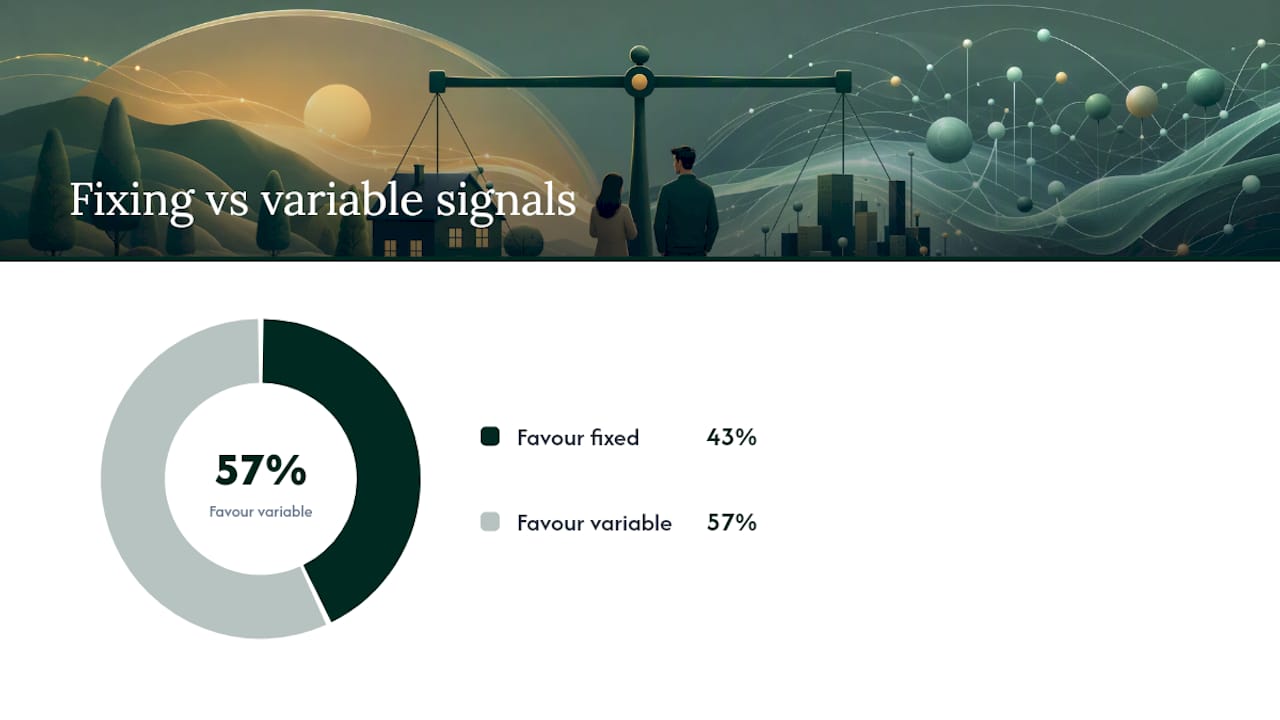
How Sydney Property Buyers can help when you are fixing or refinancing
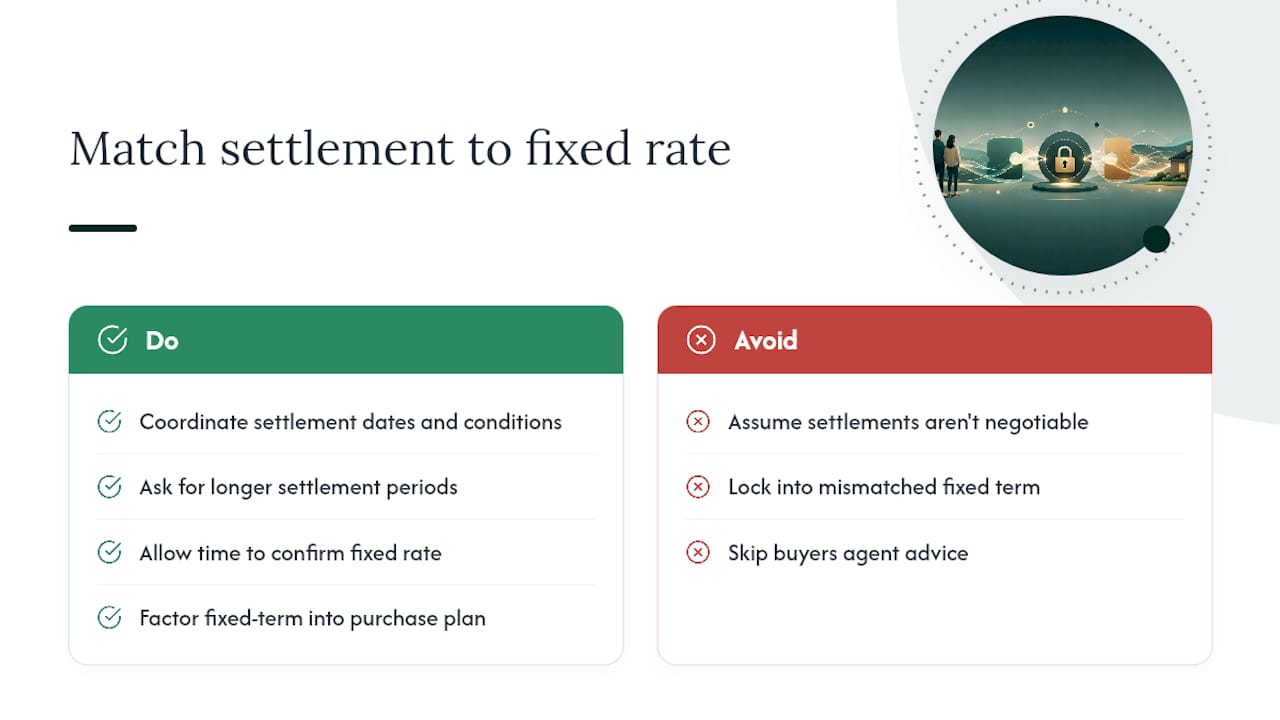
The loan structure you choose at purchase has real consequences for how your settlement is managed. A fixed-rate home loan with a short conditional period, for example, can create pressure if the settlement date shifts. Sydney Property Buyers works with buyers to coordinate settlement dates and finance conditional periods so that your loan structure and your purchase timeline actually match.
Local buyers agent expertise matters here. When negotiating terms on a property, Sydney Property Buyers can request settlement periods that give you enough time to confirm your fixed rate, complete valuations, and avoid being forced into a rate lock you did not plan for. More than 30% of purchases secured by Sydney Property Buyers are off-market, which means settlement terms are often more negotiable than on a publicly listed property.
Pro Tip: If you are a first-home buyer in Sydney considering a fixed rate, ask your buyers agent to factor the fixed term length into your purchase strategy. Buying a property you plan to renovate and sell within two years while locked into a five-year fixed rate is a mismatch that a good buyers agent will flag before you sign.
When fixing is worth it: a perspective
Fixing is a tool for a specific financial period, not a long-term identity. For borrowers who need short-term repayment certainty — a growing family, a new investor managing cashflow on a first rental, or someone buying near the top of a rate cycle — locking in for one to three years can be genuinely protective. The mistake most borrowers make is fixing for too long or fixing the entire loan when a split structure would have given them most of the certainty with far fewer restrictions. For many buyers, a split loan is the more honest answer: it acknowledges that you want some certainty without pretending you will never need flexibility. The decision should always start with your plans for the property, not with what rates are doing today.
Sydney Property Buyers: purchase strategy and settlement coordination for Sydney buyers
Choosing a loan structure is only one part of buying well in Sydney. The sharper advantage comes from having someone in your corner who can negotiate settlement terms, access properties before they hit the market, and coordinate the moving parts so your finance and your purchase actually align.

Sydney Property Buyers offers full-service buyer representation across the Inner West, Eastern Suburbs, Lower North Shore, and Eastern Beaches, covering everything from property search and independent appraisal through to negotiation, auction bidding, and settlement management. The agency has secured 100+ properties for clients with an average saving of approximately 9% on purchase price. If you are working through your finance options and want a buyers agent who understands how loan structure affects purchase strategy, explore the full range of services or call 1800 676 177 to arrange a consultation.
Sources
- Home loans 101: fixed rate home loans | Aussie
- What to do when your fixed-rate term ends | Westpac
- Choosing a home loan | Moneysmart
- Understanding fixed-rate home loans | IMB Bank
- Fixed vs variable home loan: what’s best? | NAB
- Fixed-rate vs variable-rate home loan: what’s the best option? | Canstar
- The pros and cons of fixed versus variable rates | Macquarie
- Fixed rate home loans explained | Comparethemarket
This article provides general information only and is not a substitute for professional financial or mortgage advice. Confirm current rates, product features, and eligibility with your lender or a licensed mortgage broker.
Recommended
- Fixed fee vs percentage buyers agent: Sydney guide
- What does a retainer fee mean for a buyer’s agent?
- What is a floor plan rating? A guide for buyers and investors
- Why clearance rates matter for Sydney property buyers