Underquoting means advertising a property below a genuine, evidence-based price estimate to lure more buyers through the door, and it is illegal in NSW. From 2026, penalties rise to $110,000 or three times the agent’s commission, whichever is greater, price guides become mandatory on every listing. NSW Fair Trading gains stronger disclosure and verification powers under the Property and Stock Agents Amendment (Underquoting and Other Agent Conduct) Act 2026.
If you’re buying in NSW right now, act on this straight away:
- Save every version of the listing, including the original price guide, before it changes.
- Request the agent’s Statement of Information and check it cites genuine comparable sales.
- Report suspicious pricing to NSW Fair Trading with dated evidence attached.
Buying outside NSW? Skip to the jurisdiction section below for where to look in your own state.
Key Takeaways
Underquoting is now punishable by fines of up to $110,000 in NSW, and buyers who keep dated evidence and demand a Statement of Information are far better placed to spot and report it.
| Point | Details |
|---|---|
| Know the new penalty scale | Underquoting now carries fines up to $110,000 or three times commission, whichever is greater. |
| Price guides are mandatory | Every NSW listing must now show a price or price guide, backed by a Statement of Information. |
| Save evidence as you go | Dated screenshots, correspondence and auction bid records make any complaint far stronger. |
| Report through Fair Trading | Lodge complaints with supporting documents attached for a faster, more credible investigation. |
| Independent verification pays off | A buyers agent or independent check against comparable sales catches mismatches before you bid. |
Table of Contents
- What does underquoting look like in practice?
- What changed in NSW underquoting law in 2026?
- What penalties and enforcement powers now apply?
- How do you report suspected underquoting in NSW?
- How is underquoting handled outside NSW?
- Can a buyers agent protect you from underquoting?
- What has changed for buyers dealing with price guides?
- Where to read more on NSW underquoting rules
- Frequently asked questions about underquoting NSW
- Sources
What does underquoting look like in practice?
Underquoting fails a simple test: is the advertised figure a reasonable estimate based on comparable sales, or a number chosen purely to generate traffic? NSW Fair Trading guidance requires agents to base every estimate on recent comparable sales, location, property features and current market conditions, and it explicitly bans vague phrases like “offers over” that dodge a real figure.
Three patterns show up again and again. An agent lists a home at $1.2 million after already knocking back a written offer of $1.35 million. A listing says “offers over $900,000” with no supporting comparables, designed to sound accessible while masking a much higher expected sale price. Or a price guide sits well under recent sales on the same street, purely to inflate auction attendance and bidding tension.
Building a case means gathering the paper trail:
- Screenshots of the listing with visible dates.
- The Statement of Information, if one was provided.
- Written correspondence with the agent about price expectations.
- Auction bidding records, including the highest unsuccessful bid.
Pro Tip: Archived snapshots from web caching tools and timestamped email confirmations carry more weight with investigators than a plain screenshot, because they prove when the listing actually said what you claim it said.
What changed in NSW underquoting law in 2026?
The Property and Stock Agents Amendment (Underquoting and Other Agent Conduct) Act 2026 rewrote the rules governing how agents set and advertise price expectations. Here’s the practical timeline of what it does:
- Maximum penalties jump from $22,000 to 1,000 penalty units, currently $110,000, or three times the agent’s commission.
- Dummy bidding penalties double to match the new maximum penalty.
- Every advertisement must now carry a price or price guide, not just an internal figure the agent quotes verbally.
- Agents must publish a Statement of Information showing the comparable sales used to reach their estimate.
- Advertising below a previously rejected written offer or the highest unsuccessful auction bid is expressly prohibited, under analysis from Swaab.
The reforms are designed to remove the financial incentive to mislead buyers, turning misconduct that once cost little into a penalty serious enough to change agent behaviour.
That framing comes straight from the NSW Government’s own announcement of the reforms. For the full legal text, read the Amendment Act commentary directly, and check NSW Fair Trading’s site periodically, since practitioner guidance tends to get updated as the new rules bed in.
What penalties and enforcement powers now apply?
The headline figure is the maximum penalty of 1,000 penalty units, or three times the agent’s commission on the sale, whichever amount is larger. Dummy bidding, where a vendor or their associate places fake bids to push up the sale price, now carries the same increased penalty. NSW Fair Trading enforces these rules and has been granted expanded powers to demand public disclosure of misconduct and to order independent verification of a price estimate where something looks off.
Enforcement generally follows a pattern:
- Fair Trading receives a complaint and reviews the supporting evidence.
- Investigators may request the agent’s file, including comparable sales used for the Statement of Information.
- Penalty infringement notices or formal prosecution follow where the evidence supports a breach.
- In serious or repeat cases, Fair Trading can require public disclosure of the agent’s conduct.
Pro Tip: A complaint backed by contemporaneous evidence, meaning records created at the time rather than reconstructed afterwards, moves through investigation faster and carries more weight than a complaint based on memory alone.
How do you report suspected underquoting in NSW?
Reporting is straightforward if you’ve kept the right paperwork. Here’s the process:
- Gather your evidence: listing screenshots with dates, the Statement of Information, any written correspondence, and auction bid records.
- Lodge your complaint through NSW Fair Trading’s official complaint channel, attaching all supporting documents.
- Expect an acknowledgement within a reasonable timeframe, followed by an investigation if the evidence warrants one.
- Cooperate with any follow-up requests from investigators, who may ask for additional detail or timeline clarification.
What regulators actually want to see:
- Dated screenshots of the original and any revised listing.
- The Statement of Information, where the agent provided one.
- Email or text correspondence discussing price.
- Records of the highest unsuccessful auction bid.
A typical case might run like this: a buyer lodges a complaint in week one with full documentation, Fair Trading opens a file within a fortnight, and depending on complexity, an outcome (infringement notice, further investigation, or no breach found) follows within a few months. Read the NSW Fair Trading price estimation guidance before submitting, so your complaint is framed around the actual legal test.
How is underquoting handled outside NSW?
Every Australian state and territory regulates quoting and advertising through its own consumer affairs department or real estate licensing body, and the underlying principle is consistent: an estimate must be genuine, not a marketing lure. The names and specific penalty amounts differ, but the complaint pathway usually starts in the same place, a state-level consumer protection or fair trading office.
If you’re buying outside NSW, search for your state’s equivalent body rather than assuming NSW rules apply. Useful search terms include:
- “[your state] real estate commission complaint”
- “[your state] department of fair trading underquoting”
- “[your state] consumer protection real estate advertising”
Comparator bodies tend to fall into similar categories: a state real estate licensing authority that handles agent conduct, a consumer protection agency that takes general advertising complaints, and in some cases an ombudsman service for unresolved disputes. Expect a similar evidence standard wherever you are: dated listing records, written correspondence, and bid history all strengthen a complaint regardless of jurisdiction.
Pro Tip: Wherever you’re buying, cross-check the advertised price against independent sold-price data before you bid, and don’t be afraid to ask directly for a Statement of Information or equivalent price history. A legitimate agent will have no problem providing one.
Can a buyers agent protect you from underquoting?
A buyers agent’s entire job is representing your interests, not the vendor’s, which changes how a misleading price guide gets handled. Independent appraisal means someone is checking the agent’s Statement of Information against genuine comparable sales before you commit time or emotional energy to a campaign. Off-market sourcing sidesteps quoting games entirely, since roughly a third of purchases secured through Sydney Property Buyers happen before a property is ever publicly advertised. Due diligence and auction bidding strategy mean someone experienced is reading the room on the day, not guessing at what the published guide actually means.
Picture a listing quoted at $1.1 million on a street where nothing comparable has sold under $1.3 million in a year. An engaged buyers agent flags the mismatch immediately, checks recent comparable sales independently, and either walks the client away or adjusts their bidding ceiling before auction day, rather than after a disappointing result.
Before hiring a buyers agent, ask direct questions: Are they licensed with NSW Fair Trading? How do they independently verify a price estimate rather than accepting the agent’s word? Have they handled contested auctions where the quoted range clearly understated demand?
- Independent appraisal against genuine comparable sales.
- Access to off-market and pre-market stock, avoiding quoted guides altogether.
- Due diligence on the vendor’s price and negotiation history.
- Auction bidding strategy built around real market data, not the published guide.
Sydney Property Buyers is directed by Kristan Johnson, a licensed real estate agent and 2024 Outstanding Buyers Agent of the Year at the Inner West Local Business Awards, with a specific focus on negotiation and contested auction bidding across the Inner West, Eastern Suburbs, Lower North Shore and Eastern Beaches.
What has changed for buyers dealing with price guides?
I’ve seen enough contested auctions to know a suspiciously low price guide is rarely an accident. It’s a deliberate lever, and the buyers who get burnt are the ones who take the advertised figure at face value instead of checking it against what similar homes have actually sold for.
If you take one thing from this: never bid before you’ve seen a Statement of Information and checked it against independent comparable sales yourself.
Where to read more on NSW underquoting rules
- NSW Government’s announcement on the 2026 penalty increases and enforcement powers.
- NSW Fair Trading’s price estimation guidance for the agent obligations behind every estimate.
- Swaab’s legal analysis of the Amendment Act’s procedural detail.
- The Guardian’s coverage of the reforms and public reaction.
Frequently asked questions about underquoting NSW
Is underquoting illegal in NSW?
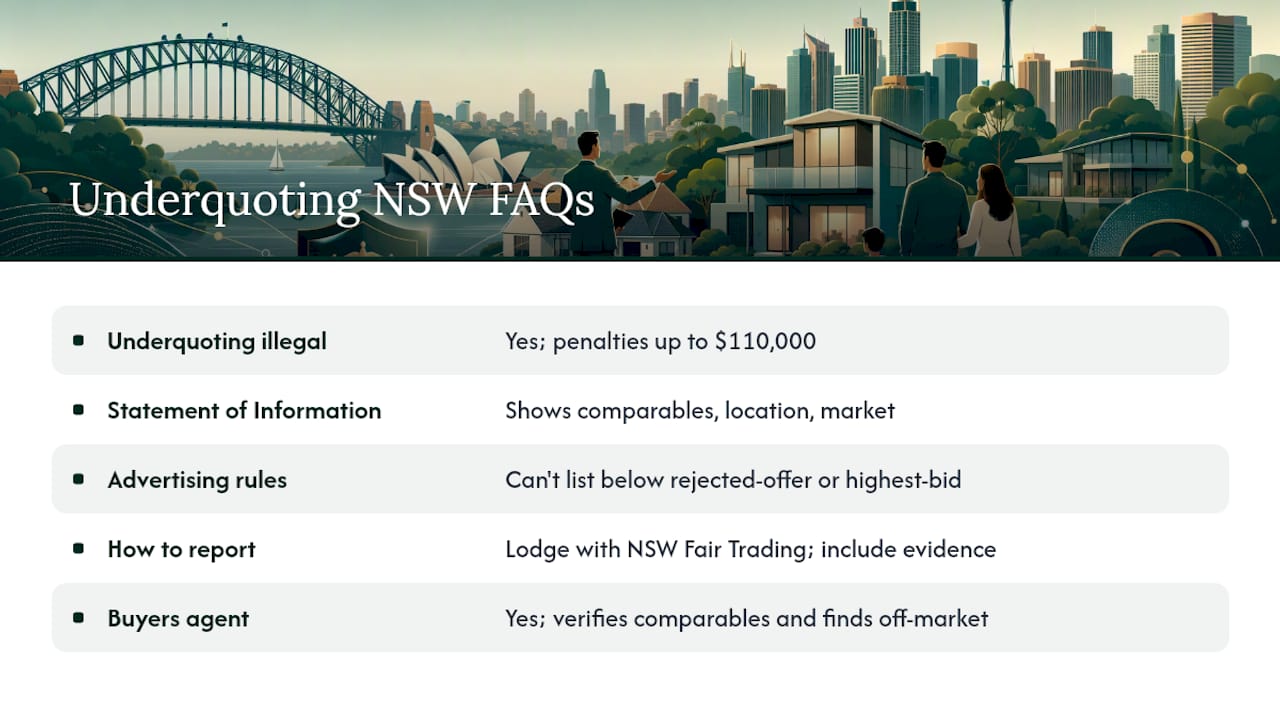
Yes. Agents must base price estimates on genuine comparable sales, and advertising below that reasonable estimate breaches the Property and Stock Agents Act, with penalties now reaching $110,000.
What is a Statement of Information?
It’s a document agents must provide setting out the comparable sales, location factors and market conditions behind their price estimate, giving buyers a way to check the figure against real evidence.
Can an agent advertise below a rejected offer?
No. The 2026 reforms expressly prohibit advertising a property below a previously rejected written offer or the highest unsuccessful auction bid.
How do I report underquoting in NSW?
Lodge a complaint with NSW Fair Trading, attaching dated listing screenshots, the Statement of Information if provided, and any relevant correspondence or auction bid records.
Does a buyers agent help against underquoting?
Yes. A buyers agent independently verifies price estimates against comparable sales and can access off-market properties that avoid the quoting problem altogether.
This article is general information, not a substitute for advice from a qualified lawyer. Consult a qualified legal professional about your own circumstances before acting on anything here.
Sources
- Hammer comes down on underquoters with tough new laws | NSW Government
- Price estimation and underquoting when selling a property | NSW Government
- Property and Stock Agents Amendment (Underquoting… | Swaab
- NSW to crack down on property underquoting, forcing sellers to publish price guides on all listings | The Guardian
Recommended
- Section 32 explained: what Sydney buyers need to know
- Why a licensed buyer’s agent matters in Sydney
- How to make an offer on a Sydney property
- Why missed properties frustrate buyers: the 2026 Sydney guide