Yes. Some Sydney school catchments add six figures, and in the sharpest cases, close to seven figures, to a property’s price. Cotality’s analysis found families paying up to $1.3 million more for homes inside sought-after zones. Whether that premium is worth paying depends on how long you’ll stay and how much certainty you need over where your children go to school. Long-term family buyers often find it justified; short-term owners rarely do.
TL;DR:
- Catchment premiums can reach up to $1.3 million, especially in North Shore and Randwick areas, but their value depends on long-term family needs.
- Boundaries are subject to change, and non-local enrolments may be accepted if schools have spare capacity, making verification essential.
- The typical property premium ranges from 10 to 25 percent of the value but often reflects local amenities and transport, not just school reputation.
- Long-term buyers might save money overall compared to private school fees, but factors like boundary redraws and interest rates pose risks.
- Expert local buyer’s agents provide crucial insight for competitive catchment purchases, especially for out-of-town families and auction scenarios.
Table of Contents
- How big is the Sydney school catchment premium?
- What is a school catchment and how does it actually work?
- Is paying a catchment premium better value than private school fees?
- How do you verify a property’s actual catchment before you buy?
- What’s the best way to buy inside a competitive catchment?
- Why local buyer’s agent expertise matters for catchment purchases
- Are catchment premiums here to stay?
- Ready to secure a home in your target catchment?
- Sources
How big is the Sydney school catchment premium?
The North Shore shows the widest gap in the country. Cotality’s research points to the combined Killara, Willoughby and Lindfield catchments as recording the largest premium nationally, with the difference running well into six figures and, in the most extreme comparison, reaching that $1.3 million ceiling.
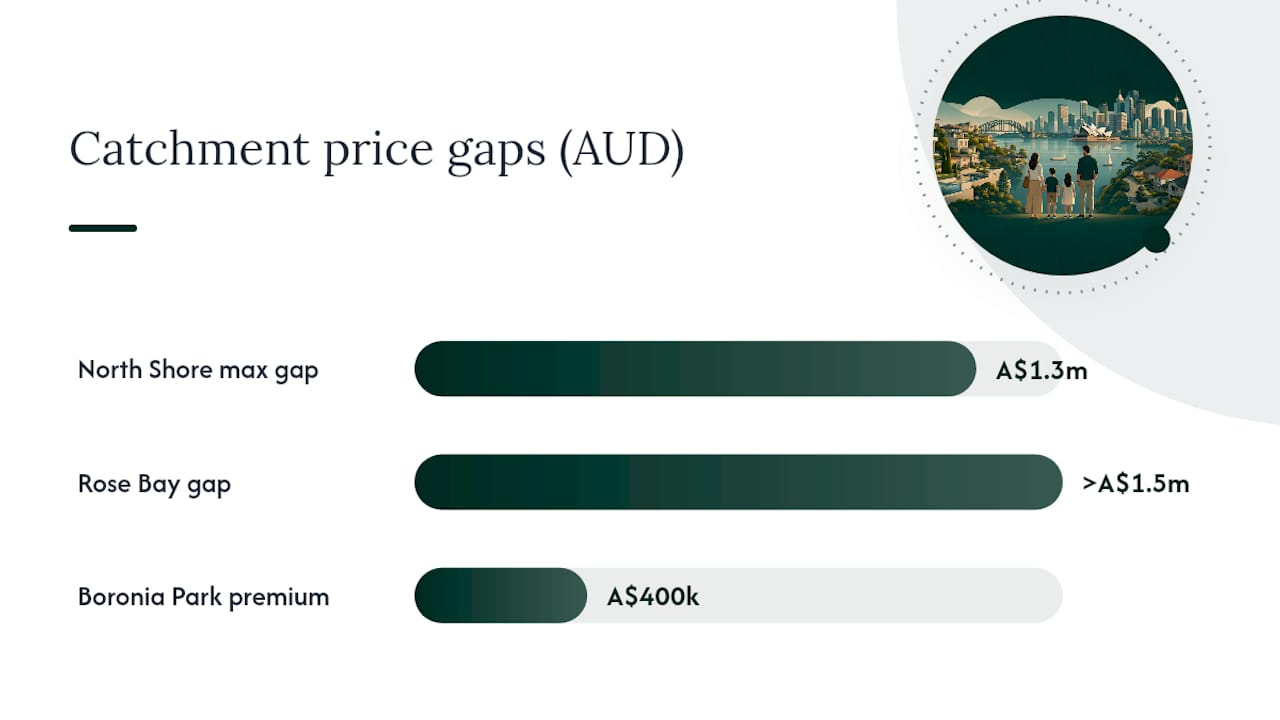
Rose Bay and Randwick tell a similarly stark story. The Sydney Morning Herald reported a median house value of roughly A$4,339,810 inside the catchment against A$2,783,174 outside it, a gap of more than A$1.5 million between streets that might sit metres apart.
These aren’t abstract statistics. One family profiled by the SMH paid an extra A$400,000 to secure an address feeding into Boronia Park Public School, a decision made purely to lock in a place rather than gamble on non-local enrolment.
The scale of these premiums varies with more than just the school’s reputation; for a detailed comparison of family-friendly areas and school-friendly suburbs, see the best areas for families with kids.
- Transport links and proximity to the CBD or a train line inflate demand independently of school quality.
- Streets with larger blocks or renovation potential attract buyers regardless of catchment, which can distort like-for-like comparisons.
- Local income levels and existing amenity, parks, cafés, walkability, tend to move in step with catchment desirability rather than being caused by it.
Typical premiums across comparable Sydney catchments sit in the 10 to 25 percent range, according to Australian Property Review’s market analysis, though outlier suburbs like Rose Bay push well beyond that band. A useful way to think about it: the school is rarely the sole driver. As Cotality’s own analysis notes, premiums usually reflect a bundle of local factors, reputation, income, transport, and green space, that cluster around a popular school rather than the school itself.
What is a school catchment and how does it actually work?
A “catchment” in New South Wales is properly called a local enrolment area, or LEA. Families living inside one are entitled to a place at that government school, which is the enrolment guarantee that drives so much of the buying behaviour discussed above. It’s a genuine guarantee, not a preference, and that distinction is exactly why buyers pay for it.

Boundaries aren’t fixed forever. The NSW Department of Education confirms that many schools have local enrolment areas, but where a school has spare capacity it may also accept non-local enrolments, subject to departmental policy at the time.
A few practical points worth holding onto:
- Boundary maps are published through the School Finder tool and the Data.NSW school intake zones dataset, which is the authoritative source, not a real estate listing.
- Data.NSW explicitly notes boundaries are updated periodically, so a map you checked last year may no longer be current.
- Your designated local school isn’t always the closest one geographically. Odd-shaped catchments split by main roads or waterways are common across Sydney.
- Selective schools and private schools operate on entirely different admission criteria, entrance tests or enrolment applications, not residential boundaries, so a catchment premium has no bearing on getting into those systems.
Is paying a catchment premium better value than private school fees?
Run the numbers before you run on instinct. Take the purchase premium, say A$400,000 on the Boronia Park example, and add the extra mortgage interest you’ll pay on that amount over your expected years in the home. Compare that total against the cumulative fees you’d otherwise pay for a private alternative across the same schooling years. For a family staying put for a decade or more, the catchment premium frequently comes out cheaper, and you keep the equity.
But the arithmetic only holds if a few assumptions survive:
- Boundary risk: local enrolment areas can be redrawn, and a redraw can strip the very guarantee you paid for.
- Growth risk: Cotality found that six of nine catchment regions studied recorded lower 15-year capital growth than neighbouring, cheaper markets, despite carrying higher current medians.
- Rate risk: a premium funded mostly by debt becomes far more expensive the moment interest rates move against you.
Pro Tip: *Model your break-even at a higher interest rate than today’s, not the current one.
As a rule of thumb: catchment premiums tend to make financial sense for long-term holds where they replace years of private fees. They tend to be a poor trade-off for buyers likely to sell within three to five years, where transaction costs and growth underperformance can erase the benefit entirely.
How do you verify a property’s actual catchment before you buy?
Don’t rely on an agent’s word or a listing description. Verify it yourself, in this order:
- Check the official sources. Search the address through School Finder and cross-reference the Data.NSW intake zones dataset, then screenshot the result with a date stamp for your records.
- Call the school directly. Ask the principal’s office for written confirmation of local enrolment criteria and current capacity, since a catchment with no spare places behaves differently to one comfortably under-enrolled.
- Pull comparable sales. Find recent sales on both sides of the boundary line and keep them in your negotiation file. This is your evidence for justifying, or resisting, a premium at the negotiation table.
- Document everything. Add your catchment confirmation, the department’s screenshot, and your comparables to the purchase file, and flag the boundary-change risk to your solicitor.
Pro Tip: The Department of Education’s own disclaimer states it cannot accept responsibility if catchment data is relied upon for decisions such as a property purchase. That single sentence is the strongest argument for verifying independently rather than trusting a portal snapshot from six months ago.
For a broader look at researching an area before you commit, our guide on how to research Sydney suburbs covers the wider due-diligence process beyond schooling.
What’s the best way to buy inside a competitive catchment?
Searching within a fixed boundary shrinks your options, so widen your search method even as you narrow your geography. Monitor both on-market listings and off-market opportunities, and set alerts specifically for streets sitting near the boundary edge, where price tension is highest and sellers sometimes underestimate demand.
At the negotiation table, arm yourself with in-catchment versus out-of-catchment comparables and set a firm price cap that already includes your acceptable premium, so you’re not recalculating under pressure. Non-price levers, flexible settlement, a longer or shorter timeline for the vendor, can sometimes close a gap that cash alone won’t.
At auction, the margin for error disappears fast:
- Get finance pre-approved before you attend, not during the week of sale.
- Authorise a trusted bidder or a buyer’s agent if you can’t attend in person or know you’ll bid emotionally.
- Watch for vendor escalation clauses, which some agents use deliberately in catchment-driven auctions to draw out extra bids.
Why local buyer’s agent expertise matters for catchment purchases
Buying inside a specific boundary under time pressure, especially before a school-year cut-off, rewards local knowledge over general market awareness. Sydney Property Buyers is directed by Kristan Johnson, a licensed real estate agent and 2024 Outstanding Buyers Agent of the Year at the Inner West Local Business Awards, with a track record built on over 100 properties secured for clients and an average purchase timeline of 54 days from engagement to settlement.
That combination of off-market access, independent appraisal, and disciplined negotiation is most valuable to interstate buyers, anyone bidding at auction for the first time, or families racing an enrolment deadline.
Are catchment premiums here to stay?
Premiums bundle transport, amenity, income and reputation as much as the school itself, which is why they can persist for years. But they’re not immune to policy change, demographic shift, or a new school opening nearby. Treat catchment as one input among several, never the whole decision.
— Kristan
Ready to secure a home in your target catchment?
Sydney Property Buyers is the alternative to going it alone against other catchment-driven buyers, most of whom are also stretching their budgets under the same enrolment pressure you are. Full Service covers strategy, search, independent appraisal, due diligence, negotiation and auction bidding from start to settlement, while Negotiation Only suits buyers who’ve already found the right address and need sharp representation to close the deal. The agency works across the Inner West, Eastern Suburbs, Lower North Shore and Eastern Beaches, the exact pockets of Sydney where catchment premiums run highest.
If you’re weighing up a catchment purchase against private school fees, or you’re an interstate buyer trying to move fast before a term cut-off, read more about the benefits of exclusive buyers agent representation or call 1800 676 177 to talk through your specific catchment and timeline.
Sources
- Families pay six-figure premiums to secure homes in top public school catchment zones
- School intake zones (catchment areas) for NSW government schools | Data.NSW
- Enrolment
- The property premium Sydney families are paying for the right state school
- School Zone Property Premium | Australian Property Review
Recommended
- Sydney inner west suburb comparison: 2026 guide
- Buyers agent fees in Sydney: what you’ll actually pay
- Sydney median house price explained: what it means for buyers