Pre-approval is a conditional estimate of how much a lender might let you borrow; final approval is the lender’s verified, unconditional commitment to fund a specific property. One is a planning tool. The other is the green light that gets you to settlement. Confusing the two is what leaves buyers exposed after they have already signed a contract.
TL;DR:
- Pre-approval is provisional and lasts three to six months; final approval requires verified income, property valuation, and title checks.
- A valuation discrepancy can cause lenders to reduce or deny the loan even after pre-approval, making timely notification critical.
- Submitting full documentation and ordering a valuation promptly after offer acceptance minimizes settlement delays and risk of loan rejection.
- Repeating credit inquiries during the process can harm your borrowing capacity; avoid shopping for multiple pre-approvals simultaneously.
- Updating pre-approval before bidding at auction or nearing expiry helps maintain a strong position and reduces the risk of losing financing at final approval.
Table of Contents
- What pre-approval vs approval actually covers at the conditional stage
- What full, unconditional approval actually involves
- Step by step: turning pre-approval into final approval
- Why a loan can still be denied after pre-approval
- A checklist to protect your final approval
- Managing approval risk: a buyer’s agent’s perspective
- Getting the timing right before you make an offer
- The gap most buyers underestimate
- Sources
What pre-approval vs approval actually covers at the conditional stage
A pre-approval, sometimes called conditional approval, tells you what a lender is provisionally willing to lend based on the financial information you have declared. It is a working figure, not a cheque. NSW Government guidance is blunt about this: it usually lasts three to six months and is not a guarantee of finance, because the lender still has to verify your paperwork and value the actual property you end up buying.
There are two flavours worth knowing before you rely on either one. A system-generated pre-approval is fast and automated, often issued within minutes based on what you type into an online form. A fully assessed pre-approval takes longer because a credit assessor has actually checked your documents, and this makes it a far more reliable indicator of what will happen later, according to Aussie.
At the pre-approval stage, a lender will typically look at:
- Your credit file and repayment history
- Declared income, whether payslips or self-employed figures
- Existing debts, credit cards, and other loans
- Basic identity verification
What it will not usually cover is a valuation of the property, a title search, or verification of every document behind your income figures. That gap matters, because NAB confirms that conditional approval remains subject to the property being acceptable to the lender and the valuation supporting the loan amount. NAB’s own conditional approval certificate carries a limited expiry, a detail buyers routinely overlook until it lapses mid house-hunt.
What full, unconditional approval actually involves
Full approval, often called unconditional approval, is where the lender stops estimating and starts verifying. This is the step that removes the conditions attached to your earlier pre-approval and turns a number on a page into money the bank will actually release at settlement.
Once you have a signed contract, the lender moves through a second, more thorough round of checks:
- Full verification of income and assets, not just declared figures
- A formal valuation of the specific property you are buying
- Confirmation of loan-to-value ratio against the valuation
- Title checks and, where required, building or pest conditions
- Confirmation of building insurance ahead of settlement
Bankwest’s outline of the approval process makes clear that final approval, and the removal of these conditions, is required before funds are committed at settlement. “Unconditional” simply means every condition on the loan has been satisfied, not that the lender skipped steps. If a valuation comes back lower than the contract price, the lender may reduce how much it will lend, which is why buyers need to notify their lender the moment an offer is accepted rather than waiting until days before settlement. Understanding what unconditional exchange means for your specific contract terms is worth doing before you sign anything, not after.
Step by step: turning pre-approval into final approval
The gap between conditional and unconditional approval is really a sequence of handoffs, and each one has a natural window.
- Offer accepted or auction won. Notify your lender or broker the same day, since the clock on valuation and processing starts here.
- Submit full documentation. Payslips, bank statements, and identification go in properly this time, not the abbreviated version used for pre-approval.
- Lender orders a valuation. This typically takes a few business days and is the step most likely to change the numbers.
- Final credit decision. The lender confirms the loan-to-value ratio holds and issues unconditional approval.
- Settlement is booked. Funds are prepared for release on the agreed date.
If your pre-approval is close to expiry when you find a property, ask your lender for a refresh rather than assuming it will simply roll over. Extensions are usually possible if you request them before the certificate lapses, Forbes Advisor notes, but a lapsed pre-approval forces you back to square one on documentation.
Pro Tip: Book your valuation request the same day your offer is accepted. Valuations are one of the few steps in this chain you cannot rush later, and a delayed valuation is a common reason settlement dates get pushed.
Why a loan can still be denied after pre-approval
Pre-approval feels like a green light, which is exactly why its limits catch people out. A loan can still be declined at the final stage, and it usually comes down to one of a handful of causes.
- Valuation shortfall. If the lender’s valuation lands below the agreed purchase price, they may cut the loan-to-value ratio or ask for a bigger deposit, a pattern Bankwest flags as one of the more frequent reasons a conditional approval gets tightened.
- Income or employment changes. A new job, reduced hours, or a switch to casual work between pre-approval and settlement changes the picture the lender relied on.
- New debts. A car loan or a second credit card taken out mid-purchase can quietly erode borrowing capacity.
- Incomplete or inconsistent documents. Gaps between declared figures at pre-approval and verified figures at final assessment slow everything down.
- Credit events. Missed payments or new defaults during the process.
Multiple loan applications in a short window compound the risk. NSW Government guidance warns that repeated credit enquiries can hurt your credit score and how lenders view your application, since each enquiry signals to a lender that you might be juggling more debt than declared. If you are pre-approved with one lender, avoid shopping around for a second or third pre-approval unless you genuinely need to compare terms.
A checklist to protect your final approval
Most of what determines whether pre-approval converts cleanly into final approval happens in the weeks between offer and settlement, not at application stage.
Start with the paperwork. Lenders typically want recent payslips, several months of bank statements, tax records or PAYG summaries, photo identification, and proof of your deposit source, a list Aussie confirms is fairly standard across the market. A detailed mortgage document checklist is worth working through before you even make an offer, so nothing is missing when the lender asks.
- Gather payslips, bank statements, tax records, and ID before you need them
- Avoid opening new credit accounts or increasing existing limits
- Keep your employment situation stable through the purchase period
- Tell your lender immediately about any change in income or circumstances
- Ask for a fully assessed pre-approval if you are close to bidding at auction
- Refresh an expired pre-approval with updated documents rather than assuming it still stands
Pro Tip: If you are planning to bid at auction, a fully assessed pre-approval is worth the extra wait. It signals to the agent and vendor that your finance is far less likely to fall over, which matters when there is no cooling-off period to fall back on. Working through how to make an offer on a Sydney property alongside your finance timeline avoids the common trap of falling for a property before your paperwork is ready.
Managing approval risk: a buyer’s agent’s perspective
The riskiest gap in any purchase is the one between an accepted offer and unconditional approval, and it is where a buyer’s agent earns its keep. Sydney Property Buyers coordinates timing between your broker, the vendor’s solicitor, and the valuation process, so documentation lands with the lender before delays creep in. That coordination matters most at auction, where there is no cooling-off period to absorb a finance hiccup.
None of that replaces your broker’s advice on lending policy specific to your file. Always confirm lender-specific conditions and timing directly with your broker before making a binding decision.
Getting the timing right before you make an offer
Get your pre-approval sorted before you start seriously inspecting property, not after you have found something you love. A fully assessed pre-approval, refreshed if it is close to its expiry, gives you a genuine negotiating position rather than a hopeful one. Timing your engagement with a buyer’s agent around this same window means you are ready to move the moment the right property surfaces, rather than scrambling to catch up on documentation while a vendor loses patience.
If you are searching in the Inner West, Eastern Suburbs, Lower North Shore, or Eastern Beaches and want a buyer’s agent to manage the handoff between your broker and the purchase itself, Sydney Property Buyers’ full purchase and negotiation-only services are built around exactly this problem: reducing the number of things that can go wrong between an accepted offer and a settled property. Call 1800 676 177 or email hello@sydneypropertybuyers.com.au to discuss your situation.
The gap most buyers underestimate
Most buyers treat pre-approval as the hard part and final approval as a formality. It is the opposite. Getting pre-approved is largely about your own numbers; getting to unconditional approval depends on a property valuation you cannot control and a documentation trail that has to hold up under scrutiny it did not face the first time round.
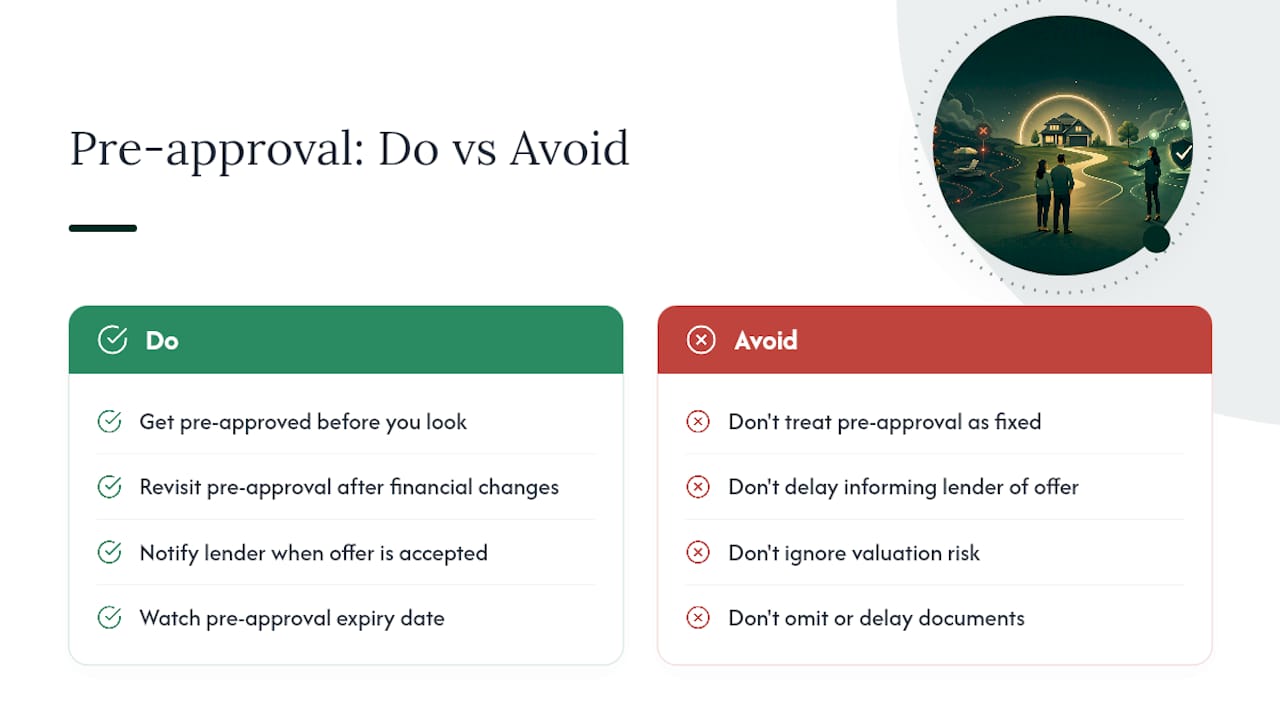
The conventional advice, “get pre-approved before you look,” is correct but incomplete. It should come with a second instruction: treat that pre-approval as a moving target, not a fixed number, and revisit it the moment your income, debts, or the property itself changes. Buyers who lose finance at the final hurdle rarely do so because they lied about their income. They do so because nobody flagged a new car loan, a valuation that came in soft, or a pre-approval that quietly expired three weeks before they needed it.
If there is one priority worth acting on immediately, it is this: treat the property valuation as the single biggest variable in the entire process, and get ahead of it by notifying your lender the day your offer is accepted, not the week before settlement.
— Kristan
This article is general information, not a substitute for advice from a qualified financial advisor. Consult a qualified financial professional about your own circumstances before acting on anything here.
Sources
- Get conditional home loan approval | NSW Government
- Home loan pre-approval | Conditional approval – NAB
- What is home loan pre-approval? | Aussie
Recommended
- Why engagement timing matters with a buyer’s agent
- Why a buyer’s agent reviews contract: Sydney guide
- Common buyers agent selection mistakes Sydney buyers make
- Buyers agent search timeline expectations: Sydney guide