Most first home buyers in NSW now pay no transfer duty at all. The First Home Buyers Assistance Scheme (FHBAS) gives a full exemption on homes valued up to $800,000 and a concessional rate on properties between $800,000 and $1 million. Revenue NSW administers the scheme, so before you exchange contracts, run your purchase price through its official calculator and check the documents you will need to lodge.
TL;DR:
- The full exemption applies to homes valued up to $800,000, saving buyers up to $30,735 on transfer duty, with a sliding concession up to $1 million.
- Eligibility depends on residency, never owning property before, and moving into the home within 12 months and living there for at least a year, including considerations for joint buyers.
- Thresholds are subject to future indexation, so always verify current figures with Revenue NSW before making offers or signing contracts.
- Using outdated or incorrect calculator inputs, such as property type or residency status, can lead to misestimated duty obligations.
- Land purchases for building reserved lower thresholds, with full exemption only up to $350,000 and concessional rates up to $450,000.
Table of Contents
- What the First Home Buyers Assistance Scheme now provides
- Who qualifies: eligibility rules and residence requirements
- Thresholds and worked examples: likely duty at common purchase prices
- How transfer duty is calculated and how to use a calculator properly
- Timing, paperwork and how to apply for the FHBAS exemption or concession
- Common scenarios first home buyers ask about
- A buyers’ agent’s view on stamp duty savings
- Official links and calculators to check
- Sources
What the First Home Buyers Assistance Scheme now provides
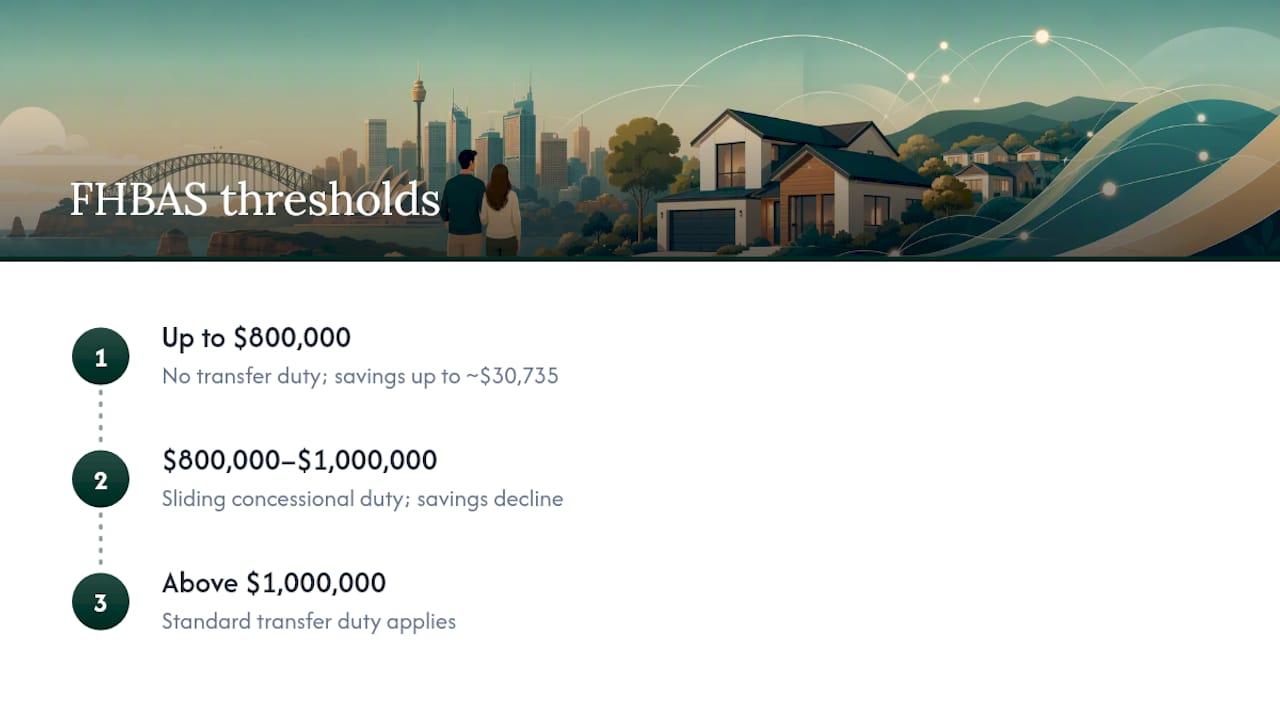
From 1 July, the NSW Government lifted the full exemption threshold to $800,000 and the concessional threshold to $1 million, a substantial jump from the previous caps. Buy an existing or new home at or under $800,000 and you pay no transfer duty whatsoever. Buy between $800,000 and $1 million and you pay a reduced, sliding rate rather than the full standard duty.
Revenue NSW sets and administers these thresholds, and it is the only body whose figures you should treat as final. Government modelling behind the change estimated that roughly 8,600 additional buyers in the $650,000 to $800,000 bracket would move from paying reduced duty to paying nothing, while around 4,400 buyers in the $800,000 to $1 million range would shift onto the concessional rate instead of the full standard charge. That is not a marginal tweak. It is a redrawing of who counts as priced out of the exemption altogether.
Here is how the numbers land at a glance:
| Threshold band | Duty outcome | Approximate saving |
|---|---|---|
| Up to $800,000 | Full exemption, no duty payable | Up to $30,735 |
| $800,000 to $1 million | Concessional (reduced) rate applies | Sliding, reduces as price rises |
| Above $1 million | Standard transfer duty applies | None |
One detail catches people out every year: these thresholds are not fixed forever. They can be indexed and adjusted in future NSW budgets, so a figure that applies this financial year is not guaranteed to apply the next. Always confirm the current threshold on the First Home Buyers Assistance Scheme page before you rely on it in a contract negotiation.
Who qualifies: eligibility rules and residence requirements
Revenue NSW applies a specific, checkable set of rules, not a general “first time buying a house” test. You need to satisfy every one of the following:
- You (and your spouse or co‑purchaser, if applicable) must be at least 18 years old, unless a hardship exemption applies.
- You or your co‑purchaser must never have owned residential property anywhere in Australia, nor previously received the First Home Owner Grant.
- You must be an Australian citizen or permanent resident at the time of purchase, or purchasing with someone who is (foreign purchasers face different surcharge rules).
- You must move into the property within 12 months of settlement and live there continuously for at least 12 months.
- If you purchase through a company or certain trust structures, the concession generally does not apply. Discretionary and unit trusts in particular can disqualify a claim.
Joint purchasers matter here in a way many buyers miss. If you are buying with a partner, friend, or family member who has owned property before, the whole application can be assessed against the person with the weaker eligibility, not just you. That single detail derails more claims than any other.
Revenue NSW checks the residence requirement after settlement, and eligibility can be assessed retrospectively. If you claim the concession and then fail to move in, or move out before the 12 months is up, Revenue NSW can reverse the exemption and demand the duty back, plus interest and penalties in some cases. It is worth confirming your circumstances genuinely fit before you sign anything, not after.
Thresholds and worked examples: likely duty at common purchase prices
Numbers make this easier to plan around than percentages ever do. Here is what a first home buyer can expect to pay under the FHBAS compared with standard transfer duty, at price points buyers actually see in the Sydney market:
For the $800,000 to $1 million band, the concession does not simply halve your bill. It follows a sliding formula that reduces the duty payable as your purchase price climbs toward $1 million, so a $900,000 purchase gets a meaningfully smaller discount than an $820,000 one. The government’s own worked example cites savings up to roughly $30,735 at the $800,000 mark, which is the ceiling saving, not a figure that applies across the whole concessional band.
Treat every figure above as indicative rather than final. Duty calculations shift with land value assessments, whether the property is new or established, and any surcharge that might apply to your specific ownership structure. Before you make an offer, run the actual contract price through Revenue NSW’s calculator or a reputable stamp duty calculator updated for the current financial year so the number in your budget matches the number Revenue NSW will actually assess.
How transfer duty is calculated and how to use a calculator properly
Transfer duty (the formal name for what most people call stamp duty in NSW) is a state tax charged on the transfer of property, and Revenue NSW calculates it against the higher of the purchase price or the property’s market value. The calculation depends on a handful of inputs: the price paid, whether the property is a new build, existing dwelling, or vacant land, and whether you qualify as a first home buyer or fall under standard rates.
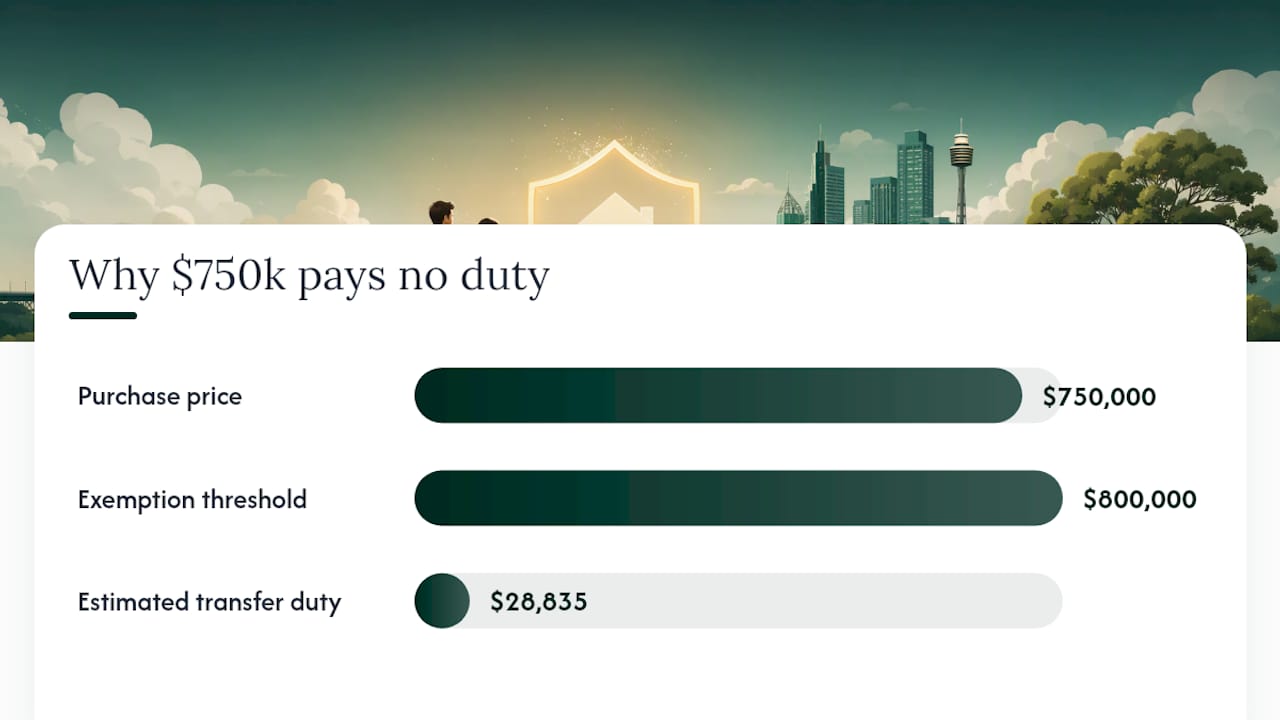
Take a $750,000 established home as an example. Under standard rates, duty would land around $28,835. Because that price sits under the $800,000 exemption threshold, an eligible first home buyer pays nothing. The calculator does the heavy lifting, but understanding the inputs stops you trusting a number that is quietly wrong.
Pro Tip: Always select “first home buyer” and the correct property type before reading the result. Calculators default to standard buyer settings, and a foreign owner surcharge or mortgage registration fee can quietly attach itself to your estimate if you tick the wrong box.
Watch for these common calculator pitfalls:
- Selecting “existing home” when your purchase is actually vacant land, which triggers the wrong threshold entirely.
- Forgetting to flag permanent residency status, which can wrongly apply a foreign purchaser surcharge.
- Ignoring mortgage registration and transfer fees, which sit outside the duty calculation but still hit settlement day.
- Using an outdated calculator that has not been refreshed for the July threshold change.
Timing, paperwork and how to apply for the FHBAS exemption or concession
- Exchange contracts on your property first. You cannot lodge an FHBAS application before this point.
- Complete the FHBAS application form (Revenue NSW’s ODA 066B) along with the purchaser/transferee declaration.
- Gather your supporting documents: proof of identity, the signed contract of sale, and evidence of your intention to occupy the property as your home.
- Lodge everything with your solicitor or conveyancer, who typically submits it to Revenue NSW as part of settlement, or lodge directly if you are managing settlement yourself.
- Keep a copy of every form. If your circumstances change (a change of co‑purchaser, a delay in moving in, or a change of citizenship status) contact Revenue NSW promptly, since unreported changes are what trigger reversals later.
Processing generally happens alongside settlement, so lodging early avoids last‑minute delays that can hold up your keys.
Common scenarios first home buyers ask about
New builds and off‑the‑plan purchases sit under the same $800,000 and $1 million thresholds as established homes, but vacant land is treated differently: full exemption applies only up to $350,000, with the concessional rate stretching to $450,000. If you are buying land to build on later, budget against those lower figures, not the $800,000 home threshold.
A few other situations come up often:
- Buying with a partner or family member who has previously owned property generally disqualifies the whole purchase from the exemption.
- Shared‑equity schemes and family guarantor arrangements can affect eligibility depending on how the title is structured, so check before you commit to a structure.
- Foreign buyers face a separate surcharge purchaser duty on top of standard rates. This is a distinct regime from FHBAS, and Revenue NSW’s foreign surcharge guidance sets it out in full.
- If your purchase involves a trust, company, or complex family arrangement, get advice from a conveyancer or solicitor before exchange. FHBAS eligibility rules were written with individual buyers in mind, and unusual structures often fall outside them.
Anyone weighing up capital gains implications for a future sale should also look at how the main residence exemption for capital gains tax works, since it interacts with the same occupation requirements FHBAS imposes.
A buyers’ agent’s view on stamp duty savings
The stamp duty exemption is not just a tax break. It is a number that should sit inside your negotiation plan from day one. If you know a $780,000 purchase saves you roughly $30,000 against a $1 million purchase, that gap changes what you can genuinely afford to offer, and it changes how hard you should push back at auction.
Where this actually shows up in outcomes is access. Roughly 30% of the purchases Sydney Property Buyers secures for clients, come from off-market and pre-market listings that never reach a public portal, which matters more for first home buyers than most people realise. Less competition on a property often means more room to negotiate a price that keeps you comfortably under the $800,000 threshold rather than tipping you into the concessional band.
Whatever number you land on, confirm it against Revenue NSW before you sign anything. Calculators and guides are useful for planning, but Revenue NSW’s own assessment is the one that counts on settlement day.
— Kristan
Official links and calculators to check
- First Home Buyers Assistance Scheme — full eligibility and threshold details from the NSW Government.
- FHBAS application forms and process — Revenue NSW’s official lodgement guidance.
- Stamp duty exemption changes explained — the government’s announcement and worked savings examples.
- NSW stamp duty calculator and rates guide — a practical calculator reflecting current thresholds.
If you would rather have someone run these numbers against a real property and negotiate on your behalf, Sydney Property Buyers’ full-service and negotiation-only offerings cover exactly that, from strategy through to settlement.
This article is general information, not a substitute for advice from a qualified financial advisor. Consult a qualified financial professional about your own circumstances before acting on anything here.
Sources
- Stamp duty axed for thousands of first home buyers from 1 July | NSW Government
- First Home Buyers Assistance Scheme | NSW Government
- First Home Buyers Assistance scheme | Revenue NSW
- New South Wales Stamp Duty 2026 — Rates, Calculator & Concessions | MortgageHelp
Recommended
- A$40,000 to A$230,000: What Sydney House Deposits Buy in 2026
- What does the first home buyer grant mean in NSW?
- Buyers agent help for first home buyers in Sydney
- Do This Before Exchange to Avoid NSW Property Settlement Delays