Bridging finance can let you buy your next home before your current one sells, but it only makes sense when you have a credible exit strategy. Without one, it’s an expensive way to lose money fast.
Terms typically run for six to 12 months, and it suits specific situations rather than everyone: winning at auction, buying in a competitive market where sellers won’t wait for your settlement, or avoiding the cost and disruption of renting between sales. The main risk is timing. If your existing property takes longer to sell than planned, or sells for less than expected, you’re carrying two debts on one income with the clock running.
- Typical term: 6 to 12 months for consumer bridging loans
- Best suited to: auction wins, competitive markets, avoiding a rental gap
- Main risk: settlement mismatch or a sale price shortfall
Before signing anything, get a solicitor to check the contracts and run the worst-case numbers yourself: what happens if your existing home doesn’t sell for six months, or sells for $50,000 less than you hoped.
Key Takeaways
Bridging finance works when peak debt stays within lender LVR limits and the borrower has verified, realistic exit evidence before signing.
| Point | Details |
|---|---|
| Confirm your exit strategy first | Only proceed if you have a signed sale contract or strong marketing evidence, not just an intention to sell. |
| Understand peak debt | Your combined exposure, existing mortgage plus new purchase less deposit, drives LVR and approval. |
| Compare rates by ranking | First-mortgage bridging typically runs 8.75% to 11% p.a.; second-ranking loans often sit at 12% to 24% p.a. |
| Budget for capitalised interest | Compounding interest can add tens of thousands to your payout figure over 6 to 12 months. |
| Get legal advice before signing | A solicitor should review both contracts together to avoid settlement mismatch and default risk. |
Table of Contents
- What is bridging finance in Australia and how does it work?
- How are bridging loans structured?
- Open vs closed bridging loans: which type do you need?
- What does bridging finance cost in Australia?
- What do lenders require for bridging loan approval?
- What are the risks of bridging finance and how do you manage them?
- What are the alternatives to bridging finance?
- How do you apply for bridging finance and what’s the timeline?
- How does Sydney Property Buyers help reduce bridging finance risk?
- How do current market conditions affect bridging finance?
- What are the tax implications of bridging finance in Australia?
- What the numbers actually tell you about bridging finance
- Frequently asked questions
- Sources
What is bridging finance in Australia and how does it work?
Bridging finance is a short-term loan that covers the gap between buying a new property and selling your existing one. Rather than waiting for your current home to settle, you draw on a loan secured against both properties, then repay the bulk of it once your sale goes through.
The mechanics hinge on something lenders call peak debt. This is the total amount you owe during the bridging period, calculated as your outstanding mortgage on the existing property plus the purchase price of the new one, less any deposit you’ve put down. Peak debt is the figure lenders use to assess your loan-to-value ratio (LVR), and it’s almost always higher than either loan would be on its own, because for a window of weeks or months you’re technically holding both properties.
Say you owe $400,000 on your current home and you’re buying a new one for $900,000 with a $50,000 deposit. Your peak debt sits at roughly $1,250,000 until settlement of the sale reduces it back down. That number, not your eventual “end debt”, is what the bank stress tests against your income and the combined value of both properties.
Common everyday uses include:
- Buying at auction, where an unconditional contract leaves no room to wait for your existing sale
- Securing a property in a tight market before a rival buyer moves in
- Covering short-term renovation or project costs while a sale is finalised
Both properties typically act as security during the bridging term. Some lenders will ask for additional security, such as a guarantee from a third party or an offset against other assets, particularly if your peak debt pushes the combined LVR close to their ceiling. Once your existing home settles, the sale proceeds pay down the peak debt and you’re left with your “end debt,” which is simply a standard home loan against the new property.
How are bridging loans structured?
Two things determine how expensive a bridging loan actually is: how the interest is charged, and where your loan sits in the queue of security against the property.
Most bridging lenders offer a choice between paying interest monthly, like a normal mortgage, or capitalising it, where the interest is added to the loan balance and paid in one lump sum at the end. Capitalised interest feels easier during the bridging period, because you’re not making repayments on top of your existing mortgage. But it compounds. Every month, you’re paying interest on interest, and the payout figure at settlement can come as a shock if you haven’t modelled it properly.
Loan ranking matters just as much as the interest structure. Here’s the practical difference:
- First mortgage bridging replaces or sits ahead of your existing home loan, giving the lender first claim on the property if things go wrong. This is the cheaper option, and where most bank bridging finance sits.
- Second-ranking bridging loans sit behind an existing first mortgage you’d rather not disturb, perhaps because you’re on a good fixed rate. The lender takes on more risk, so the pricing sits materially higher, and these loans are typically capitalised rather than paid monthly.
- Combined structures occasionally apply where a portion of peak debt is first-ranking and a smaller top-up sits second, used when a borrower needs slightly more than a first mortgage alone allows.
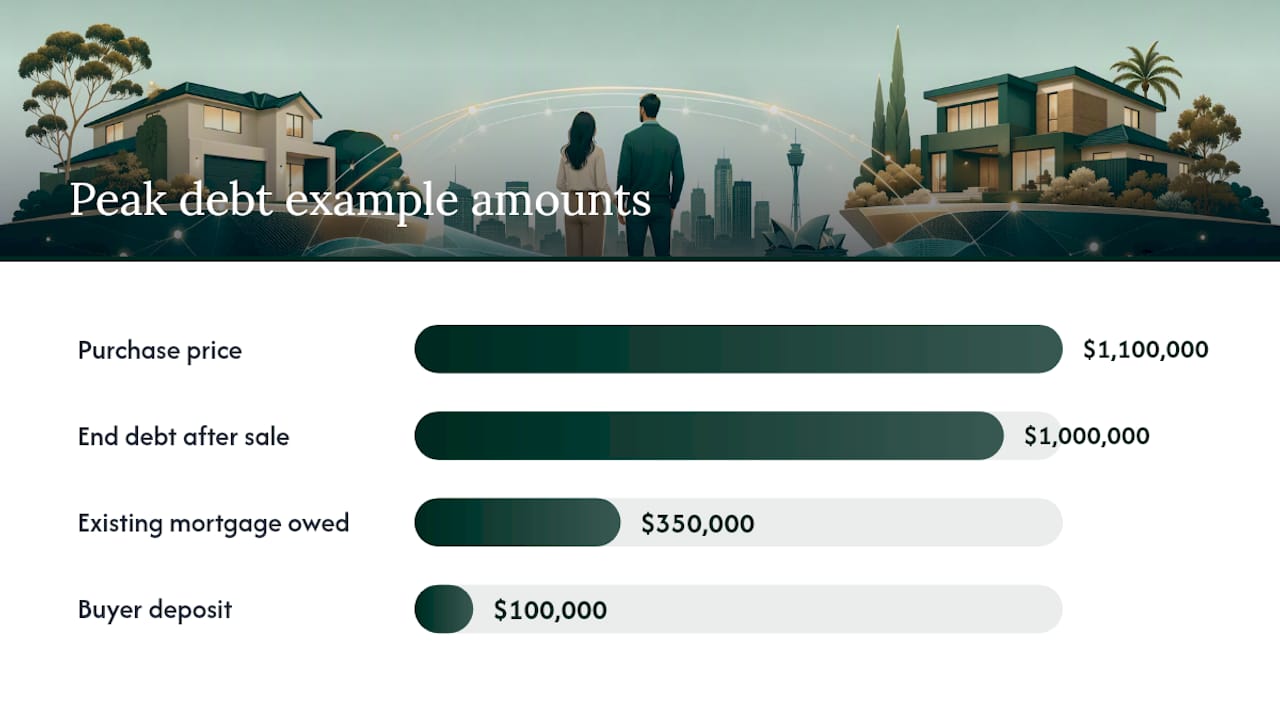
Here’s a simplified peak debt worked example. You owe $350,000 on your current property, valued at $900,000. You’re buying a new home for $1,100,000 with a $100,000 deposit. Once your existing property sells and clears its $350,000 mortgage, your end debt drops to $1,000,000 against the new $1,100,000 property, an LVR of roughly 91%, which may then require lenders mortgage insurance depending on the lender.
Second-ranking loans should generally only be used when disturbing an attractive first mortgage isn’t worth it, not as a default choice, given the rate premium involved.
Open vs closed bridging loans: which type do you need?
Whether you need an open or closed bridging loan comes down to one question: do you already have a signed contract to sell your existing property?
Closed bridging loans apply when you have an unconditional sale contract with a fixed settlement date. Because the lender can see exactly when your peak debt will be repaid, closed loans are generally priced more favourably and approved more easily. If your existing home is already under contract, this is the product to ask for.
Open bridging loans apply when you haven’t sold yet, or your sale isn’t unconditional. The lender is taking on more uncertainty about when, or whether, the debt clears, so open bridging typically comes with tighter conditions: a maximum term, sometimes a requirement to list the property within a set number of weeks, and closer scrutiny of your capacity to service both debts if the sale drags on.
There’s also a regulatory distinction that catches many borrowers out:
- Consumer bridging loans, used to buy or sell your own home, fall under the National Consumer Credit Protection Act, which brings standard responsible lending obligations and disclosure requirements.
- Business-purpose bridging loans, sometimes used by property investors or self-employed borrowers structuring a purchase through a company or trust, often sit outside these consumer protections, which can mean faster approval but fewer legislated safeguards.
If you’re unsure which category your situation falls into, that’s a conversation for your broker or solicitor before you sign, not after.
What does bridging finance cost in Australia?
Pricing varies more in bridging finance than in a standard home loan, largely because ranking and lender type change the risk profile so much.
Indicative rate ranges (2026):
First-mortgage bridging loans through private lenders are commonly priced from around 8.75% to 11% p.a. Second-ranking bridging loans sit meaningfully higher, often in the 12% to 24% p.a. range, reflecting the added risk the lender carries by sitting behind an existing mortgage. Bank bridging products, where available, often price closer to a standard variable rate but come with slower turnaround and stricter serviceability checks.
Beyond the headline rate, budget for:
- Establishment fees, commonly a small percentage of the loan amount 1% to 2%
- Valuation fees on both the existing and new property, often several hundred dollars each
- Legal fees for loan documentation and contract review
- Discharge fees when your existing mortgage is paid out
- Exit fees, though these are less common on modern bridging products than they once were
The compounding effect of capitalised interest is where borrowers most often underestimate the true cost. Capitalised over nine months, the interest alone adds roughly $71,000 to the payout figure, and that’s before establishment and legal costs. Stretch the term to 12 months and the gap widens further. This is precisely the kind of shortfall that catches people out, because the monthly figure feels abstract until it’s a lump sum due at settlement.
Pro Tip: Ask every lender for a written cost comparison at three different exit timeframes: 6, 9, and 12 months. If the loan looks affordable only in the fastest scenario, that’s your signal to build a bigger contingency buffer or reconsider the loan altogether.
What do lenders require for bridging loan approval?
Lenders assess bridging applications differently to standard mortgages, weighting your exit plan almost as heavily as your income.
Loan-to-value ratio and equity. Most lenders want combined peak debt to sit comfortably under 80% LVR against the combined value of both properties, though some will stretch higher for strong applicants with clear exit evidence. The more equity you’re carrying in your existing home, the more room you have to negotiate rate and term.
Exit evidence. This is where applications succeed or stall. Lenders typically want to see one of the following:
- A signed, unconditional contract of sale for your existing property
- Evidence of active marketing, such as a signed agency agreement and listing history, if the sale hasn’t yet completed
- A refinance pre-approval if your exit plan is to convert the bridging loan into standard debt rather than sell
Serviceability versus security. Bank lenders generally test your ability to service the full peak debt at a buffered rate, even though it’s temporary. Private lenders, by contrast, often weight the strength of the security and exit strategy more heavily than income, which can suit self-employed borrowers or asset-rich, income-light applicants who don’t fit neatly into a bank’s serviceability model.
Pro Tip: If you’re self-employed and know a bank will baulk at your income documentation, ask a broker about private bridging options early. It can save weeks of back-and-forth on an application that was never going to clear a bank’s serviceability test.
Understanding how much usable equity you’re carrying in your current home is worth doing before you approach any lender, since it shapes both your LVR position and your negotiating leverage on rate.
What are the risks of bridging finance and how do you manage them?
The single biggest risk in bridging finance is a mismatch between when your sale settles and when your bridging term expires. Settlement delays happen for mundane reasons: a buyer’s finance falls through, a building inspection turns up an issue, or a chain of related settlements slips by a week. When that happens on a bridging loan, you’re not just inconvenienced, you’re accruing interest on peak debt for longer than budgeted, and in the worst cases, breaching your loan term.

There are genuine legal risks when contracts and settlement dates aren’t properly aligned, including exposure to default, loss of deposit, or lender enforcement action if the bridging facility isn’t repaid on time. A shortfall scenario, where your existing property sells for less than expected, is arguably worse: it leaves you with a debt gap that has to be found from somewhere, and lenders have contractual rights to escalate recovery action if that gap isn’t resolved quickly.
Practical mitigations that actually work:
- Insist on conditional clauses in your sale contract that give you flexibility if settlement slips
- Have a solicitor review both the purchase and sale contracts together, not in isolation
- Price your existing property conservatively rather than optimistically, especially in a softening market
- Keep a contingency fund equivalent to at least one or two extra months of bridging interest
- Ask about lender flexibility on term extensions before you sign, not after you need one
One of the most common mistakes is treating a bridging loan like long-term debt, assuming there’s always room to extend if the sale runs late. That assumption has caught out plenty of otherwise careful buyers.
Pro Tip: Build your exit timeline backwards from the bridging loan expiry date, not forwards from when you list. If your realistic selling timeline doesn’t leave at least a month of buffer before the loan matures, renegotiate the term before you commit.
What are the alternatives to bridging finance?
Bridging finance isn’t the only way to buy before you sell, and it isn’t always the cheapest.
Deposit bonds let you secure a purchase without tying up cash or increasing your peak debt, useful if your existing property is close to selling but you need to move quickly on a new one. Extended settlement terms, negotiated directly with the vendor, can achieve a similar outcome without borrowing anything extra, though they depend entirely on the vendor’s willingness to wait.
Refinancing your existing loan, or drawing on redraw or offset funds you’ve already built up, can cover a short-term cash gap without the establishment costs and higher rates that come with a dedicated bridging product. This works best when the gap is genuinely small and short.
Favour an alternative over bridging finance when:
- Your funding horizon is longer than 12 months, or genuinely uncertain
- Your existing property doesn’t have strong exit visibility, such as a slow-moving suburb or an unusual property type
- The bridging costs, once you’ve priced establishment fees and capitalised interest, outweigh the benefit of avoiding a rental gap
For many buyers, the smarter move isn’t a cheaper loan at all, it’s avoiding the timing squeeze altogether by securing a property through channels that give you more control over settlement dates from the outset.
How do you apply for bridging finance and what’s the timeline?
Getting from application to settlement runs faster than most borrowers expect, provided your paperwork is ready.
- Get pre-approved based on your peak debt scenario, not just the new purchase price
- Arrange valuations on both the existing and new property, since lenders need both to calculate LVR
- Have a solicitor check the purchase contract, the sale contract (if signed), and the bridging loan documents together
- Sign the loan documents once conditions are met, including any exit evidence the lender has requested
- Book settlement, coordinating the timing of your purchase settlement with your existing sale wherever possible
Timelines vary sharply by lender type. Private lenders can settle in as little as two to five business days when valuations and legal work are expedited, which matters enormously if you’re racing an auction deadline. Bank bridging loans, by contrast, often take several weeks given standard credit assessment processes, so they suit buyers with more lead time rather than urgent purchases.
Documents worth having ready before you apply: recent payslips or two years of tax returns if self-employed, your existing mortgage statement, a copy of your sale contract or marketing evidence, identification, and a signed purchase contract or draft for the new property. Having these organised before you approach a lender can shave days off the process, particularly with private lenders who move at the speed of your paperwork.
How does Sydney Property Buyers help reduce bridging finance risk?
Most of the risk in bridging finance isn’t the loan itself, it’s the timing squeeze that forces you into one. A buyer’s agent’s job is to reduce that squeeze before it ever reaches your lender’s desk.
Sydney Property Buyers is directed by Kristan Johnson, a licensed real estate agent and winner of the 2024 Outstanding Buyers Agent of the Year award from the Inner West Local Business Awards.
In practice, that expertise shows up in ways that directly reduce bridging exposure:
- Negotiating settlement dates that align more closely with a client’s expected sale timeline, rather than accepting the vendor’s default terms
- Building conditional clauses into offers where the market allows it, giving clients breathing room if their own sale slips
- Sourcing off-market and pre-market properties, which often come with more flexible settlement negotiation than a competitive on-market campaign
Buyers who feel forced into bridging finance are often buyers who felt forced into a deadline. Give a client more time and more options, through off-market access or a longer negotiated settlement, and the need for expensive short-term debt often disappears entirely.
If you’re weighing up a purchase that might require bridging finance, it’s worth exploring how full-service buyer representation can change your negotiating position before you ever need to speak to a bridging lender.
How do current market conditions affect bridging finance?
Bridging finance becomes more usable, and more necessary, when a market is moving quickly. In a competitive Sydney market with fast-clearing auctions and limited stock in sought-after suburbs, vendors have little incentive to wait for a buyer’s existing sale to settle, which pushes more buyers towards bridging solutions simply to compete.
The flip side matters just as much. When conditions soften and properties take longer to sell, your exit risk on a bridging loan rises sharply. A property that might have sold in four weeks during a strong market can take three months or more when buyer demand cools, and that gap is exactly where bridging borrowers get caught out, carrying peak debt for far longer than their original cost modelling assumed.
Valuation risk moves in the same direction. In a rising market, your existing property is likely to hold or grow in value across the bridging term, giving you a buffer if your sale timeline slips. In a flat or declining market, there’s a real chance your property sells for less than the valuation used to calculate your original peak debt, which is precisely the shortfall scenario that creates legal and financial strain.
The practical takeaway is that bridging finance works best when you have realistic, conservative expectations about your local market rather than optimistic ones based on last year’s conditions. Pricing your existing property to sell quickly, even if it means accepting slightly less, is often cheaper than the extra weeks or months of compounding bridging interest.
What are the tax implications of bridging finance in Australia?
Bridging finance itself doesn’t create a separate tax category, but it interacts with existing tax rules in ways worth understanding before you commit.
If your existing property is your main residence, interest on the bridging loan tied to that property generally isn’t tax deductible, in line with the standard treatment of owner-occupied home loan interest. Where the situation shifts is if either property is an investment. Interest attributable to the portion of peak debt used to fund an investment property can potentially be deductible, though the apportionment between owner-occupied and investment use needs careful calculation, particularly when a single bridging facility covers both purposes.
Capital gains tax (CGT) considerations also come into play around the sale of your existing property. If that property has been your main residence throughout, the main residence exemption generally applies regardless of how the sale interacts with your bridging arrangement. But if you’ve used the property for any income-producing purpose, or if there’s a gap between vacating it and settling the sale, the timing bridging finance creates can affect how CGT is calculated.
None of this is something to work out on the back of an envelope. Bridging finance arrangements often involve genuinely complex interactions between deductibility, apportionment, and CGT timing, and getting professional tax advice before you structure the loan is far cheaper than correcting it afterwards.
What the numbers actually tell you about bridging finance
The conventional advice on bridging finance treats it as a rate comparison exercise: shop around, find the lowest percentage, sign the paperwork. That misses the point entirely. The number that actually determines whether a bridging loan works out isn’t the interest rate, it’s how confident you genuinely are in your sale timeline, and most borrowers overstate that confidence by weeks or months.
What’s underrated is how much of this risk sits outside the loan itself. A well-negotiated settlement date, or a property sourced off-market where you’re not racing a deadline, does more to protect a buyer than any amount of rate shopping. Lenders will happily approve a loan against optimistic assumptions. They won’t be the ones absorbing the cost if those assumptions don’t hold.
If you take one thing from this, prioritise your exit evidence before your interest rate. A slightly more expensive loan with a genuinely solid sale contract behind it beats a cheaper one resting on hope.
Frequently asked questions
How long does bridging finance typically last in Australia?
Most consumer bridging loans run for six to 12 months, though some lenders allow shorter closed-bridge terms when a sale contract is already signed.
Can I get bridging finance if I haven’t sold my property yet?
Yes, through an open bridging loan, though lenders will typically want evidence of active marketing and may apply tighter conditions than for a closed loan with a signed sale contract.
Is bridging finance more expensive than a standard home loan?
Generally yes.
What happens if my property doesn’t sell during the bridging period?
You’ll need to negotiate a term extension with your lender, refinance the bridging debt into a standard loan, or, in the worst case, face default consequences, which is why a realistic exit strategy matters more than the interest rate itself.
Do I need a solicitor for a bridging loan?
Strongly recommended. Bridging arrangements carry genuine legal risk around settlement timing and contract alignment, and a solicitor reviewing both contracts together can catch mismatches before they become expensive problems.
This article is general information, not a substitute for advice from a qualified financial advisor. Consult a qualified financial professional about your own circumstances before acting on anything here.
Sources
Recommended
- Why a buyer’s agent suits interstate buyers in Sydney
- What does loan portability mean for home buyers?
- Blog – Welcome
- Benefits of buying off-market in Sydney: 2026 guide