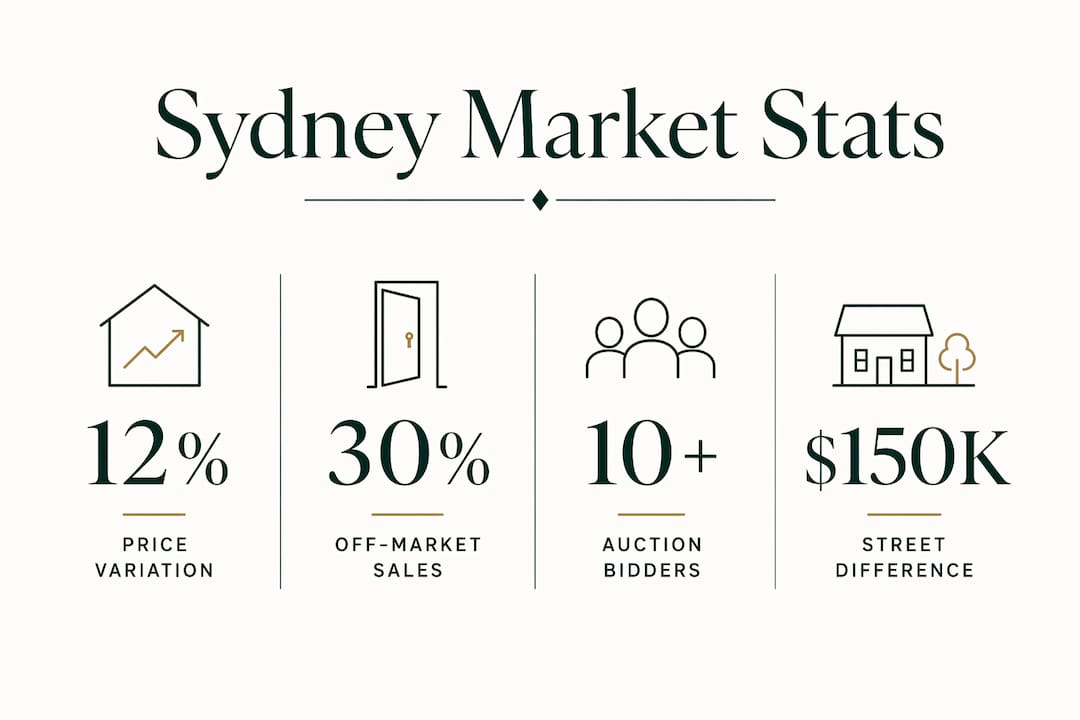
Local knowledge is the defining advantage a buyer’s agent brings to Sydney property buyers, separating genuinely informed guidance from generic advice built on data alone. A buyer’s agent with deep local expertise can identify why one street in Marrickville commands a 12% price premium over the next, while an agent relying solely on online listings cannot. Sydney’s property market is not one market. It is dozens of micro-markets, each with its own auction dynamics, buyer competition, heritage constraints, and lifestyle appeal. Understanding why local knowledge matters for a buyer’s agent is the first step to making a sound purchase decision in this city.
Why local knowledge matters for a buyer’s agent in Sydney
A buyer’s agent’s local market knowledge directly determines how accurately they can value a property. Online platforms aggregate suburb-level data, but neighbourhood value often depends on micro-factors that algorithms cannot detect. School catchment boundaries, the character of a particular street, proximity to a noisy arterial road, or the presence of a beloved local park all shift a property’s true worth in ways that raw price-per-square-metre figures will never capture.

Why raw data alone is not enough
Sydney’s inner suburbs demonstrate this gap clearly. Two terraces on adjacent streets in Newtown can differ by $150,000 or more, not because of size or condition, but because one sits within the Newtown High School of Performing Arts catchment and the other does not. An agent who has spent years working that pocket knows this instinctively. An agent relying on a CoreLogic report does not.
Agents who monitor seasonal buyer activity and inventory shifts gain decisive insights that national data platforms simply cannot replicate. This matters at every stage of a purchase, from setting a realistic bidding ceiling at auction to deciding whether to make a pre-auction offer.
How micro-market variations affect your offer
Sydney’s suburbs are not uniform. Within a single postcode, buyer demand can vary dramatically by street, aspect, and proximity to transport. A buyer’s agent with genuine local expertise accounts for all of this when advising on an offer price. Without it, you risk either overpaying in a competitive pocket or missing a genuine opportunity in an undervalued one.
Key factors a locally informed buyer’s agent interprets correctly include:
- School catchment zones and how boundary changes affect resale value
- Traffic and noise corridors that suppress prices on otherwise desirable streets
- Demand pockets where buyer competition is consistently high, driving auction clearance rates above suburb averages
- Aspect and overshadowing patterns specific to particular blocks
- Planned infrastructure such as light rail extensions or rezoning proposals that shift value before they appear in public data
Pro Tip: Ask any buyer’s agent you interview to name the three best-value streets in the suburb you are targeting and explain why. A locally grounded agent will answer immediately and specifically. A generalist will hesitate.
How does local knowledge help identify risks early?
Local expertise reduces financial risk by surfacing problems before they become expensive surprises. Local knowledge enables more accurate repair requests and budgeting because an experienced local agent already knows which building types, streets, or eras of construction carry recurring issues.
In Sydney, this is particularly relevant given the city’s mix of federation-era terraces, post-war brick veneer, and 1980s strata blocks. Each carries distinct risk profiles. Federation homes in Balmain or Annandale frequently present with rising damp, original wiring, and asbestos-containing materials. A buyer’s agent who has purchased dozens of properties in those suburbs knows exactly which building inspectors to engage and which defects to negotiate on.
The risks that only local insight reveals include:
- Heritage overlays that restrict renovation or extension, affecting both liveability and resale value
- Flood and stormwater easements that limit building footprints in parts of the Inner West and Eastern Suburbs
- Pending development applications for neighbouring sites that could affect amenity or views
- Strata financial health in buildings where a locally active agent knows the body corporate’s history
- Contaminated land registers relevant to former industrial sites now being converted to residential use in suburbs like Alexandria and St Peters
Each of these risks is detectable before exchange, but only if your agent knows where to look. A buyer’s agent without local grounding will not know to check a heritage overlay on a Leichhardt semi or flag a drainage easement on a Rozelle terrace.
Pro Tip: Before signing a contract, ask your buyer’s agent to walk you through the specific local risks for that property type and street. The depth of their answer tells you everything about their local knowledge.
How does local insight shape negotiation strategy?
Negotiation in Sydney property is not a generic skill. Offer and negotiation strategies must be hyperlocal because seller expectations, agent behaviours, and buyer competition vary significantly between suburbs and even between streets within the same suburb.
Some Sydney micro-markets attract 10 or more registered bidders at auction, while nearby pockets draw only two or three. That difference changes everything about how you approach a campaign. In a high-competition pocket, a pre-auction offer below vendor expectations will be dismissed. In a quieter pocket, the same tactic can secure a property before it reaches the auction room.
What a locally informed negotiation looks like
A buyer’s agent with genuine local expertise uses the following levers that a generalist cannot:
- Vendor motivation signals picked up through agent relationships built over years of transacting in the same suburb
- Settlement term preferences that vary by seller profile. Downsizers in Mosman often prioritise longer settlements; investors in Surry Hills frequently want a quick exchange.
- Appraisal gap awareness where a locally active agent knows whether a selling agent’s price guide is typically set conservatively or aggressively in that suburb
- Auction bidding patterns specific to particular auctioneers and agencies operating in the area
- Off-market access through relationships that only come from sustained local presence
Sydney Property Buyers secures more than 30% of purchases off-market, a figure that reflects the depth of local relationships built across the Inner West, Eastern Suburbs, Lower North Shore, and Eastern Beaches. Off-market access is not a product you can buy. It is the result of years of local engagement.
Why lifestyle and community insight matter beyond price
Lifestyle access and community features often dictate long-term property performance more than property size or finishes. A buyer’s agent who understands a suburb’s social fabric can advise on factors that no data platform captures.
The table below illustrates how lifestyle factors translate into measurable property outcomes across several Sydney micro-markets.
| Lifestyle factor | Example suburb | Impact on property value |
|---|---|---|
| Café and dining strip proximity | Enmore, Newtown | Sustained buyer demand and faster resale |
| Primary school catchment quality | Mosman, Balmain | Consistent price premium above suburb median |
| Walkability to train station | Redfern, Petersham | Reduced days on market and stronger auction competition |
| Coastal access and beach proximity | Coogee, Manly | Long-term capital growth above Sydney average |
| New infrastructure (light rail, cycleways) | Dulwich Hill, Randwick | Early value uplift before completion |
An agent who lives and works in a suburb notices when a new café opens on a previously quiet street, when a school’s catchment boundary shifts, or when a rezoning proposal changes the development potential of a block. These are the early signals that distinguish genuine growth areas from marketing noise. They are invisible to anyone not embedded in the community.
Community engagement builds trust in ways that market statistics alone cannot. A buyer’s agent who attends local auctions every weekend, knows the selling agents by name, and understands the rhythm of each suburb’s market cycle brings a quality of insight that no algorithm replicates. For buyers making the largest financial decision of their lives, that insight is not a bonus. It is a necessity.
Key takeaways
A buyer’s agent with genuine local knowledge is the single most effective protection against overpaying, hidden risks, and failed negotiations in Sydney’s fragmented property market.
| Point | Details |
|---|---|
| Micro-market pricing is hyperlocal | Adjacent streets can differ by up to 12% in price due to factors algorithms cannot detect. |
| Local expertise reduces risk | Only a locally grounded agent knows which building types, heritage overlays, and easements to investigate before exchange. |
| Negotiation must match the suburb | Offer strategies, settlement terms, and auction tactics vary significantly between Sydney micro-markets. |
| Lifestyle insight drives long-term value | Cafés, school catchments, and transport access shape capital growth in ways that raw data does not capture. |
| Off-market access requires local relationships | Sustained local presence, not a database subscription, is what unlocks properties before they reach the open market. |
What I have learnt from years in Sydney’s micro-markets
The buyers who come to me after a frustrating search almost always share one experience. They worked with an agent who knew Sydney broadly but did not know their target suburb deeply. They received suburb-level reports, attended open homes, and still felt uncertain. That uncertainty is not a personality trait. It is a direct result of receiving generic information about a specific market.
What I have found, after securing properties across the Inner West, Eastern Suburbs, Lower North Shore, and Eastern Beaches, is that the most valuable knowledge is never in a report. It is in knowing that a particular selling agent in Balmain always sets a conservative guide and expects the auction to run hard. It is knowing that a heritage-listed street in Glebe carries specific council constraints that will affect any renovation budget. It is knowing which body corporates in Surry Hills have deferred maintenance that will hit owners with a special levy within two years.
Buyers who ask me “how do you know that?” are asking the right question. The answer is always the same. You know it because you have been there, repeatedly, over years. Digital tools are useful for filtering. They are not a substitute for presence. If you are evaluating a buyer’s agent, ask them to describe the last three properties they purchased in your target suburb and what made each negotiation different. The specificity of their answer will tell you everything about the depth of their local knowledge.
— Kristan
How Sydney Property Buyers puts local expertise to work for you
Sydney Property Buyers operates exclusively across Inner West Sydney, Eastern Suburbs, Lower North Shore, and Eastern Beaches. Every search, appraisal, and negotiation is grounded in direct, ongoing engagement with those specific markets.

The agency’s full purchase service covers strategy, property search including off-market opportunities, independent appraisal, due diligence, negotiation, and auction bidding. The average purchase completes within 54 days of engagement, with an average saving of approximately 9% on purchase price. For buyers who have already identified a property, the Negotiation Only service provides professional representation at the point where local knowledge matters most. Contact Sydney Property Buyers on 1800 676 177 or at hello@sydneypropertybuyers.com.au to discuss your search.
FAQ
Why does local knowledge matter more than online data?
Online platforms provide suburb-level averages, but neighbourhood-specific value depends on micro-factors like school catchments, street character, and infrastructure plans that algorithms cannot interpret. A locally active buyer’s agent translates those factors into accurate price guidance.
How does local expertise help at auction in Sydney?
Micro-markets vary significantly in auction competition, with some pockets attracting 10 or more bidders while nearby areas draw very few. A locally informed buyer’s agent uses that knowledge to set the right bidding ceiling and decide whether a pre-auction offer is the better tactic.
What local risks should a buyer’s agent identify before exchange?
A locally grounded agent checks for heritage overlays, flood and stormwater easements, pending development applications, strata financial history, and contaminated land registers. These risks are suburb and street-specific, and local knowledge enables more accurate budgeting for any required remediation.
How does lifestyle knowledge affect property investment outcomes?
Lifestyle access factors such as café strips, school catchments, and transport links consistently drive long-term capital growth and buyer demand. An agent embedded in the local community spots these signals early, before they appear in price data.
How do I know if a buyer’s agent has genuine local knowledge?
Ask them to name the best-value streets in your target suburb and explain the last three negotiations they completed there. Genuine local expertise produces immediate, specific answers. Broad market familiarity produces generalities.
Recommended
- Common buyers agent selection mistakes Sydney buyers make
- Why a buyer’s agent suits interstate buyers in Sydney
- Why a licensed buyer’s agent matters in Sydney
- Buyers agent for North Shore property: 2026 guide