A property negotiation strategy is a structured plan that helps buyers secure the best possible purchase terms through data-backed offers, seller psychology, and flexible deal structuring. Knowing what is a property negotiation strategy separates buyers who pay asking price from those who save tens of thousands of dollars on the same property. In Sydney’s competitive market, where prices shift quickly across the Inner West, Eastern Suburbs, and Lower North Shore, a clear plan is not optional. Sydney Property Buyers consistently achieves an average saving of around 9% on purchase price for clients, which on a $1.5 million property represents roughly $135,000 in real savings.
What are the essential components of an effective property negotiation strategy?
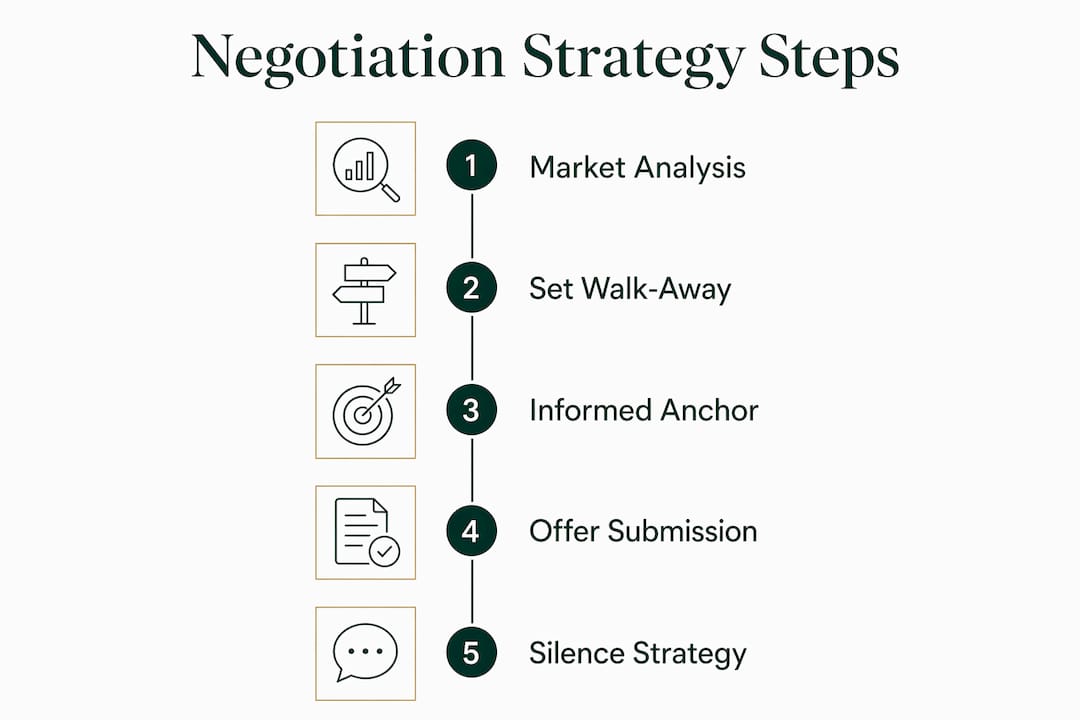
A property negotiation strategy rests on five core components: market analysis, a defined walk-away price, an informed opening offer, an understanding of seller motivations, and flexibility on non-price terms.
Market analysis through a Comparative Market Analysis (CMA) is the starting point. A CMA focuses on comparable sales within 3–6 months to establish a credible valuation range. Without this, any offer is a guess rather than a position.

Setting a walk-away price before you enter any negotiation is non-negotiable. Master negotiator Michael Yardney stresses that knowing your absolute walk-away point prevents emotional overspending when you fall in love with a property. Write the number down before you make contact with the agent.
The Informed Anchor is your opening offer. The Informed Anchor strategy involves presenting an initial offer supported by comparable sales and days-on-market data, rather than a random lowball figure. A lowball offer without rationale shuts down dialogue immediately.
Surfacing seller motivations unlocks deals that pure price negotiation cannot. Trading non-price terms such as settlement dates, included appliances, or repair credits can deliver value equivalent to, or greater than, a direct price reduction.
Timing and silence are underrated tools. Silence after submitting an offer prevents premature concessions. The first party to break silence often signals willingness to move, which costs the buyer ground.
- Conduct a CMA using sales from the past 3–6 months in the same suburb
- Set your maximum price in writing before the first conversation
- Build your opening offer around comparable evidence, not hope
- Ask the selling agent what matters most to the vendor beyond price
- Offer settlement flexibility before offering a price reduction
- Submit your offer and then wait
Pro Tip: After submitting an offer, resist the urge to follow up within 24 hours. Silence signals confidence. Buyers who call back quickly are read as anxious, and anxious buyers concede more.
How does understanding seller psychology improve negotiation outcomes?
Sellers respond to perceived fairness, urgency, and risk far more than most buyers realise. Psychological drivers often determine outcomes more than the numbers themselves. A seller who feels respected and understood is far more likely to accept a lower offer than one who feels insulted by it.
Presenting offers with confidence and a clear rationale builds trust. When you explain that your offer reflects recent sales at 14 Blank Street and 22 Blank Avenue, you are not attacking the vendor’s price expectation. You are inviting them into a shared reality.
Avoid lowball offers without supporting evidence. An unsupported low offer triggers defensiveness, and a defensive seller becomes an irrational one. Once a seller feels disrespected, recovering the negotiation costs significant time and goodwill.
- Research the vendor’s situation before making contact. Has the property been on the market for 60 days? Has it been relisted? These signals indicate motivation.
- Frame your offer as a reflection of the market, not a judgement of the property.
- Offer two or three structured options where possible. Giving a seller a choice between settlement terms creates a sense of control that makes acceptance easier.
- Use measured, calm responses to counter-offers. Reacting quickly to every counter signals desperation.
- Align your offer conditions with what the seller actually needs. A vendor who needs a long settlement to find their next home will value that flexibility more than an extra $10,000.
“Negotiation success often hinges more on psychological framing and understanding seller fears than on the exact numbers. Buyers who treat negotiation as a purely financial exercise leave deals on the table that a more empathetic approach would have closed.”
What advanced negotiation techniques work in stalled or complex deals?
Stalled negotiations are not dead negotiations. They are opportunities for buyers who know how to restructure a deal rather than simply push harder on price.
One of the most effective techniques for bridging a valuation gap is a “loose” deal structure. This involves offering a higher purchase price in exchange for a 60-day seller search period and a break-up fee of around $25,000 or less. The seller gets confidence to accept your offer while still searching for their next property. The buyer gains a committed vendor without overpaying unconditionally.
Contract flexibility is another lever most buyers ignore. Offering to remove a building and pest inspection clause in exchange for a price reduction, or agreeing to an unconditional exchange in return for a lower figure, can unlock deals that conditional offers cannot. This approach requires confidence in your due diligence, which is why professional representation matters.
Sometimes the most effective tactic is to step back entirely. Giving a seller “room” by withdrawing from active negotiation for a week can reset the dynamic. Sellers who feel pressured become resistant. Sellers who feel they may lose a genuine buyer often become more flexible.
| Situation | Technique | Outcome |
|---|---|---|
| Valuation gap | Loose deal with 60-day window and break-up fee | Seller accepts offer; buyer avoids overpaying unconditionally |
| Conditional offer rejected | Trade inspection clause for price reduction | Unconditional offer accepted at lower price |
| Stalled counter-offer | Step back for 5–7 days | Seller re-engages with improved terms |
| Agent pushing to split the difference | Seek concession elsewhere in the deal | Buyer maintains value without splitting |
Buyers should not feel compelled to split the difference on counter-offers. Splitting the difference is a classic agent tactic to push for quick agreement. Effective buyers seek concessions in other deal aspects, such as inclusions or settlement timing, to maintain overall deal value.
Pro Tip: If an agent suggests splitting the difference, respond with: “I’m not in a position to move on price, but I’m happy to discuss settlement terms.” This keeps the deal alive without surrendering dollars.
What practical steps should Sydney buyers take before negotiating?
Preparation is where most Sydney buyers lose their negotiation before it begins. Walking into a negotiation without research is the equivalent of bidding at auction without a budget.
- Conduct a CMA for the specific suburb. Pull comparable sales from the past 3–6 months. Focus on properties with similar land size, bedroom count, and condition. Days on market is as important as sale price.
- Secure mortgage pre-approval before making any offer. Pre-approval signals seriousness to the vendor and removes a common reason for offer rejection.
- Work with a licensed buyers agent. Sydney Property Buyers’ full purchase service covers independent appraisal, negotiation, and auction bidding. Professional representation removes the emotional bias that costs buyers money.
- Understand your BATNA. Your Best Alternative to a Negotiated Agreement is the next best property you would buy if this deal falls through. Buyers with a clear BATNA negotiate with genuine confidence, not bluster.
- Role-play negotiation scenarios. Practise your response to common counter-offer tactics before you face them in a real conversation. Preparation reduces the chance of an emotional reaction.
- Monitor market conditions. A buyer’s market gives you time and leverage. A seller’s market demands faster decisions and tighter preparation. Sydney’s market shifts between these states suburb by suburb, so researching Sydney suburbs before you negotiate is not optional.
- Build rapport with the selling agent. Vendor communication best practices include consistent, professional contact that positions you as a credible, low-risk buyer. Agents advocate for buyers they trust to perform.
Seasoned negotiators treat price as one of many variables, using settlement terms, repairs, inclusions, and timelines to create overall deal value. Buyers who focus only on price miss the full picture.
Key takeaways
A property negotiation strategy combines market data, seller psychology, and deal flexibility to secure the best possible terms, not just the lowest price.
| Point | Details |
|---|---|
| CMA is foundational | Base every offer on comparable sales from the past 3–6 months in the same suburb. |
| Set your walk-away price first | Define your maximum before negotiating to prevent emotional overpaying. |
| Use the Informed Anchor | Open with an offer supported by data, not a lowball figure that kills dialogue. |
| Non-price terms create value | Settlement dates, inclusions, and repair credits can be worth more than a price cut. |
| Silence is a tactic | After submitting an offer, wait. The first party to break silence often concedes ground. |
The negotiation insight most buyers never act on
Most buyers I work with arrive well-researched on price and completely unprepared on everything else. They know the suburb median. They know what the house two doors down sold for. But they have no idea what the seller actually needs, and that gap costs them deals.
The most successful negotiations I have been involved in were not won on price. They were won because we understood that the vendor needed a 90-day settlement to secure their next property, or that they were anxious about a conditional offer falling through. Once you know what someone is actually afraid of, you can structure an offer that removes that fear. That is worth far more than an extra $20,000 on the purchase price.
Sydney buyers also underestimate how much preparation matters at auction. Auction conditions remove most of the tactics I have described here, which is why real estate auction strategies require a completely separate framework. Knowing your limit, bidding with authority, and not chasing a property past your walk-away point are skills that take practice.
The uncomfortable truth is that negotiation is a skill, not a personality trait. Introverted buyers often outperform extroverted ones because they listen more and react less. The buyers who struggle are those who treat negotiation as a confrontation rather than a conversation about how to make a deal work for both sides.
— Kristan
How Sydney Property Buyers approaches property negotiation
Buying property in Sydney without a negotiation plan is expensive. Sydney Property Buyers works exclusively for buyers, never sellers, which means every strategy is built around your interests.

The agency’s full purchase and negotiation services cover independent appraisal, offer strategy, conditional structuring, and auction representation across the Inner West, Eastern Suburbs, Lower North Shore, and Eastern Beaches. For buyers who have already found a property, the Negotiation Only service provides professional representation at the point where it matters most. With a 5.0 Google rating, 100+ properties secured, and an average saving of around 9% on purchase price, the results speak clearly. Call 1800 676 177 or email hello@sydneypropertybuyers.com.au to discuss your situation.
FAQ
What is a property negotiation strategy?
A property negotiation strategy is a structured plan that uses market data, seller psychology, and flexible deal terms to help buyers secure the best possible purchase price and conditions. It goes well beyond price haggling to include timing, contract structure, and non-price variables.
How do I find a fair offer price before negotiating?
Conduct a Comparative Market Analysis using comparable sales from the past 3–6 months in the same suburb. Focus on properties with similar size, condition, and location to establish a credible valuation range before making any offer.
Should I always try to negotiate the price down?
Price is one of many negotiable variables. Settlement dates, included appliances, repair credits, and contract conditions can deliver equivalent or greater value than a direct price reduction, particularly when a seller is motivated by timing rather than money.
What is the Informed Anchor strategy?
The Informed Anchor is an opening offer supported by comparable sales data and days-on-market evidence. It avoids the lowball offer trap, which shuts down dialogue, while still establishing a position below the asking price.
When should I use a buyers agent for negotiation?
A buyers agent is most valuable when you are emotionally invested in a property, unfamiliar with the local market, or facing a complex deal structure such as an off-market purchase or a stalled negotiation. Sydney Property Buyers offers a Negotiation Only service for buyers who have already identified a property and need professional representation to close the deal.
Recommended
- Types of buyers agent search strategies in Sydney
- What does a buyer’s market mean in sydney?
- Why a licensed buyer’s agent matters in Sydney
- Why a buyer’s agent suits interstate buyers in Sydney