A deposit bond is a guarantee issued by an insurer in place of a cash deposit when you exchange contracts on a property. Rather than handing over tens of thousands of dollars at exchange, you present the bond, which promises the vendor that the full deposit will be paid by settlement. Moneysmart defines it as a substitute for the deposit amount at exchange, giving the vendor certainty of receiving the money by the agreed date.
Buyers typically reach for a deposit bond in three situations:
- Funds are tied up in a property sale that hasn’t yet settled
- Loan approval is in place but liquid cash isn’t available until settlement
- An off-the-plan purchase requires a deposit to be held for months or years before settlement
One critical point before you proceed: not every vendor or agent will accept a deposit bond, so you must confirm acceptance in writing before exchanging contracts. And if you default and the vendor claims on the bond, the issuer pays the vendor and then pursues you for repayment. A deposit bond is not a free pass.
Key takeaways
A deposit bond is a practical tool for buyers whose funds are temporarily unavailable, but vendor acceptance and underwriting approval are the two variables that determine whether it works for your purchase.
| Point | Details |
|---|---|
| What a deposit bond is | A guarantee from an insurer that replaces a cash deposit at exchange, with the full deposit paid at settlement. |
| Typical cover amount | Bonds commonly cover around 10% of the purchase price, aligned to the expected settlement date. |
| Cost structure | A one-off premium, not ongoing interest; compare it against bridging finance costs for your specific timeline. |
| Vendor acceptance is not guaranteed | Confirm in writing before exchange; some vendors and agents will only accept cleared funds. |
| Buyer liability if claimed | If the bond is called, the issuer pays the vendor and recovers the full amount from you; seek legal advice immediately if a claim is threatened. |
| Sydney Property Buyers | Can negotiate vendor acceptance, coordinate settlement timing, and advise on bond versus bridging finance for Sydney purchases. |
Table of Contents
- What is a deposit bond and how does it work?
- Who issues deposit bonds in Australia and who qualifies?
- What do deposit bonds cover and what do they cost?
- Pros and cons of using a deposit bond
- When does a deposit bond make sense, and what are the alternatives?
- How to apply for a deposit bond step by step
- What happens if the bond is called?
- When to involve a buyer’s agent if you’re using a deposit bond
- A buyer’s agent’s view on the two mistakes that cost buyers most
- Sydney Property Buyers can help you navigate deposit bond situations
- Sources
What is a deposit bond and how does it work?
The mechanics are straightforward once you see them laid out in sequence.
Step 1: Application. You apply to a specialist insurer or authorised provider, submitting proof of identity, evidence of your loan approval or financial capacity, and details of the purchase. Approval is a credit-style assessment. Canstar notes that issuers check your capacity to settle the full purchase price, not simply your desire to avoid handing over cash. Expect underwriting, not a rubber stamp.
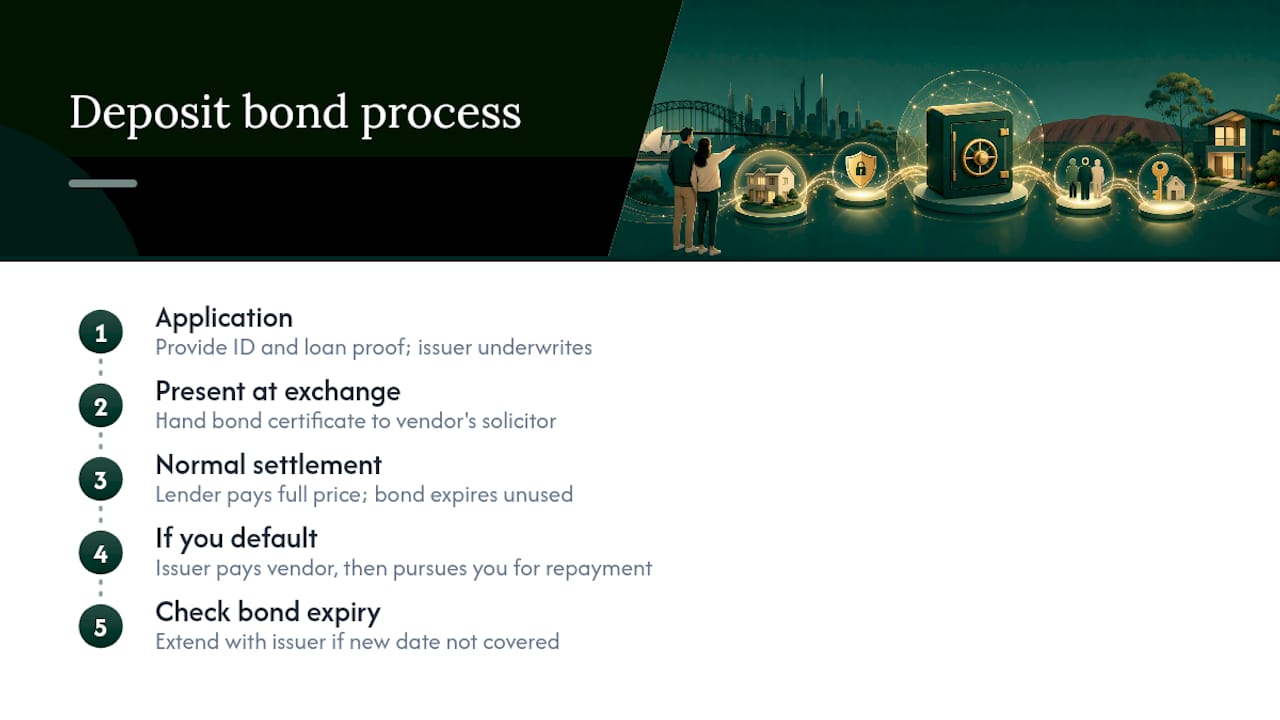
You present this to the vendor’s solicitor at exchange in place of the cash deposit.
Step 3: Normal settlement. In the vast majority of transactions, settlement proceeds without incident. Your lender pays the full purchase price on settlement day, the bond expires, and that’s the end of it. The vendor never needed to call on the guarantee.
Step 4: If you default. If you cannot settle and the contract entitles the vendor to retain the deposit, the vendor lodges a claim with the issuer. The issuer pays the vendor the deposit amount. The issuer then pursues you for repayment, plus any associated fees. Realestate Lens explains this clearly: a deposit bond is a guarantee, not a loan. You receive no money, no interest accrues, and the issuer’s payment to the vendor does not absolve you of the debt.
Illustrative example: You’re buying a $1,200,000 property in Sydney’s Inner West. Rather than drawing down savings or arranging bridging finance, you obtain a deposit bond for $120,000 valid for 90 days. At exchange, you hand over the bond certificate. Settlement proceeds normally, your lender pays $1,200,000, and the bond is never called.
Pro Tip: If your settlement date is pushed back after exchange, check immediately whether your bond’s expiry date still covers the new date. An expired bond at settlement is a serious contractual problem, and extending it requires going back to the issuer.
Who issues deposit bonds in Australia and who qualifies?
Provider types
Deposit bonds in Australia are issued primarily by specialist insurers. Some lenders offer lender-issued deposit bonds as part of their home loan products, though these are less common and typically tied to the lender’s own loan approval. Authorised financial institutions may also facilitate bonds in certain circumstances.
The practical difference: insurer-issued bonds are generally available to a wider range of buyers and are not tied to a specific lender. Lender-issued bonds can be faster to obtain if you already have approval with that lender, but you lose flexibility if you switch lenders before settlement.
Eligibility and documents
Approval functions like underwriting, so prepare for a genuine assessment of your financial position. Typical documents required include:
- Photo ID (passport or driver’s licence)
- Signed contract of sale or at minimum a copy of the property details
- Formal loan approval or pre-approval letter from your lender
- Evidence of assets or capacity to settle if no formal loan approval exists
- Details of your existing property sale (if funds are tied up in a settlement)
- Statutory declaration or supporting documents where complex circumstances apply
Approval for straightforward cases, where you have formal loan approval and clear capacity to settle, can be fast. Complex situations, such as self-employed buyers, multiple settlement chains, or off-the-plan purchases with long lead times, require more thorough underwriting and take longer.
Vendor acceptance
Before you even apply, confirm that the vendor will accept a deposit bond. Some vendors and agents insist on cleared funds, particularly in competitive markets or where the vendor has their own settlement obligations. Get written confirmation of acceptance before exchange. Raising it for the first time on exchange day is a risk you don’t need to take. Understanding unconditional exchange obligations in NSW is useful context here, as exchange commits both parties to the contract terms.
What do deposit bonds cover and what do they cost?
Typical cover and term
Deposit bonds commonly cover around 10% of the purchase price, which is the standard deposit amount in most Australian residential contracts. The bond term is set to align with your expected settlement date. For standard purchases, terms of 30 to 180 days are typical. Off-the-plan purchases can require longer terms, sometimes 12 months or more, and these attract different pricing and stricter underwriting to reflect the extended risk window.
Fee structure
The cost is a one-off premium paid at the time of issue, not an ongoing interest charge. The premium is generally calculated as a percentage of the deposit amount, with the rate varying by term length and the applicant’s risk profile. A shorter term and a straightforward financial position produce a lower premium; a longer term or complex circumstances push it higher.
You should request quotes from multiple providers and compare them directly. The premium is a fixed, known cost, which makes it easier to compare against alternatives.
For context on the broader costs involved in buying a property, a deposit bond premium is typically modest relative to stamp duty, legal fees, and lender charges, but it is an additional line item to budget for.
Factors that increase the premium:
- Longer bond term (off-the-plan purchases)
- Higher perceived settlement risk or complex income structure
- Need for additional security or guarantor support
- Larger deposit amount
Pro Tip: Compare the bond premium against the cost of bridging finance for the same period. For a short timing gap, the one-off premium is often materially lower than bridging interest, and it avoids the administrative burden of a short-term loan.
Pros and cons of using a deposit bond
Buyer advantages
- Preserves liquidity. Your cash stays invested or accessible until settlement rather than sitting idle as a held deposit.
- Avoids bridging finance. For buyers whose funds are temporarily tied up, a bond sidesteps the cost and complexity of a short-term loan.
- Secures the property. You can exchange contracts and lock in the purchase even when cash isn’t immediately available.
- Fixed, known cost. The one-off premium is predictable, unlike bridging interest which compounds over time.
Buyer risks and disadvantages
- You remain liable. If the bond is called, the issuer pays the vendor and then recovers the full amount from you. The bond does not limit your financial exposure.
- Underwriting can fail. Not every applicant qualifies. If your financial position doesn’t satisfy the issuer’s criteria, you won’t get the bond.
- Premium is non-refundable. If the purchase falls through for reasons that don’t trigger a claim, you’ve still paid the premium.
- Vendor refusal. A bond is only useful if the vendor accepts it. Some won’t, particularly in competitive markets where vendors have multiple offers with cash deposits.
Vendor perspective
From a vendor’s standpoint, a deposit bond backed by a reputable insurer offers a form of certainty, but it is not the same as cleared funds in a trust account. Some vendors prefer cash because it is immediately accessible if the buyer defaults. Others are comfortable with a bond, particularly where the buyer’s financial position is clearly strong. Agents sometimes advise vendors against bonds in fast-moving markets where the vendor can easily find a cash-deposit buyer. Contract clauses that explicitly require a cash deposit will override any bond arrangement, so read the contract carefully before assuming a bond will be accepted.

When does a deposit bond make sense, and what are the alternatives?
A deposit bond suits specific circumstances well. It’s a poor fit for others.
Use a deposit bond when:
- Your funds are tied up in a property sale that settles after your purchase exchange date
- You have formal loan approval but your cash won’t be available until settlement
- You’re purchasing off-the-plan and settlement is months or years away
- The premium cost is lower than the cost of bridging finance for the same period
Consider alternatives when:
- The vendor insists on cleared funds (a bond won’t help you here)
- Your financial position is complex and underwriting approval is uncertain
- Settlement is imminent and there’s no timing gap to bridge
Alternatives compared
Cash deposit is the simplest option. No underwriting, no premium, no vendor resistance. The downside is that your funds are held in trust and unavailable until settlement, which can create pressure if you need that capital elsewhere.
Bridging finance gives you actual funds to pay the cash deposit. It’s certain and universally accepted, but it carries interest costs and requires its own loan approval process. For longer gaps, the interest bill can exceed the bond premium significantly.
Family guarantee arrangements, where a family member provides security against their own property, can substitute for a cash deposit in some lender products. These are more complex to arrange and carry risk for the guarantor.

Lender-issued deposit arrangements are available through some lenders as part of their home loan products. They can be convenient if you’re already approved with that lender, but they tie you to that lender’s product.
Decision checklist:
- Can you confirm vendor acceptance of a bond before exchange?
- Is your financial position strong enough to pass underwriting?
- Is the premium lower than the cost of bridging finance for your timeline?
- Do you have formal loan approval or clear evidence of capacity to settle?
- Is your settlement chain straightforward enough that timing risk is manageable?
If you answer yes to all five, a deposit bond is worth pursuing. If any answer is uncertain, weigh the alternatives carefully.
How to apply for a deposit bond step by step
Before you apply
- Obtain a copy of the contract of sale and check whether it permits a deposit bond or requires cleared funds.
- Secure formal loan approval or pre-approval from your lender if you don’t already have it.
- Confirm verbally with the vendor’s agent that a deposit bond will be accepted, and request written confirmation.
- Gather your documents: photo ID, loan approval letter, contract details, and any sale documentation for an existing property.
The application process
- Approach a specialist deposit bond issuer or ask your mortgage broker to facilitate an application.
- Submit your documents and complete the issuer’s application form.
- Allow time for underwriting. Standard cases can be assessed quickly; complex cases take longer.
- Receive the bond certificate (digital or paper) upon approval.
- Deliver the bond certificate to the vendor’s solicitor prior to exchange, along with written confirmation of the vendor’s acceptance.
Presenting the bond to the vendor or agent
- Include the issuer’s contact details and a summary of the bond’s terms and expiry date.
- Provide the vendor’s solicitor with the bond certificate before exchange day, not on the day itself.
- Get the vendor’s written acceptance of the bond documented in the contract or in a separate written exchange with the agent.
Timing matters. Apply early enough to allow underwriting and any vendor queries. A last-minute application that delays exchange creates pressure on everyone and may give the vendor grounds to walk away. For off-the-plan purchases, apply as soon as the contract is available.
What happens if the bond is called?
The claim process follows a clear sequence, and buyers need to understand it before they commit to using a bond.
Claim flow:
- The vendor determines the buyer has defaulted and that the contract entitles them to retain the deposit.
- The vendor lodges a formal claim with the bond issuer.
- The issuer assesses the claim and, if valid, pays the vendor the deposit amount.
- The issuer then pursues the buyer for full repayment of that amount, plus any fees and costs incurred.
EA Lawyers outlines the mechanics clearly and recommends legal advice where the vendor’s entitlement to the deposit is disputed. That’s the key point: if you believe the vendor is not entitled to retain the deposit, you need a solicitor or conveyancer involved immediately, before the issuer pays out.
Buyer liability is real. The bond does not cap or limit what you owe. If the issuer pays $120,000 to the vendor, you owe the issuer $120,000 plus costs. Failure to repay can result in debt recovery action and credit consequences.
Practical cautions:
- Keep all communications with the vendor and agent documented in writing.
- Secure written vendor acceptance of the bond before exchange, not after.
- If settlement is delayed, notify the issuer immediately and check whether the bond term needs extending.
- If a claim is threatened, contact your solicitor or conveyancer before responding to the issuer or vendor.
- Never assume a disputed vendor entitlement will resolve itself. Get legal advice early.
When to involve a buyer’s agent if you’re using a deposit bond
Deposit bonds introduce timing and negotiation complexity that a buyer’s agent is well-placed to manage. There are specific situations where professional representation makes a material difference.
Situations where a buyer’s agent adds clear value:
- Short exchange windows where there’s limited time to obtain the bond and secure vendor acceptance
- Vendor or agent resistance to bonds, where negotiation is needed to get written acceptance
- Complex settlement chains where your purchase and sale settlements need to be coordinated
- Off-the-plan purchases in Sydney where longer bond terms and stricter underwriting apply
- Interstate buyers purchasing in Sydney who can’t attend in person to manage exchange logistics
A buyer’s agent can negotiate vendor acceptance of a deposit bond as part of the broader contract negotiation, coordinate timing across settlement chains, advise on whether bridging finance or a bond is the better fit for your specific situation, and liaise directly with your solicitor and bond issuer to keep the transaction on track.
Sydney Property Buyers is directed by Kristan Johnson, 2024 Outstanding Buyers Agent of the Year (Inner West Local Business Awards). The agency has secured 100+ properties for clients across Sydney’s Inner West, Eastern Suburbs, Lower North Shore, and Eastern Beaches, with more than 30% of purchases completed off-market. Where deposit bond timing or vendor acceptance has been a sticking point, coordinating the exchange conditions and securing written vendor agreement is part of the negotiation process, not an afterthought.
Understanding the benefits of exclusive buyers agent representation is worth reading if you’re weighing whether professional help is warranted for your purchase.
A buyer’s agent’s view on the two mistakes that cost buyers most
The two pitfalls I see repeatedly are vendor non-acceptance discovered too late, and bond approvals that arrive after exchange day has been set.
On vendor acceptance: buyers often assume that because a deposit bond is a legitimate financial instrument, vendors will accept it without question. They won’t, not always. In competitive Sydney markets, a vendor with multiple interested parties will take the cash deposit every time. Raising the bond question early, ideally before you’ve committed emotionally to the property, gives you time to negotiate or pivot to an alternative.
On timing: underwriting takes time, particularly if your financial position is anything other than straightforward. Applying the day before exchange is a gamble. Apply as soon as you have a contract copy and loan approval, and build in buffer for the issuer’s questions.
If your transaction has a tight timeline, a complex settlement chain, or any uncertainty about vendor acceptance, get advice specific to your situation before you exchange. A conversation with a buyer’s agent or conveyancer at that stage costs far less than a failed exchange.
Sydney Property Buyers can help you navigate deposit bond situations

Deposit bond transactions in Sydney carry specific risks: vendor resistance, tight exchange windows, and settlement chains that need careful coordination. Sydney Property Buyers works exclusively for buyers, never sellers, which means the negotiation focus is entirely on securing the best outcome for you, including getting written vendor acceptance of a deposit bond where that’s the right approach.
Kristan Johnson and the team handle the full purchase journey across Sydney’s Inner West, Eastern Suburbs, Lower North Shore, and Eastern Beaches, from strategy and property search through to settlement coordination. If you’ve identified a property and need negotiation-only support, that’s available too.
If a deposit bond is part of your purchase plan, or if you’re unsure whether it’s the right option for your situation, explore the full range of services or call 1800 676 177 to discuss your circumstances directly.
This article is general information, not a substitute for advice from a qualified financial advisor. Consult a qualified financial professional about your own circumstances before acting on anything here.
Sources
The following sources were used to compile this article and contain more detailed explanations, fee examples, and legal commentary:
- Moneysmart
- Deposit Bonds: what are they and how do they work? | Canstar
- What are deposit bonds and how do they work? | Loan Market
- Understanding Deposit Bonds: How They Work for Australian Property Buyers | Realestate Lens
- Deposit Bonds When Buying and Selling Property | EA Lawyers
Recommended
- Types of buyers agent licensing requirements in Australia
- Unconditional exchange: what Sydney buyers must know
- Common misconceptions about buyers agents explained
- What does fiduciary duty mean for a buyer’s agent?