Complying development is a combined planning and construction approval, issued as a single Complying Development Certificate (CDC), for straightforward residential, commercial and industrial works in New South Wales. According to NSW Planning, approvals can be issued in as little as 20 days, or just 10 days for projects that qualify for the NSW Housing Pattern Book fast‑track pathway, which has a dedicated process for eligible residential dwellings. You apply online through the NSW Planning Portal, and either your local council or an accredited private certifier assesses and issues the certificate.
The key distinction from a standard Development Application (DA) is that a CDC is a checklist decision, not a merit-based one. If your project meets the prescribed standards, the certifier must issue the certificate. There is no subjective design assessment, no community notification period, and no council deliberation. That is what makes it fast.
- Combined planning and building approval in a single certificate
- Assessed against fixed standards in the Codes SEPP (State Environmental Planning Policy (Exempt and Complying Development Codes) 2008) or the NSW Housing Pattern Book
- Issued by council or an accredited private certifier
- Standard statutory assessment period: 20 days
- Pattern Book pathway: a shorter timeframe
- Lodge online via the NSW Planning Portal
Key takeaways
Complying development is a checklist-based, combined planning and building approval that must be issued within 20 days if every standard is met, or within 10 days for qualifying applications under the NSW Housing Pattern Book fast-track pathway, making it the fastest formal approval process in NSW.
| Point | Details |
|---|---|
| What a CDC is | A single combined planning and construction approval for straightforward works, assessed against fixed Codes SEPP or Pattern Book standards. |
| Who issues it | Either your local council or an accredited private certifier, both regulated under the same legislative framework. |
| Standard timeframe | 20 days for a standard CDC; 10 days for eligible projects under the NSW Housing Pattern Book pathway. |
| Key exclusions | Heritage items, ecologically sensitive land, coastal hazard zones, certain ANEF contours, and unsewered land in drinking water catchments are common blockers. |
| First practical step | Check your LEP, heritage, and environmental overlays on the NSW Planning Portal before spending money on plans or reports. |
Table of Contents
- What types of work commonly qualify as complying development?
- Who assesses and issues a Complying Development Certificate?
- How do you apply for a CDC via the NSW Planning Portal?
- What do complying development costs and timeframes look like?
- How does complying development differ from exempt development and a DA?
- Where is complying development not allowed?
- What are your obligations after a CDC is issued?
- What is the NSW Housing Pattern Book and how does it affect your application?
- How to check whether your property or project is eligible
- Who should you contact for help with complying development?
- The eligibility question buyers consistently underestimate
- Need help with CDC due diligence before you buy?
- Sources
What types of work commonly qualify as complying development?
The definition of complying development covers a broad range of works, provided each project meets specific design and siting standards set out in the Codes SEPP or the Pattern Book. Common eligible works include:
- New dwelling houses (subject to floor area, height and setback limits)
- Alterations and additions to existing dwellings
- Secondary dwellings (granny flats) where the land and zoning permit
- Swimming pools and spas
- Demolition of structures where the Codes SEPP allows it
- Simple commercial and industrial fit-outs
- Carports, garages, and outbuildings within prescribed dimensions
Complying development generally covers larger or more complex works than exempt development, which requires no approval at all. The trade-off is that every element of your project must satisfy a specific numerical or performance standard. There is no room to argue that a design is “in the spirit” of the rules. If one measurement falls outside the standard, the project is not eligible as a CDC and must go through a DA instead.
Who assesses and issues a Complying Development Certificate?
NSW Government guidance confirms that either your local council or a registered accredited certifier can issue a CDC. Both must apply the same legislative standards. The choice is yours.
Council operates as a public authority. Fees are set by regulation, turnaround times can vary with workload, and the process is transparent but sometimes slower in practice.
Accredited private certifiers are regulated by NSW Fair Trading and act as independent decision-makers, not as consultants working in your interest. That distinction matters. A certifier’s job is to assess compliance objectively, and under Section 4.28 of the Environmental Planning and Assessment Act 1979, a certifier must not refuse a CDC if the proposal meets the applicable development standards. They cannot add conditions based on personal preference or neighbourhood opinion.
- Both council and private certifiers follow identical legislative standards
- Private certifiers are regulated by NSW Fair Trading
- Certifiers act as independent agents of the public interest, not as advocates for the applicant
- Response times and service models differ between council and private certifiers in practice
Pro Tip: Get quotes from two or three accredited private certifiers before committing. Fees vary, and some certifiers have deeper experience with specific project types — a certifier who regularly handles granny flat CDCs will often move faster and flag issues earlier than one who does not.
How do you apply for a CDC via the NSW Planning Portal?
The shortest answer: apply online via the NSW Planning Portal Online CDC service. Service NSW also provides guidance on eligible project types and the transactional steps involved.
- Confirm eligibility. Check your land zoning, LEP constraints, and whether any heritage or environmental overlays apply. Use the Planning Portal’s mapping tools and your council’s LEP maps.
- Prepare your documents. You will typically need architectural plans, a site plan, a BASIX certificate (for residential thermal and water efficiency where required), a construction certificate documentation package, a title search, and any specialist reports (structural, survey, bushfire, flood).
- Choose your certifier. Decide whether to lodge with council or an accredited private certifier. Both can receive applications through the Planning Portal.
- Lodge online. Create or log into your NSW Planning Portal account and submit the application with all supporting documents.
- Pay the lodgement fee. A small NSW Planning Portal lodgement fee applies at submission.
- Assessment period begins. The certifier has 20 days to assess your application (10 days under the Pattern Book pathway). They may request additional information, which pauses the clock.
- CDC issued or refused. If your project meets all standards, the CDC must be issued. If it does not comply, you will receive written reasons and may need to revise the design or pursue a DA.
Required documents at a glance:
- Scaled architectural and site plans
- BASIX certificate (residential projects where applicable)
- Title search and survey
- Structural engineer’s report (where required)
- Specialist reports: bushfire, flood, acoustic (where the site triggers these)
- Construction certificate documentation
What do complying development costs and timeframes look like?
The statutory assessment periods are fixed: 20 days for a standard CDC, 10 days for projects qualifying under the NSW Housing Pattern Book pathway. Those clocks start from the date a complete application is lodged, so having all documents ready before you submit is the single most effective way to avoid delays.
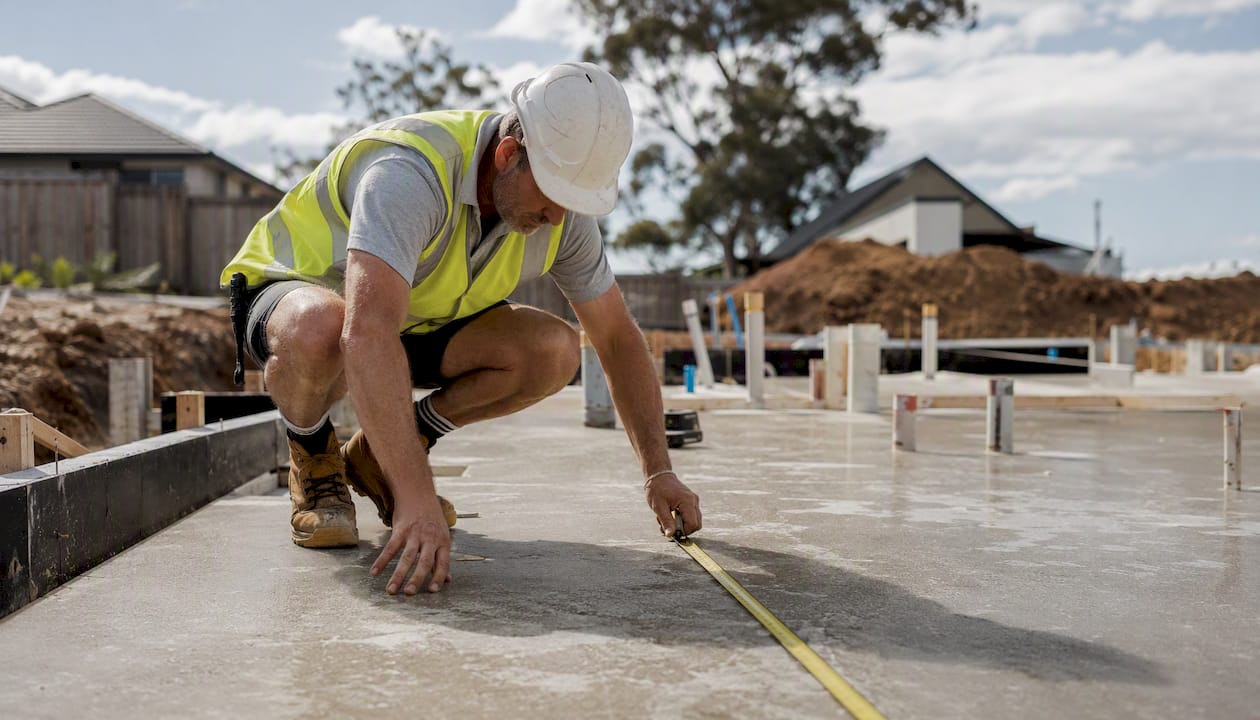
On fees, industry guidance notes a broad example range of approximately $1,500 to $5,000+ for common residential CDCs, with variability depending on project type and scope. These are indicative figures only. Always request a written quote from your council or chosen certifier.
Typical fee components:
- NSW Planning Portal lodgement fee, which includes a small flat amount
- Council or private certifier assessment fee (the largest component)
- BASIX certificate fee (where required)
- Structural or specialist report fees
- Survey costs
- Inspection and compliance certificate fees during and after construction
Pro Tip: Budget a contingency of 15–20% above the certifier’s quoted fee. Specialist reports, amended plans, and additional inspections are common and add up quickly on projects that sit close to the eligibility boundaries.
| Fee component | Who charges it | Typical range (indicative) |
|---|---|---|
| Certifier or council assessment | Council or private certifier | Varies by project; part of the $1,500–$5,000+ range |
| Planning Portal lodgement | NSW Government | Small flat fee (example: ~$47) |
| BASIX certificate | Accredited assessor | Varies by project |
| Specialist reports (structural, survey, bushfire) | Consultants | Varies by site and complexity |
How does complying development differ from exempt development and a DA?
NSW Planning guidance draws a clear line between the three pathways. Understanding where your project sits determines how much time and money you spend before a single brick is laid.
| Pathway | Approval required | How it is assessed | Typical timeframe |
|---|---|---|---|
| Exempt development | None | Self-assessed against Codes SEPP standards | Immediate — no application |
| Complying development (CDC) | Yes — CDC required | Checklist against Codes SEPP or Pattern Book standards | 20 days (10 days for eligible Pattern Book applications) |
| Development Application (DA) | Yes — DA required | Merit-based assessment by council | Weeks to months |
The critical difference between a CDC and a DA is the nature of the decision. A certifier assessing a CDC applies a binary test based on compliance with specific standards. If yes, the certificate must be issued. A council assessing a DA can weigh competing interests, apply discretion, and impose conditions that go well beyond the minimum standards. That flexibility is sometimes useful for complex or unusual projects, but it also means longer timeframes and less certainty.
Exempt development sits at the other end: small-scale works like garden sheds, minor fencing, or low decks that meet specific standards in the Codes SEPP require no approval at all. You simply build, provided every standard is satisfied.
- Exempt: no application, no certificate, no certifier — but standards still apply
- CDC: fast, certain, checklist-based — works must meet every prescribed standard
- DA: flexible, merit-based, longer — appropriate for complex, non-standard, or sensitive sites
Where is complying development not allowed?
Certain land types and site conditions make a property ineligible for complying development regardless of how well the design meets the dimensional standards. These are common eligibility blockers that catch buyers and owners off guard.
- Heritage items and heritage conservation areas: properties listed on a heritage register or within a conservation area are generally excluded
- Ecologically sensitive land: land mapped as critical habitat, wilderness, or biodiversity sensitive areas
- Coastal hazard zones: properties within mapped coastal erosion or inundation hazard areas
- ANEF contours: land within certain Australian Noise Exposure Forecast contours near airports
- Unsewered land in drinking water catchments: specific restrictions apply in these areas
- Flood-prone land: certain flood planning levels or flood classifications preclude CDC eligibility
Beyond these mapped exclusions, the local LEP (Local Environmental Plan) and DCP (Development Control Plan) can impose additional constraints. A zone objective, a minimum lot size clause, or a specific provision in the LEP can override CDC eligibility even when the Codes SEPP would otherwise permit the works.
The practical takeaway: always check the property’s LEP mapping on the Planning Portal and confirm with your council or an accredited certifier before spending money on plans or reports.
What are your obligations after a CDC is issued?
Receiving a CDC is not the end of the process. It is the start of a construction phase with specific obligations attached.
Common conditions include:
- Construction hours and noise controls
- Erosion and sedimentation management during works
- Compliance with the approved plans (no variations without a formal amendment)
- Landscaping and site restoration requirements
- Fire safety measures where required by the Building Code of Australia
Inspections are mandatory at prescribed stages of construction. Your certifier will specify the required hold points, which typically include footings, framing, waterproofing, and a final occupation certificate inspection. The certifier issues a compliance certificate at each stage and an Occupation Certificate at completion, confirming the works are lawful and the building is suitable for occupation.
Failing to comply with CDC conditions is not a minor administrative issue. Unapproved variations to approved plans, missed inspections, or works outside the approved footprint can trigger enforcement action by council, orders to rectify or demolish non-compliant work, and complications at the point of sale. A buyer’s agent performing due diligence checks on a property should always verify that any CDC on the title has been properly completed and that an Occupation Certificate has been issued.
What is the NSW Housing Pattern Book and how does it affect your application?
The NSW Housing Pattern Book is a pre-approved design pathway that allows eligible dwelling houses to be assessed in 10 days rather than the standard 20. It uses a set of standardised designs and a dedicated Pattern Book Development Code, which sits alongside the broader Codes SEPP framework.
The Pattern Book pathway is particularly relevant for new dwelling houses on standard residential lots. If your proposed design matches a Pattern Book design and your site meets the eligibility criteria, the faster timetable applies automatically.
The Planning Portal’s draft plans and variation notices page is where NSW Planning publishes proposed amendments to complying development rules, including Pattern Book updates. Rules do change, and a version of the Codes SEPP or Pattern Book that was current when you started planning may have been amended by the time you lodge.
- Check the current Pattern Book designs on the Planning Portal before commissioning plans
- Confirm your site meets the Pattern Book eligibility criteria (lot size, zoning, constraints)
- Review any recent variation notices that may affect your project type
- Always use the current version of the Codes SEPP and Pattern Book at the time of lodgement
How to check whether your property or project is eligible
Run through this checklist before spending money on plans or specialist reports.
- Check the land zoning. Open the NSW Planning Portal and search your property address. Confirm the zone and whether the proposed use is permitted.
- Review the LEP. Download your council’s LEP and check for any site-specific provisions, minimum lot sizes, or clauses that restrict CDC eligibility.
- Check for heritage and environmental overlays. Use the Planning Portal mapping to identify heritage listings, biodiversity sensitivity, coastal hazard zones, and flood planning levels.
- Verify sewer connection. Confirm the property is connected to a reticulated sewer system if your project requires it.
- Check ANEF mapping. If the property is near an airport, confirm it falls outside the ANEF contours that preclude CDC eligibility.
- Measure against Codes SEPP standards. Compare your proposed dimensions (height, setbacks, floor area, site coverage) against the relevant development standards in the Codes SEPP or Pattern Book.
- Consult a certifier or council. If any step raises a question, get a pre-lodgement meeting with your council or a preliminary opinion from an accredited certifier before committing to full documentation.
Useful tools for eligibility checks:
- NSW Planning Portal property search and mapping
- Your council’s LEP and DCP (available on the council website)
- Service NSW CDC eligibility guidance
- Accredited certifier pre-lodgement advice
Who should you contact for help with complying development?
The right contact depends on where you are in the process.
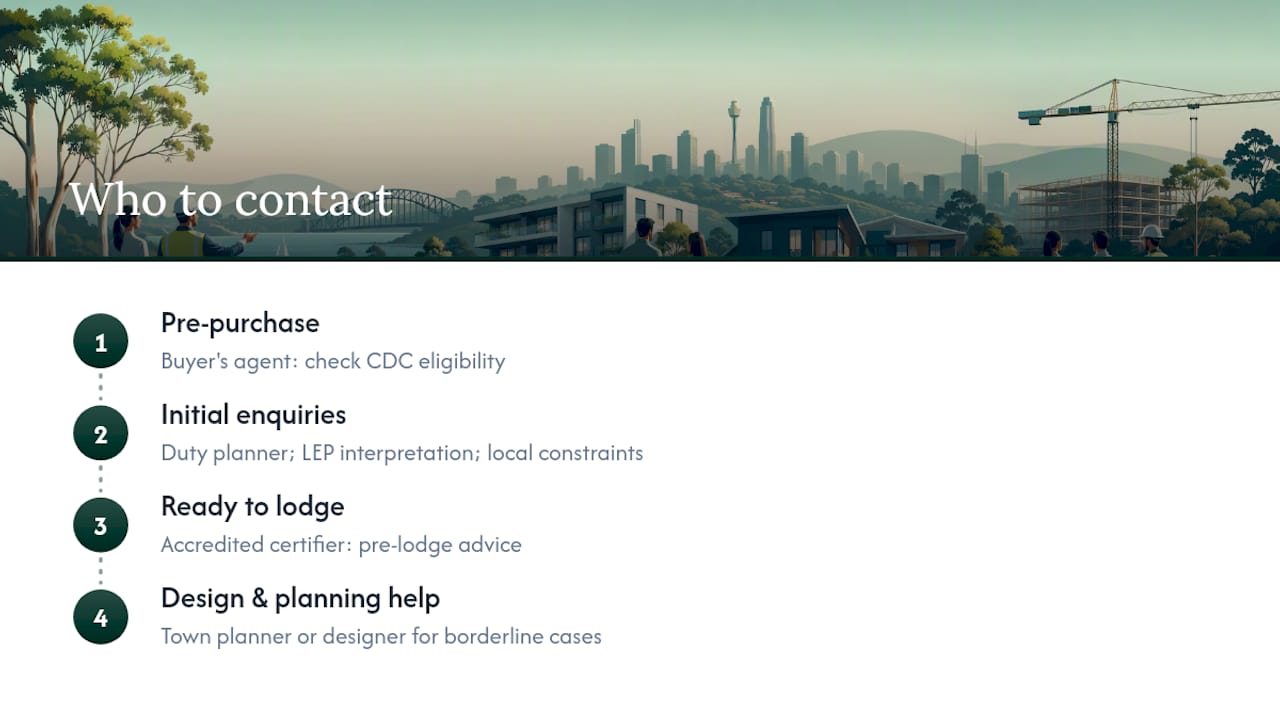
Local council planning team is a good first call for general eligibility questions, LEP interpretation, and understanding local constraints. Most councils offer a duty planner service for short preliminary enquiries at no charge.
Accredited private certifiers are the right choice once you are ready to lodge. They can also provide pre-lodgement advice on whether your project is likely to comply, which saves money on plans that may need to be revised.
Town planners and building designers are useful when a project sits close to the eligibility boundary or when you need help preparing compliant plans and documentation.
A buyer’s agent is relevant at the pre-purchase stage. If you are buying a property with the intention of building, renovating, or adding a secondary dwelling, understanding CDC eligibility before you exchange contracts can be the difference between a sound investment and an expensive surprise. Sydney Property Buyers routinely performs this kind of due diligence as part of its full-service acquisition process, helping buyers in the Inner West, Eastern Suburbs, Lower North Shore, and Eastern Beaches understand what approvals a property can realistically support. Local knowledge matters when planning constraints vary street by street.
The eligibility question buyers consistently underestimate
Most buyers focus on price, location, and condition. Planning eligibility, including whether a property can support a CDC, tends to come up only after contracts are exchanged, which is precisely when it is too late to renegotiate.
The pattern is predictable: a buyer sees a property with a granny flat opportunity or a renovation potential that looks straightforward on paper. They exchange, then discover the land is in a heritage conservation area, or the lot falls just short of the minimum size for a secondary dwelling under the Codes SEPP. The project either cannot proceed as a CDC or cannot proceed at all.
The fix is simple but requires discipline: check CDC eligibility before exchange, not after. That means running the LEP and mapping checks described above, and if anything is unclear, getting a written pre-lodgement opinion from a certifier. A licensed buyer’s agent who understands local planning controls can flag these constraints during due diligence, before you are contractually committed.
Need help with CDC due diligence before you buy?
Sydney Property Buyers provides full-service acquisition support across Inner West Sydney, Eastern Suburbs Sydney, Lower North Shore Sydney, and Eastern Beaches Sydney, including pre-purchase due diligence on planning and CDC eligibility. With a 5.0 Google rating, 100+ properties secured, and an average saving of approximately 9% on purchase price, the firm’s process is built around protecting buyers from exactly the kind of planning surprises described above.
Explore Sydney Property Buyers’ services or call 1800 676 177 to discuss your property search.
Sources
These are the primary NSW Government resources for verifying rules, checking eligibility, and lodging a CDC application.
- Complying development | Planning
- Complying Development | Planning Portal – Department of Planning and Environment
Process for obtaining complying development certificates](http://20.austlii.edu.au/cgi-bin/viewdoc/au/legis/nsw/consol_act/epaaa1979389/s4.28.html) - Apply for a complying development certificate
- Development consent or a Complying Development Certificate (CDC)
- How Much Does a CDC Cost in NSW?
Recommended
- What does the first home buyer grant mean in NSW?
- What is conflict of interest in real estate?
- Why a licensed buyer’s agent matters in Sydney
- Sydney inner west suburb comparison: 2026 guide