Strata by-laws in NSW are legally enforceable rules made under the Strata Schemes Management Act 2015, and they bind every owner, tenant and visitor in the scheme. They commonly govern pets, parking, noise, smoking, renovations and short-term rentals.
Breach one and the owners corporation can issue a Notice to Comply, refer the matter to mediation through NSW Fair Trading, or apply to the NSW Civil and Administrative Tribunal for orders and fines.
You can get a copy of your scheme’s by-laws several ways:
- Ask the owners corporation or strata manager directly
- Check the contract of sale if you’re buying
- Run a paid search through NSW Land Registry Services
Key Takeaways
Strata by-laws in NSW are enforceable under the Strata Schemes Management Act 2015, and breaches escalate through Notice to Comply, mediation and NCAT, with penalties reaching penalty unit levels for repeat offences.
| Point | Details |
|---|---|
| By-laws bind everyone | Owners, tenants and visitors must all follow scheme by-laws, regardless of who signed the lease. |
| Model vs scheme-specific | Most schemes adapt the standard model by-laws with local clauses for pets, parking and renovations. |
| Six-month registration rule | Approved by-law changes must be registered with NSW LRS within six months or the resolution lapses. |
| Enforcement has real teeth | NCAT can impose penalties of 10 penalty units rising to 20 penalty units for repeat breaches. |
| Check records before you commit | Sydney Property Buyers reviews by-laws, minutes and financials as part of its due diligence before exchange. |
Table of Contents
- What do strata by-laws in NSW actually cover?
- Where can you find your strata by-laws?
- How do you make or change strata by-laws in NSW?
- What happens when someone breaches a strata by-law?
- What can’t a strata by-law legally do?
- Why registration timing with NSW LRS actually matters
- A practical checklist before you buy, own or rent
- Sources
What do strata by-laws in NSW actually cover?
Every scheme starts with a set of model by-laws, a standard template the Strata Schemes Management Act 2015 provides so owners corporations have a legally sound starting point. Most schemes then adapt them, adding scheme-specific clauses that reflect the building’s layout, age or history of disputes.
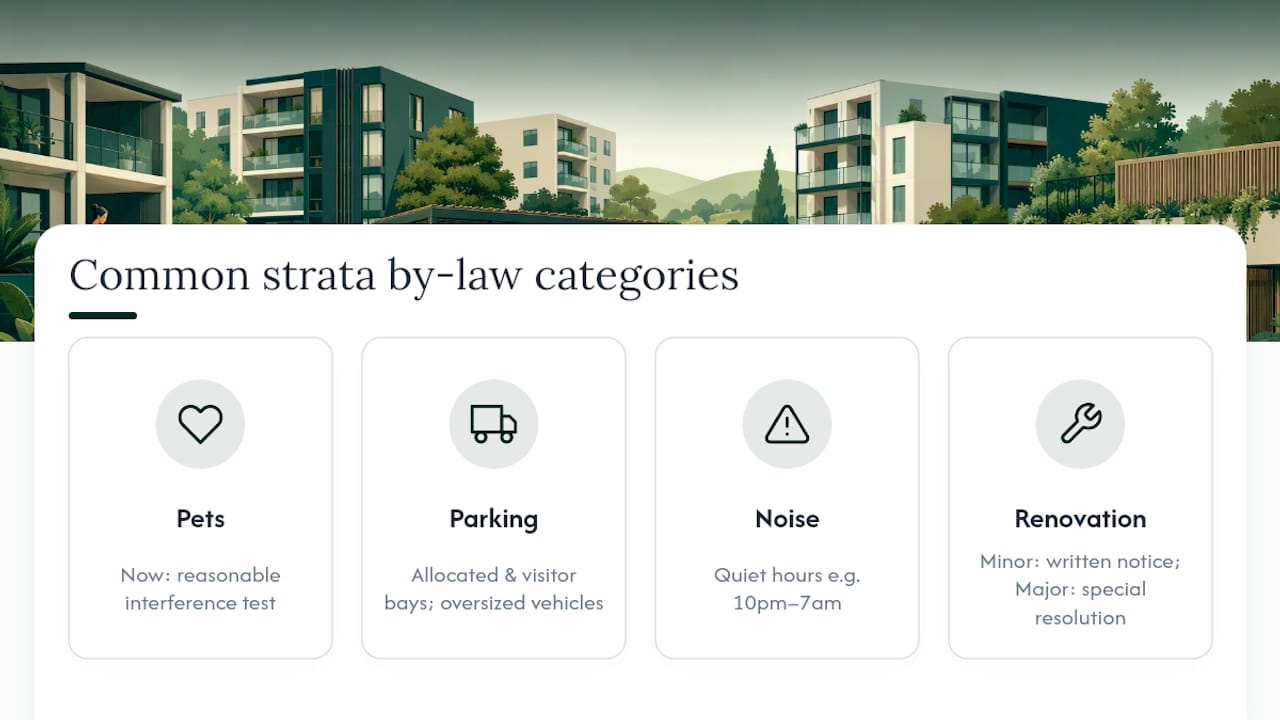
Pets are the classic example. Older by-laws often banned animals outright. Since a well-known court challenge tested blanket pet bans, most schemes now use a “reasonable interference” test instead, meaning a resident can keep a pet unless it unreasonably interferes with another occupier’s use of their lot or the common property. Parking by-laws typically nominate allocated spaces, deal with visitor bays and set rules for oversized vehicles or trailers. Noise by-laws usually specify quiet hours, often something like 10pm to 7am, and renovation by-laws set out when you need owners corporation consent before you touch structural walls, flooring or balconies.
By-laws bind tenants and visitors exactly as they bind owners. A landlord can’t opt a tenant out of the noise rules, and a weekend guest parking in someone else’s allocated bay is still in breach even if they’ve never read the by-laws.
Pro Tip: Before you renovate, check whether your scheme distinguishes between “minor renovations” (which often only need owners corporation approval by written notice) and “major renovations” (which need a special resolution at a general meeting). Getting this wrong can mean redoing paperwork months into a build.
Where can you find your strata by-laws?
Getting hold of the actual document is usually straightforward, provided you know where to look.
- Ask the owners corporation or strata manager first. They’re required to hold a current, consolidated set and most will email a copy within a few days.
- Check the contract of sale. If you’re buying, the by-laws should be attached to the contract along with the strata plan, minutes and financials, since agents are obliged to disclose this before exchange.
- Run a search through NSW LRS. If the seller or agent can’t produce a copy, you can order a strata search through NSW Land Registry Services or an approved information broker for a small fee.
Tenants have it slightly easier: agents must give prospective tenants a copy of the by-laws before they sign a lease, so if you haven’t seen them, ask before you commit to anything — or consider specialist strata cleaning services for upkeep of common areas affected by breaches.
How do you make or change strata by-laws in NSW?
Changing a by-law isn’t as simple as the committee agreeing over coffee. It has to go through a formal process, and skipping steps is the fastest way to end up with an unenforceable rule.
- Draft the proposed by-law. Any owner can propose one, but vague or overly broad wording gets challenged. If the change is significant (say, a short-term letting restriction), it’s worth getting legal input before it reaches a vote.
- Prepare a motion and explanatory note. This goes on the agenda for a general meeting, giving other owners time to read and consider it before voting.
- Pass a special resolution. No more than 25% of the votes cast can be against the motion for it to succeed, unlike an ordinary resolution which just needs a simple majority.
- Register the change with NSW LRS within six months. This is the step people forget, and it matters: registration is what makes the by-law legally effective.
There’s an important distinction between consolidating by-laws (repackaging existing rules into one clean document with no substantive change) and actually changing them (which alters rights or obligations and needs the full special resolution process).
Pro Tip: Keep a paper trail of every motion, vote count and registration receipt. If a by-law is ever challenged at NCAT, the owners corporation needs to prove it followed the correct procedure, not just that the by-law exists.
What happens when someone breaches a strata by-law?
Escalation follows a fairly predictable path, and understanding it helps you gauge how long a dispute might realistically take.
- Gather evidence early. Date-stamped photos, a noise log with times and dates, and copies of any written complaints all strengthen a case considerably more than a vague verbal grievance.
- Notice to Comply. The owners corporation, or its delegate, must issue this formally. It has to specify exactly which by-law was breached and what needs to stop. Residents can’t issue this themselves; they report the breach to the committee, which then acts.
- Mediation. NSW Fair Trading offers mediation before or alongside a Tribunal application, and many disputes resolve at this stage without ever reaching a hearing.
- NCAT application. If mediation fails, NCAT can issue orders and impose civil penalties requiring the behaviour to stop.
A first breach can attract a penalty of 10 penalty units (around $1,100), rising to 20 penalty units (around $2,200) for a repeat breach within 12 months. Straightforward disputes with strong evidence often resolve within a few months; contested ones involving legal representation can run considerably longer.
What can’t a strata by-law legally do?
By-laws have real limits, and owners corporations that push past them risk having the rule struck down entirely.
- A by-law cannot conflict with existing legislation, no matter how the committee votes.
- It cannot be harsh, unconscionable or oppressive to a particular owner or class of owner.
- It cannot ban children from living in the scheme or impose blanket bans on assistance animals.
- It cannot block reasonable sustainability installations, such as solar panels or EV chargers, except in limited heritage-listed circumstances.
Blanket pet bans are the most frequently cited example: NCAT and the courts have repeatedly found that an outright ban is unreasonable, forcing schemes back to the “reasonable interference” model instead.
Why registration timing with NSW LRS actually matters
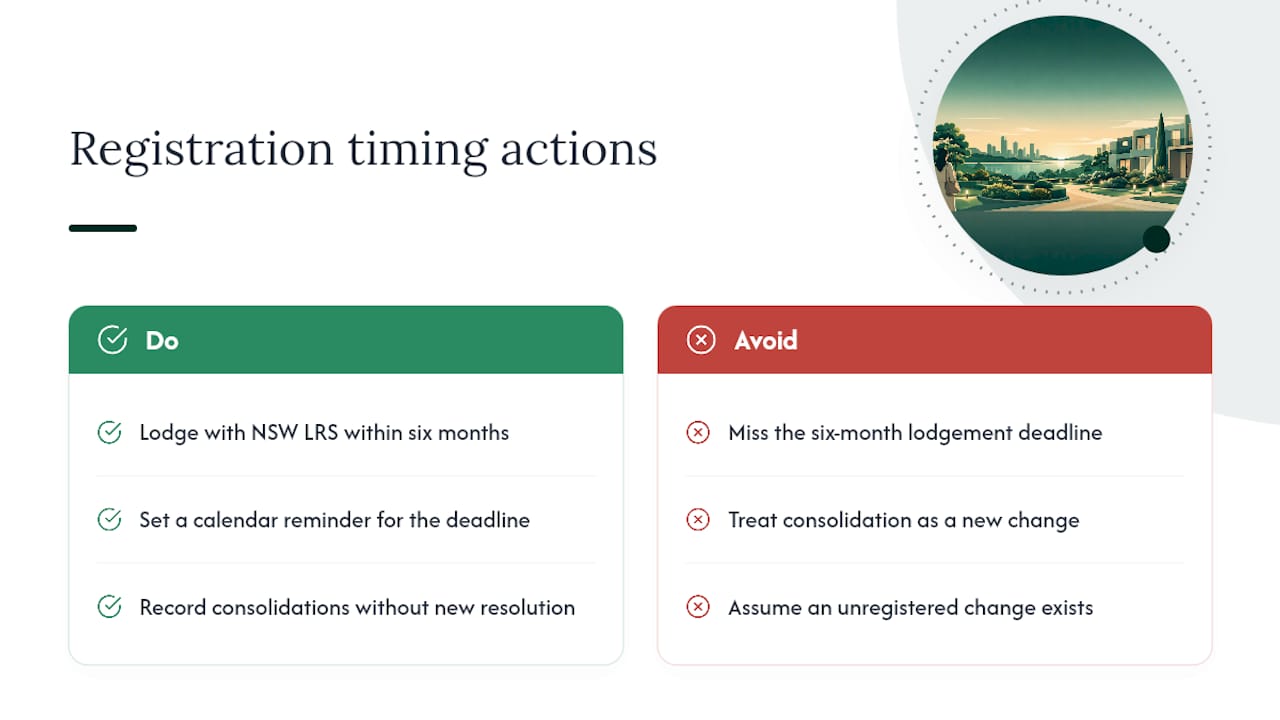
A by-law change only takes legal effect once it’s registered, and you have six months from the date the special resolution passes to lodge it with NSW Land Registry Services. Miss that window and the change simply doesn’t exist in law.
That’s a different process from consolidating: bundling existing, unchanged by-laws into a single tidy document doesn’t need a fresh resolution, just an accurate record. If the six-month deadline lapses on a genuine change, the owners corporation has to start again, pass another special resolution and register it properly. It’s a costly do-over for something that a calendar reminder could have avoided.
A practical checklist before you buy, own or rent
Whether you’re purchasing, already living in a scheme, or renting, a short list of checks now saves a much longer dispute later.
- Request the full document set: current by-laws, the strata plan, the last two years of AGM minutes, financial statements, and the certificate of currency for building insurance.
- Ask direct questions of the strata manager: outstanding by-law breaches, pending NCAT matters, upcoming special levies and any building defects under negotiation.
- If a dispute is already brewing, start a log immediately: dated photos, written correspondence, witness names and a timeline of events.
- Get professional eyes on it when the scheme has a complicated by-law history or an active dispute. A strata report or a buyer’s agent’s review of strata records can surface risks a quick skim of the minutes won’t.
Pro Tip: Ask specifically whether any by-law amendments have lapsed unregistered. It’s a question most buyers never think to ask, and it can reveal a scheme with a history of governance shortcuts.
Common mistakes buyers and owners make with by-laws
The mistake I see most often isn’t ignorance of the rules, it’s assuming an informal chat with a neighbour will fix a breach that’s been entrenched for years. It rarely does. Noise disputes, parking disagreements and pet complaints that have festered for months need the formal Notice to Comply process, not another polite email.
Buyers who check by-laws and recent NCAT history before exchange avoid the worst surprises. Bringing in professional help before you’re locked into a contract is almost always cheaper than untangling a dispute after settlement.
— Kristan
How Sydney Property Buyers handles strata due diligence for purchasers
There are other ways to check a scheme’s by-laws before you buy: request them yourself from the agent, order a search through NSW LRS, or ask a solicitor to review the contract documents. Each works, but each also leaves the reading, interpreting and risk-flagging entirely up to you at exactly the point in a purchase when you have the least time to do it properly.

Sydney Property Buyers reviews strata records as a standard part of due diligence within its full-service buyer representation, covering by-laws, minutes, financials and insurance before you’re committed to a contract. That means a risk report lands in your hands before exchange, not after settlement when it’s too late to negotiate. The team then carries that groundwork straight through negotiation, auction bidding and settlement, so nothing gets missed between the strata check and the day you get the keys. If you’re weighing up a purchase with a complicated strata history, look at the full search-to-settlement process and get in touch before you make an offer.
Sources
- Strata by-laws | NSW Government
- STRATA SCHEMES MANAGEMENT ACT 2015 (NSW) — consolidated
- Strata search | NSW Government
Recommended
- Strata schemes in Australia: what every buyer must know
- Why a buyer’s agent checks strata records in Sydney
- What is a strata report? A buyer’s guide for 2026
- Unit entitlement NSW: what owners and buyers need to know