Buying off the plan carries materially more financial and contract risk than buying a finished property, and most of that risk sits in five places: the price you agree today can diverge sharply from what a bank values the finished unit at, the developer can delay or collapse before completion, the contract can contain clauses that work against you, your finance can fall short at settlement, and the finished product can look nothing like the brochure. None of this means off the plan buying is a bad idea. It means the exposure is different from buying an established home, and it needs to be managed before you sign, not after.
The risks that matter most, in order of how often they bite:
- Valuation shortfall — the bank’s completion valuation comes in under your contract price
- Developer or builder insolvency — the project stalls or collapses mid-build
- Contract traps — sunset clauses, variation rights and vague finishes schedules
- Finance risk at settlement — your loan approval doesn’t stretch to cover a lower valuation
- Quality and design drift — what gets built differs from what you were shown
Before you pay a cent, confirm exactly how your deposit is held and get a property lawyer to review the contract. That single step resolves more off the plan property issues than anything else you can do at the outset.
TL;DR:
- Off the plan buyers face significant valuation risks at settlement, with lenders often valuing the property lower than the purchase price, potentially requiring additional cash or causing default.
- Contract clauses like sunset provisions, substitution rights, and escalation clauses can be exploited by developers; legal review and negotiation are essential to mitigate these risks.
- Developer insolvency or delays during construction are common and can lead to project halts, resale at reduced prices, or loss of deposits if protections are not properly in place.
- Financing is riskier than for established properties, as loan amounts are assessed at completion, often years later, with the potential for valuation drops and unanticipated shortfalls.
- Ongoing costs such as levies, vacancies, and special levies in large developments can erode investment returns; thorough due diligence on these expenses is crucial before committing.
Table of Contents
- Off the plan risks in the market: what a lender re-valuation can cost you
- Contract traps: sunset clauses and other clauses that quietly favour the developer
- Developer and construction risk: insolvency, delays and finish quality
- Off the plan risks in financing: why settlement day is not guaranteed
- Ongoing costs and vacancy risk for off plan investors
- Due diligence checklist before you sign an off the plan contract
- Mitigation tactics that actually reduce your exposure
- How a buyer’s agent evaluates off the plan risk before you commit
- Get professional support before you sign an off the plan contract
- Key Takeaways
- What the conventional advice on off the plan buying gets wrong
- Sources
Off the plan risks in the market: what a lender re-valuation can cost you
Buying off the plan means paying an agreed price now for a property that doesn’t exist yet, and settling only once it’s built and registered, sometimes years later. That gap between signing and settling is where most of the financial exposure sits, because the market you bought into and the market you settle into can be two different animals.
Here’s the mechanic that catches people out. When you exchange contracts, your finance is typically approved against the contract price. But lenders don’t lend against a promise. At or near completion, they send a valuer to assess the finished unit on its own merits, and that valuation replaces the contract price as the basis for your loan. If property values have fallen, or if the finished building simply doesn’t stack up against recent comparable sales, the lender’s completion valuation can come in below the price you agreed to pay.
That shortfall becomes your problem, not the bank’s. Three things typically happen:
- You find extra cash. The bank lends against the lower valuation, and you cover the gap between what it will lend and what you owe the developer.
- You pay lenders mortgage insurance. If the shortfall pushes your loan-to-value ratio higher than expected, LMI can apply even if you didn’t budget for it.
- You default and lose your deposit. If you genuinely can’t find the shortfall, you may be unable to settle, and the developer can terminate the contract and keep your deposit, then pursue you for further loss on resale.
A simple illustration. Say you exchange on an apartment for a high price with a typical deposit percentage. Two years later, at completion, the bank’s valuer assesses the finished unit at a lower value. Assuming an 80% loan-to-value ratio, your lender will advance a lower amount based on that valuation, potentially requiring you to find a significant shortfall from savings or other sources, on top of your planned settlement costs.
This is far from a rare edge case. Off the plan settlements often land years after exchange, and price cycles in that window can move considerably in either direction. A few practical checks reduce the surprise:
- Ask your lender directly what its policy is on off the plan valuations and whether it revalues automatically at completion.
- Look at how comparable projects in the same precinct have tracked between exchange and settlement, not just current asking prices.
- Build a buffer into your savings specifically earmarked for a valuation shortfall, rather than assuming the contract price will hold.
Contract traps: sunset clauses and other clauses that quietly favour the developer
Off the plan contracts are longer, denser, and far more one-sided than a standard contract for an existing home, and a handful of specific clauses do most of the damage.
Sunset clauses. A sunset clause sets a date by which the project must reach registration or completion. If it doesn’t, either party can typically walk away, which sounds fair until you notice how it’s sometimes used. A small number of developers have historically let a project run past its sunset date deliberately, particularly when the market has risen since the original sale, so they can rescind the contract, refund the deposit, and resell the same unit at a higher price. NSW and other states have tightened the rules here. Under NSW law, a developer generally cannot rescind under a sunset clause without either purchaser consent or the Supreme Court’s permission, which closes off the worst version of this tactic, but the clause itself still needs scrutiny, and protections vary by jurisdiction.
Substitution and variation clauses. Most off the plan contracts give the developer the right to substitute materials, fittings, or even layouts, provided the change is “not material” or “of equivalent quality”. That wording is doing a lot of work, and it is almost always defined by the developer, not the buyer. A promised stone benchtop can become reconstituted composite. A north-facing outlook can shift when a neighbouring block’s design changes. Push your lawyer to tighten this language to something specific and measurable, not a vague comfort clause.
Escalation and staged payment clauses. Some contracts include cost-escalation provisions that pass on increases in construction costs, council contributions, or statutory levies to the buyer after exchange. Read for who bears the risk of a rise in build costs. In a well-drafted contract, that risk sits with the developer, since it is the party controlling the build.
Before you sign, confirm each of these deposit and cooling-off protections directly with your conveyancer:
- Deposits should sit in a solicitor’s trust account or an approved stakeholding arrangement, never released to the developer before settlement.
- A standard cooling-off period generally applies to off the plan contracts, though the length and any waiver conditions vary by state, so confirm the specific rule that applies to your purchase.
- The developer is generally obliged to notify you of material changes to the plans, and you may have a right to rescind if those changes are significant.
- Ask whether the trust account is interest-bearing and who is entitled to that interest at settlement.
Reviewing this documentation is exactly the kind of task worth getting right the first time. Sydney Property Buyers’ guide to what a section 32 disclosure covers walks through the disclosure obligations that sit alongside these contract terms.
Developer and construction risk: insolvency, delays and finish quality
A construction business collapsing mid-project isn’t a hypothetical for off the plan buyers, it’s one of the more common ways these purchases go wrong, and the fallout depends heavily on when in the build cycle it happens.
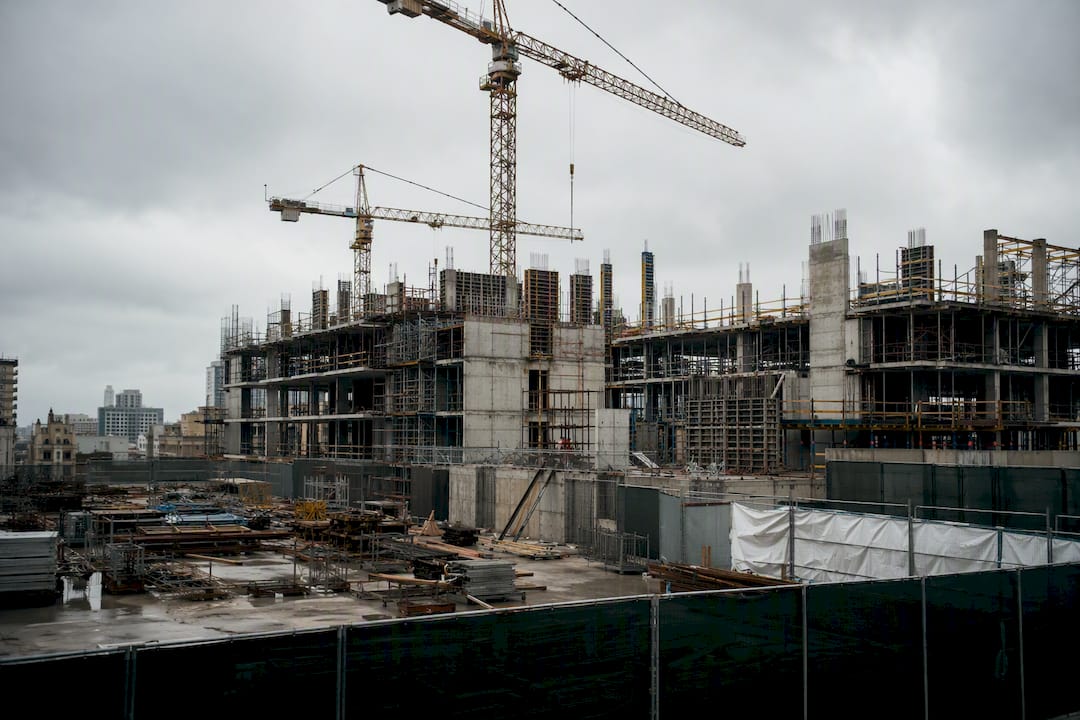
If a developer or builder becomes insolvent before your unit is complete, you’re typically looking at one of a few outcomes: a new builder is appointed and the project resumes on a delayed timeline, the project is mothballed indefinitely while administrators sort out creditor claims, or the site is sold off entirely and your contract is at risk of termination. Your deposit protection becomes critical here, which is why confirming it sits in trust rather than with the developer directly matters so much.
Delays are more common than outright insolvency, and they stack up from ordinary causes: trade shortages, weather, council approval hold-ups, or supply chain disruption on imported materials. Construction delays and developer insolvency both feature consistently among the risks buyers underestimate when they first sign. A delay of six to twelve months isn’t unusual on larger developments, and every month of delay is a month your finance approval, your rental plans, or your own selling timeline (if you’re upgrading) has to stretch to cover.
Then there’s the gap between the marketing render and the finished product. Consumer guidance is blunt about this: buyers cannot inspect the finished product before committing, so the schedule of finishes in your contract is the only real protection against a downgrade in quality. Insist on a detailed, itemised schedule naming brands, models, and materials, not general descriptions.
Before signing, check:
- The builder’s licensing status and any history of complaints through your state’s fair trading or building commission.
- Whether home building compensation or warranty insurance applies to the project, and what it actually covers.
- Whether structural defect warranties extend the standard statutory period.
Pro Tip: Search the builder’s name alongside “administration” or “liquidation” in recent news, not just review sites. Financial distress usually surfaces there long before it appears in official searches.
Off the plan risks in financing: why settlement day is not guaranteed
Financing an off the plan purchase works differently from financing an established home, and the difference catches out even experienced buyers.
When you buy an existing property, your lender values the actual asset before you exchange, so you know roughly where you stand. Off the plan, your initial approval is based on a contract price for something that doesn’t exist yet. The lender’s real assessment happens at or near completion, sometimes years later, using current market data and the finished building. If values have softened, your loan amount can shrink even though your purchase price hasn’t changed.
This is compounded by another quirk of off the plan contracts: the standard “subject to finance” condition that protects buyers of established homes is rarely available here, or is heavily time-limited. Most developers require unconditional exchange, meaning you’re contractually bound to settle regardless of whether your finance situation changes in the intervening years. A job loss, a rate rise, or a change in lending policy between exchange and settlement is your risk to carry, not the developer’s.
To reduce this exposure:
- Get more than a standard pre-approval. Ask your broker or lender specifically how they treat off the plan valuations and whether they’ll commit to a policy in writing.
- Stress-test your borrowing capacity against a lower valuation and a higher interest rate than today’s, not just current settings.
- Keep a genuine cash buffer earmarked purely for a valuation shortfall, separate from your deposit and settlement costs.
- Maintain your financial position between exchange and settlement. Avoid new debt, job changes, or anything that could weaken your borrowing capacity when the lender reassesses you.
- Talk to your lender early if settlement is approaching and finance looks tight. Some will consider a short-term facility or bridging arrangement rather than let you default, but only if you raise it before settlement day, not after.
If finance genuinely falls through, your options narrow fast: negotiate a short settlement extension with the developer (not guaranteed, and often at a cost), bring in a guarantor, or in the worst case, walk away and lose your deposit. None of these are comfortable, which is exactly why the preparation has to happen at exchange, not in the weeks before settlement.
Ongoing costs and vacancy risk for off plan investors
The purchase price is only the start of the sums for an investor. Off the plan apartments come with ongoing strata or body corporate levies that fund building insurance, common area upkeep, and a sinking fund for future capital works. New buildings sometimes carry special levies in the first few years once defects or underfunded sinking funds become apparent, and these figures are rarely disclosed with much precision at the point of sale.
Timing works against investors in another way too. When a large tower or precinct completes, dozens or hundreds of near-identical units often hit the rental market within months of each other. That concentration of supply can depress achievable rents and extend vacancy periods well beyond what the original sales projections assumed.
A few checks before you commit to an off plan investment:
- Ask for the strata plan’s projected annual levy and sinking fund forecast, not just a rough estimate from the sales agent.
- Check how many other apartments in the same building or precinct are due to settle in the same quarter as yours.
- Stress-test your rental yield assumption against a vacancy period of several months, not the best-case scenario in the marketing material.
- Factor in how rising interest rates or building insurance premiums would affect your net cashflow if rents come in below projection.
Due diligence checklist before you sign an off the plan contract
Reducing off the plan property issues comes down to four categories of checking, done properly and in writing, before any money leaves your account.
Developer checks.
- Review the developer’s past completed projects in person, not just in marketing photos.
- Search for liens, disputes, or unresolved complaints against the developer through your state’s building authority.
- Check the developer’s financial standing where public information is available, including any history of related-entity insolvencies.
Project checks.
4. Confirm the development approval or planning permit status, and whether any conditions remain unresolved.
5. Check the title is clear and confirm the expected plan registration date, understanding it is an estimate, not a guarantee.
6. Ask when the strata plan will be registered and what happens to your contract if registration is delayed.
Contract checks.
7. Confirm exactly how and where your deposit is held, and under what circumstances it can be released early.
8. Review the sunset clause wording and negotiate the tightest possible date and rescission conditions.
9. Get an itemised schedule of finishes and cap the developer’s substitution rights to genuinely equivalent products.
Financial checks.
10. Secure a thorough pre-approval and ask your lender specifically about its off the plan valuation policy.
11. Commission an independent valuation, or at minimum, a detailed comparable sales analysis, before exchange.
12. Build a cash buffer for a potential valuation shortfall into your overall budget, not as an afterthought.
Pro Tip: Run every off the plan contract past a solicitor who specialises in this specific type of purchase, not a general conveyancer. The clauses that matter most, sunset provisions, variation rights, deposit release conditions, are easy to skim past if you’re not looking for them specifically. A structured due diligence approach applies just as much to a $700,000 apartment as it does to a luxury acquisition. The stakes are simply proportional.
Mitigation tactics that actually reduce your exposure
Most off the plan risk is negotiable at the contract stage and much harder to fix afterwards, so the leverage you have is front-loaded, before exchange, not after.
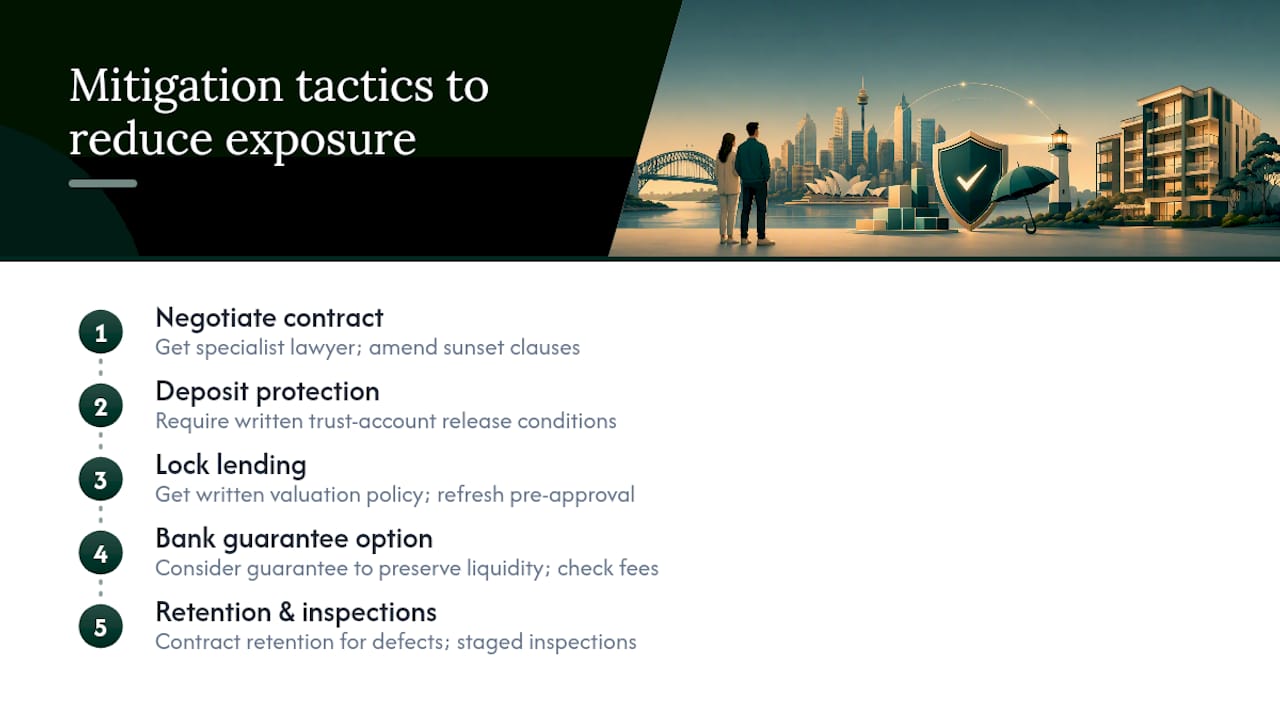
Get a specialist to negotiate the contract, not just review it. A property lawyer who works regularly with off the plan purchases will know which sunset clause wording is standard versus predatory, and can push for amendments: a firm outside date, a requirement for developer consent or court approval before rescission, and a cap on how “material” a design variation needs to be before you’re entitled to walk away.
Insist on trust account deposit protection, in writing. Confirm the specific conditions under which funds can be released to the developer, whether that’s registration of the plan, practical completion, or another defined milestone, and get it named in the contract, not left to verbal assurance.
Lock in the firmest lending commitment available to you. Ask your lender for a written statement of their off the plan valuation policy, and revisit your pre-approval every six to twelve months if settlement is more than a year away, so you’re not blindsided by a lending policy change. Some buyers use a bank guarantee in place of a cash deposit to preserve liquidity, though this needs weighing against the guarantee fees involved.
Arrange staged inspections and retention where the contract allows it. For larger developments, a retention clause that holds back a portion of the final payment until defects are rectified gives you real leverage post-settlement, when your negotiating position otherwise drops to almost nothing. Confirm what statutory home building compensation applies in your state, and don’t assume it covers everything a private warranty would.
None of these steps eliminate risk entirely. They shift the balance of who carries it, from you alone, to something shared between you, the developer, and the lender, which is exactly where it should sit.
How a buyer’s agent evaluates off the plan risk before you commit
A developer’s marketing suite tells you what they want you to see. It doesn’t tell you whether they’ve delivered on time before, whether their finishes schedule holds up under scrutiny, or whether the precinct is about to be flooded with identical stock the year you’re trying to rent yours out. That’s the gap professional representation closes.
Sydney Property Buyers approaches an off the plan purchase the way it approaches any acquisition: independent appraisal first, developer track record second, contract terms third, and negotiation only once those checks are satisfied. That includes reviewing a developer’s completed projects, checking for a pattern of delays or disputes, and, where the numbers support it, sourcing comparable opportunities that never reach the open market at all. The agency’s off-market access means over 30% of client purchases are secured before a listing goes public, often bypassing developer sales offices with less negotiating friction attached.
Engaging a licensed buyer’s agent tends to make the most financial sense when the stakes are highest: a first off the plan purchase, an interstate or overseas buyer unable to attend inspections, or an investor weighing multiple projects at once. Kristan Johnson, Sydney Property Buyers’ director and the 2024 Outstanding Buyers Agent of the Year (Inner West Local Business Awards), has built the agency’s process around exactly this kind of scrutiny.
Get professional support before you sign an off the plan contract
Off the plan purchases reward buyers who do the unglamorous work upfront, checking the developer, checking the contract, and checking their own finance position against a worst-case valuation, rather than a best-case one. That’s precisely where a buyer’s agent earns its fee.
If you’re weighing an off the plan purchase in Inner West Sydney, the Eastern Suburbs, the Lower North Shore, or the Eastern Beaches, and want an independent set of eyes on the contract and the developer before you commit, Sydney Property Buyers’ full-service and negotiation-only offerings are built for exactly this decision point. Call 1800 676 177 or email hello@sydneypropertybuyers.com.au to talk through a specific project before you exchange.
Key Takeaways
Off the plan risk is manageable when deposits are trust protected, contracts are professionally negotiated before signing, and finance is stress-tested against a lower completion valuation.
| Point | Details |
|---|---|
| Valuation shortfall is the top risk | Lenders revalue at completion, and a lower figure can force extra cash, LMI, or default. |
| Sunset clauses need scrutiny | Confirm rescission requires purchaser consent or court approval, per current NSW protections. |
| Deposits belong in trust | Confirm funds sit in a solicitor’s trust or stakeholding account, never with the developer directly. |
| Developer track record matters | Check past projects, complaints, and financial standing before exchanging contracts. |
| Vacancy risk clusters at completion | Concentrated settlements in one precinct can depress rents right when you need a tenant. |
What the conventional advice on off the plan buying gets wrong
Most guidance on off the plan buying treats sunset clauses as the headline risk, and the finance shortfall as a footnote. Based on how these purchases actually unravel, that emphasis is backwards. Sunset clause abuse is rarer now that reforms have tightened it. A quiet undervaluation at completion, three years after a buyer signed at the top of a cycle, is far more common and far less discussed.
The gap I’d point to is preparation timing. Buyers do their due diligence on the developer and the contract, then treat their own finance as settled the day they get pre-approved. It isn’t. A pre-approval from two years before settlement is close to worthless if the lender’s valuation policy or your income position has shifted in the meantime.
If you take one thing from this, prioritise the finance conversation as seriously as the contract review, and revisit it repeatedly, not once. The buyers who come unstuck at settlement are rarely the ones who skipped legal advice. They’re the ones who assumed their finance would simply be there when the day came.
— Kristan
Sources
For state-specific rules on cooling-off periods, disclosure obligations, and sunset clause protections, the NSW Government’s guidance on buying property off the plan is a solid starting point, though buyers in other states should confirm their own jurisdiction’s equivalent rules. Consumer Affairs Victoria’s off the plan guidance covers similar ground for Victorian buyers. For contract-specific risks and mechanics, the Lawdocs guide to off the plan contract traps is worth reading before you engage a conveyancer. Always confirm the current rules in your own state and get independent legal and financial advice before signing anything.
- Buying Property Off The Plan: Risks & Benefits Explained | Canstar
- Buying Off-the-Plan in Australia: Risks, Rewards & Contract Traps 2025 – Property Conveyancing -Lawdocs
- Buying property off the plan | NSW Government
Recommended
- Why off-market listings matter for Sydney buyers
- Benefits of buying off-market in Sydney: 2026 guide
- Why a licensed buyer’s agent matters in Sydney
- Strata schemes in Australia: what every buyer must know