Balmain suits buyers chasing a waterfront, village-style life and are prepared to pay a premium for heritage houses. Leichhardt suits buyers who want heritage streetscapes, strong family amenity, and better yields for unit investors. Balmain’s median house price sits well above Leichhardt’s, while Leichhardt’s Norton Street strip and light rail access give it an edge on liquidity and rental income. The comparison below breaks down prices, commute times, schooling and safety so you can match the right suburb to your budget and goals.
- Best for lifestyle and prestige: Balmain, if you want ferry access and a premium harbourside address.
- Best for family value and yield: Leichhardt, if you want more space per dollar and stronger unit returns.
- Next step: check the comparison table and buyer’s checklist further down before you start inspecting.
Key Takeaways
Balmain rewards buyers prioritising waterfront lifestyle and long-term capital growth, while Leichhardt delivers stronger family value and better rental yield for unit investors.
| Point | Details |
|---|---|
| Balmain fits lifestyle buyers | Median house price approximately $3,000,000, driven by heritage supply constraints and ferry access to the CBD. |
| Leichhardt fits value and yield seekers | Median house price approximately $2,250,000 and median unit price approximately $975,000, with stronger rental returns. |
| Norton Street sustains demand | Leichhardt’s Italian dining precinct keeps rental demand steady for nearby units year-round. |
| Heritage rules shape negotiation | Balmain’s conservation overlays slow settlement timelines, giving prepared buyers room to negotiate. |
| Off-market access matters | Buyer’s agents secure roughly 30% of Inner West purchases before they reach public listing. |
Table of Contents
- Balmain: snapshot of housing, lifestyle and commute
- Leichhardt: snapshot of housing, lifestyle and commute
- How do Balmain and Leichhardt compare side by side?
- What does the investment outlook look like for each suburb?
- How should you choose between Balmain and Leichhardt?
- What are the green spaces and pollution levels like?
- How do the two suburbs compare on safety?
- What development and council projects are planned nearby?
- What healthcare and essential services are nearby?
- Which suburb has better schooling options?
- Who lives in Balmain and Leichhardt?
- What does the evidence actually tell buyers weighing Balmain against Leichhardt?
- Sources
Balmain: snapshot of housing, lifestyle and commute
Balmain is a waterfront peninsula suburb built around Darling Street, its main retail and dining strip, with a heritage streetscape that has barely changed in decades. Terrace houses and Victorian cottages dominate, and strict conservation controls mean new supply is limited and mostly restricted to boutique apartment conversions rather than large developments.
That scarcity shows up in price. Stellar Finance Group’s 10-year comparison puts Balmain’s median house price at roughly $3,000,000, up from around $1,643,000 a decade earlier,.
The median house price has roughly doubled over the past decade, driven largely by the fixed supply of waterfront-adjacent stock and the suburb’s tightly held heritage core.
Lifestyle is the other half of the equation. Darling Street runs the length of the peninsula with cafes, boutiques, and pubs, and the Saturday market at the local primary school draws crowds from across the Inner West. Weekend mornings often mean a harbourside walk along the foreshore reserve before brunch.
Transport is a genuine drawcard. The ferry from Balmain wharves reaches Circular Quay in about 20 minutes, and buses connect to the CBD in a similar window, giving residents a commute that avoids road traffic almost entirely.
- Housing mix: Victorian terraces, cottages, boutique apartments
- Median house price: approximately $3,000,000 (10-year growth from ~$1,643,000)
- Transport: ferry to Circular Quay, bus routes to CBD
- Typical buyer: established families and waterfront lifestyle seekers
Leichhardt: snapshot of housing, lifestyle and commute
Leichhardt offers a similar heritage character to Balmain, Federation terraces, workers’ cottages, and a growing stock of low-rise unit blocks, but at a noticeably lower entry price and with more room to move for families.
SmartPropertyInvestment’s data for postcode 2040 shows a median house price around $2,250,000 and a median unit price near $975,000, with rental yield figures that make units in the area considerably more attractive to income-focused investors than most nearby house stock.
Leichhardt’s median house price is noticeably below Balmain’s, a gap that widens further once you compare unit prices, where Leichhardt’s stock is both cheaper and more liquid.
Norton Street is the suburb’s defining feature: Sydney’s longest-running Italian dining strip, lined with restaurants, delis, and gelaterias that have traded for generations. RealSearch notes Leichhardt gives buyers more space than Balmain at a relative discount, positioning it as the practical choice for growing families who still want inner-city character.
Transport runs on dense bus routes plus proximity to the Leichhardt North light rail stop, giving reasonable CBD access without Balmain’s ferry advantage.
- Housing mix: Federation terraces, cottages, low-rise units
- Median house price: approximately $2,250,000; median unit price approximately $975,000
- Transport: bus network, light rail proximity at Leichhardt North
- Typical buyer: families, food lovers, unit investors seeking yield
How do Balmain and Leichhardt compare side by side?
| Best for | Median house price | Median unit price | Gross rental yield | Time on market | Commute to CBD | Standout amenity |
|---|---|---|---|---|---|---|
| Balmain: waterfront lifestyle, capital growth | approximately $3,000,000 | Higher than Leichhardt, exact figures vary by building age | Lower, houses favour growth over yield | Longer, heritage stock moves slowly | ~20 minutes by ferry | Darling Street and harbourside walks |
| Leichhardt: family value, unit yield | approximately $2,250,000 | ~$975,000 | Stronger, particularly near transport nodes | Shorter, more stock turnover | Bus and light rail, slightly longer than ferry | Norton Street dining precinct |
The gap between the two suburbs is really a trade-off between growth and income. Balmain’s fixed peninsula geography and heritage overlays choke off new supply, which keeps upward pressure on house prices but does little for rental yield. Leichhardt’s slightly larger footprint and better-supplied unit market mean investors chasing immediate cash flow tend to look there first.
- Buyers wanting long-term capital growth and lifestyle premium: Balmain houses
- Buyers wanting yield and faster resale: Leichhardt units
- Buyers wanting family space without leaving the Inner West: Leichhardt houses
- Buyers prioritising commute time above all else: Balmain, via ferry
Pro Tip: Balmain’s heritage conservation area means even minor renovations often require council approval, which slows settlement timelines and gives well-prepared buyers extra room to negotiate on price while a seller waits out the permit process.
What does the investment outlook look like for each suburb?
Leichhardt’s recent performance data from SmartPropertyInvestment shows steady rental demand and yields that outperform many house-dominated Inner West suburbs, largely because its unit stock sits close to transport and Norton Street’s dining precinct. Balmain’s growth story, tracked by Stellar Finance Group, leans almost entirely on capital appreciation rather than rental return.
The house versus unit decision matters more here than in most Sydney suburbs. Units offer a lower entry price, faster turnover, and stronger yield, while houses in either suburb demand a longer holding period to justify the purchase cost.
Prestige houses, especially in Balmain, are more sensitive to interest rate movements, since buyers at that price point rely heavily on finance capacity. Inner West units tend to hold up better through rate cycles because rental demand from tenants stays relatively constant.
- Model both yield and growth scenarios before bidding, not just purchase price
- Compare Leichhardt unit yields against Balmain house holding costs
- Factor in vacancy risk for premium houses during ownership turnover
- Use tools like this property investment comparison guide to stress-test assumptions before auction day
How should you choose between Balmain and Leichhardt?
- Set your budget band first. If your ceiling sits below $2.5 million, Leichhardt’s house stock and Balmain’s unit stock are your realistic options.
- Map school catchments early. Family buyers should confirm zoning before falling for a particular street, since catchment boundaries shift year to year.
- Check heritage and flood overlays. Both suburbs carry conservation restrictions; Balmain’s waterfront edge also carries flood and foreshore building controls worth checking with council.
- Compare rental comparables directly, not suburb averages, since a two-bedroom unit near Norton Street can rent very differently from one three streets away.
- Decide whether you’re buying for growth or yield, then let that decision, not suburb loyalty, drive your final shortlist.
- Engage a buyer’s agent if you’re bidding at auction from interstate or overseas, or if you want access to properties that never reach a public listing.
Pro Tip: Order a strata report and building inspection before you fall in love with a Leichhardt unit. Older converted terraces sometimes carry higher-than-expected strata levies once deferred maintenance catches up with the owners’ corporation.
What are the green spaces and pollution levels like?
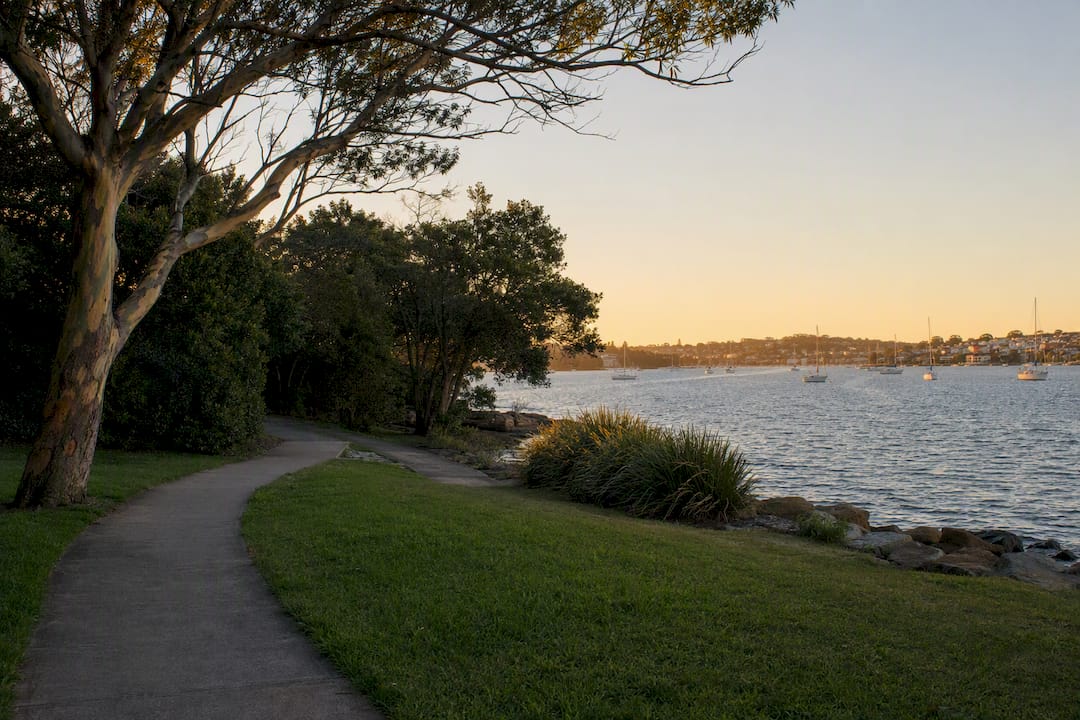
Balmain’s foreshore reserves, including Elkington Park and the Ballast Point headland, give residents direct water access and unbroken harbour views, a genuine point of difference from most Inner West suburbs. The peninsula’s traffic is mostly local, since through-traffic has nowhere to go once it hits the water, which keeps air quality relatively good for an inner-city location.
Leichhardt trades waterfront parkland for more conventional green space. Pioneers Memorial Park and Leichhardt Oval anchor the suburb’s open space, and the streets around Norton Street benefit from established tree canopy that softens the density of terrace housing. Traffic along Parramatta Road, which forms Leichhardt’s northern boundary, is the suburb’s main environmental downside, bringing noise and vehicle emissions that don’t affect Balmain’s more enclosed geography.
Both suburbs sit within the Inner West Council area, which has pushed tree canopy targets and stormwater upgrades in recent years as part of broader urban greening commitments. Buyers sensitive to traffic noise should walk prospective streets at peak hour before committing, particularly in Leichhardt’s northern pockets closer to Parramatta Road, and in Balmain’s stretches nearest the main arterial roads leading off the peninsula.
How do the two suburbs compare on safety?
Both Balmain and Leichhardt fall within the Inner West Council local government area and are generally regarded as low-crime, family-friendly pockets of Sydney. Neither suburb features prominently in state crime hotspot data, and both benefit from consistent foot traffic along their main strips, Darling Street and Norton Street, which keeps evening activity visible and reduces opportunistic crime.
Balmain’s peninsula layout means through-traffic is minimal, and the suburb’s tight-knit village feel, reinforced by decades of low resident turnover, contributes to a strong sense of informal community oversight. Leichhardt’s density and busier retail strip bring more foot and vehicle traffic, but its family-oriented demographic and active local business association help maintain a similarly settled atmosphere.
Prospective buyers should always check current data through the NSW Bureau of Crime Statistics and Research for the specific streets they’re considering, since crime patterns can vary block to block even within a well-regarded suburb. Neither Balmain nor Leichhardt shows the volatility seen in some transitional Sydney suburbs, which is part of why both command consistent buyer demand year after year.
What development and council projects are planned nearby?
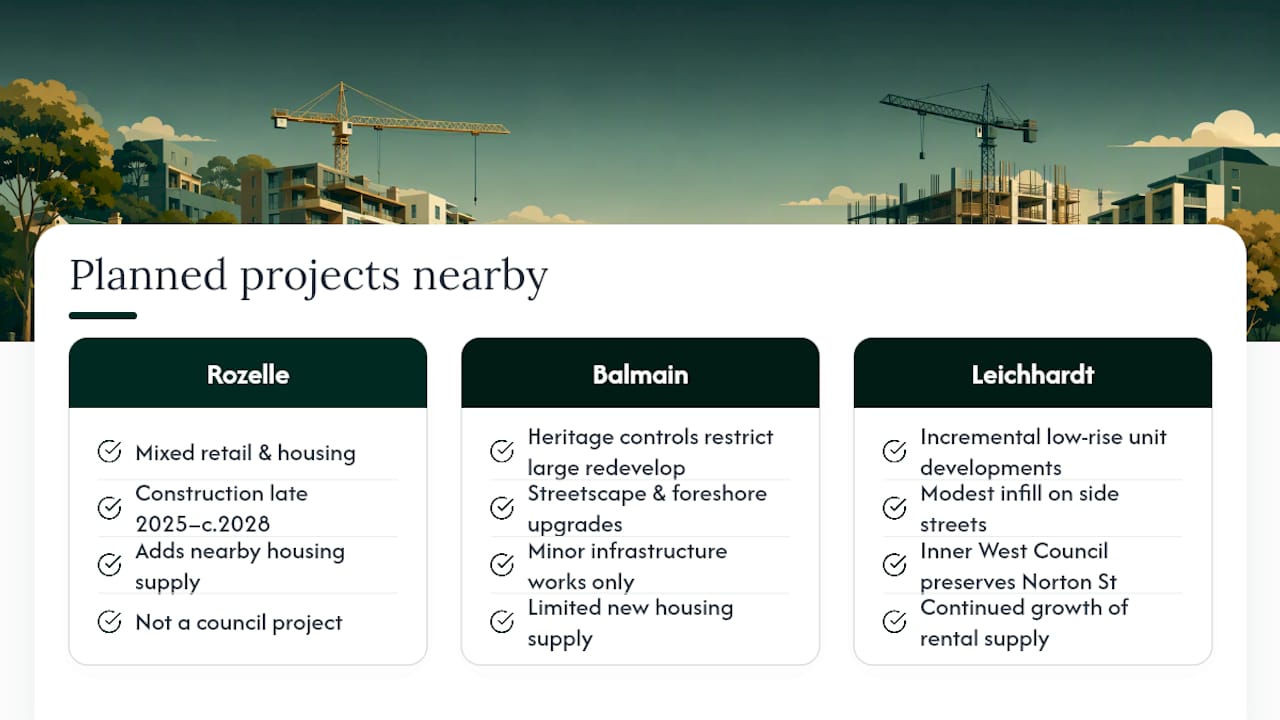
The most significant nearby project is Rozelle Village, a mixed retail and housing development starting construction in late 2025 with completion expected around 2028. It sits adjacent to Balmain rather than within it, but its scale means new retail options and additional housing supply will likely influence amenity and buyer interest in the surrounding peninsula suburbs over the next few years.
Within Balmain itself, heritage conservation controls mean large-scale redevelopment is unlikely. Council projects tend to focus on streetscape upgrades, foreshore maintenance, and minor infrastructure improvements rather than new housing stock.
Leichhardt has seen more incremental change, with low-rise unit developments continuing to add to the suburb’s rental pool. Inner West Council’s planning framework favours preserving Norton Street’s heritage character while allowing modest infill development on side streets, a balance that keeps the suburb’s Italian precinct intact while still growing its housing supply. Buyers weighing long-term capital growth should watch council development applications in both suburbs closely, since approved projects can shift local amenity and pricing faster than broader market trends.
What healthcare and essential services are nearby?
Both suburbs sit within easy reach of major Sydney hospitals. Royal Prince Alfred Hospital in Camperdown and Concord Repatriation General Hospital are both a short drive from either Balmain or Leichhardt, giving residents access to major emergency and specialist services without needing to travel into the CBD.
Balmain has its own local medical centres and pharmacies along Darling Street, covering general practice and allied health needs, though residents needing specialist care typically travel to Camperdown or the CBD. Leichhardt’s Norton Street precinct similarly hosts general practices, dental clinics, and pharmacies, and the suburb’s slightly larger population supports a wider spread of allied health services, including physiotherapy and pathology collection centres.
Both suburbs are well served by Sydney’s public transport network, meaning healthcare access isn’t dependent on car ownership. Aged care and childcare facilities are present in both suburbs, though Leichhardt’s larger family population has historically supported a broader range of childcare centres and after-school care options relative to Balmain’s more compact resident base.
Which suburb has better schooling options?
Balmain sits within the catchment for Balmain Public School and Birchgrove Public School, both well-regarded local primary options, with Balmain Learning Community offering a public education pathway through to secondary level. Private options nearby include several Catholic parish schools, though families wanting a broader selection of private secondary schools typically look toward the Eastern Suburbs or North Shore.
Leichhardt offers a similar public school profile, with Leichhardt Public School serving the suburb’s primary-aged children, plus access to Sydney Secondary College’s Leichhardt campus for older students. The suburb’s larger family population has historically supported a slightly wider network of before and after-school care providers.
Both suburbs sit close enough to central Sydney that families willing to commute can access selective and private schools in neighbouring areas, though neither Balmain nor Leichhardt hosts a major private secondary school within its own boundaries. For most family buyers, the practical difference comes down to catchment zoning rather than a clear quality gap, so confirming current enrolment boundaries with the NSW Department of Education before purchasing is worth the extra step, particularly given how often catchment lines shift in high-demand Inner West suburbs.
Who lives in Balmain and Leichhardt?
Balmain’s population skews toward established professionals and long-term owner-occupiers, many of whom bought decades ago and have watched the suburb’s median price climb well beyond what a first-time buyer could now afford. The community vibe is quiet and settled, with a strong sense of continuity built around Darling Street’s independent traders and the annual rhythms of the Saturday market.
Leichhardt’s demographic mix leans more toward families and younger professionals, drawn by the combination of heritage housing, Italian heritage community ties, and comparatively better value. The suburb’s Italian-Australian roots remain visible in Norton Street’s businesses, many family-run for multiple generations, giving Leichhardt a warmer, more generationally layered community feel than some of its Inner West neighbours.
Both suburbs share the broader Inner West identity: walkable, heritage-conscious, and resistant to the high-rise development seen closer to the CBD. The practical difference is turnover. Balmain’s tightly held housing stock means fewer opportunities come to market, while Leichhardt’s slightly larger and more varied housing pool gives newer residents more entry points into the community.
What does the evidence actually tell buyers weighing Balmain against Leichhardt?
Most suburb comparisons treat Balmain and Leichhardt as near-substitutes because they sit side by side on a map. They aren’t. Balmain is a growth play dressed up as a lifestyle purchase, and Leichhardt is a yield play dressed up as a family suburb. The data backs this distinction more clearly than most local guides admit.
The conventional advice, “buy in the best suburb you can afford”, ignores that these two suburbs solve different financial problems. Balmain’s fixed peninsula supply means you’re paying for scarcity and a view, not for immediate cash flow. Leichhardt’s slightly deeper housing pool and stronger unit yields suit anyone who needs the numbers to work from year one, not just at resale.
What I’d prioritise first isn’t the suburb at all. It’s whether you’re buying for growth or income, because that answer determines which suburb, and which property type within it, actually fits. Get that sequencing wrong and no amount of Darling Street charm or Norton Street cannoli will fix the spreadsheet.
— Kristan
Sources
- Inner West Sydney: Villages, Culture, Lifestyle & Local Guide – Sydney Info
- LEICHHARDT, 2040 — SmartPropertyInvestment data page
- The Ultimate Guide to Inner West Property in 2026 – Stellar Finance Group
- Live in the Heart of Leichhardt NSW 2040: Explore Apartments, Houses & Rentals. | Real Search
If you’d rather have someone else run the comparables and handle the bidding, our full-service and negotiation-only offerings cover both scenarios, and our off-market access page explains how we find properties before they’re publicly listed. Call 1800 676 177 or email hello@sydneypropertybuyers.com.au to discuss your Inner West shortlist.
Recommended
- Sydney inner west suburb comparison: 2026 guide
- Inner West Sydney – Welcome
- Eastern suburbs property buying guide: 2026 edition
- How to research Sydney suburbs property in 2026