Missed properties frustrate buyers because of a compounding mix of market volatility, psychological pressure, and lending constraints that work against even well-prepared purchasers. Sydney’s property market in 2026 has shifted dramatically, with auction clearance rates falling below 50% for the first time since 2020 and vendor behaviour changing in ways that catch buyers off guard. Understanding why buyers miss properties is the first step toward doing something about it.
Why missed properties frustrate buyers in Sydney’s 2026 market
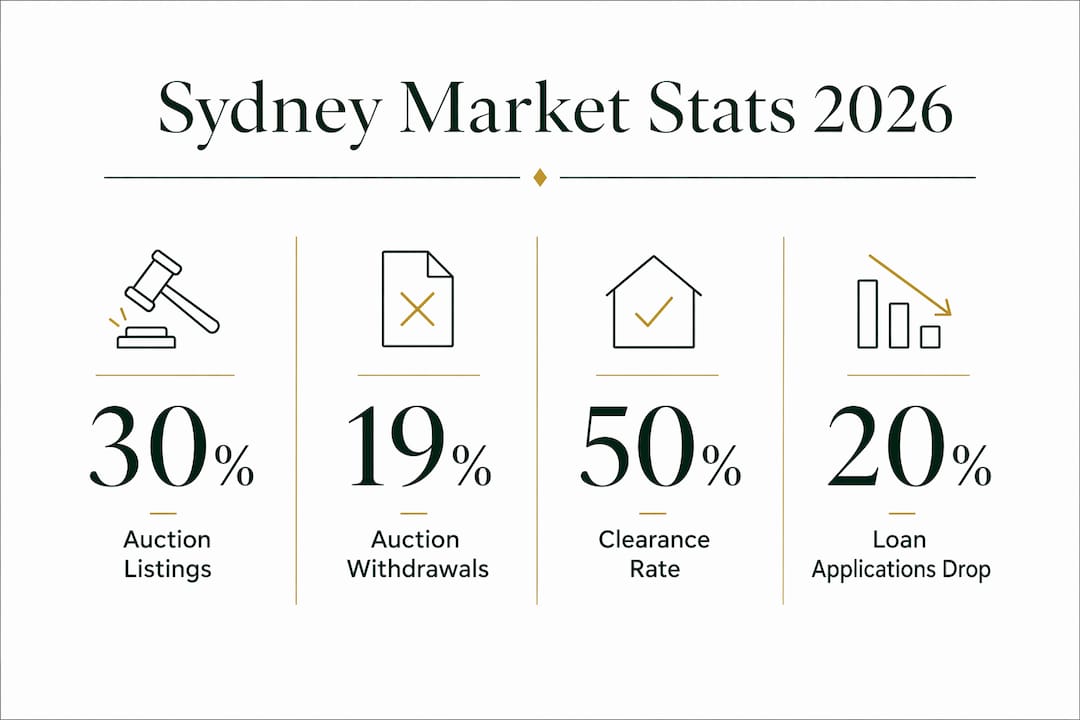
Sydney’s auction market has fundamentally changed since late 2025. Auction listings dropped from 45% to just over 30% of total sales between november 2025 and june 2026, as vendors shifted to private treaty sales in response to weak demand. That shift matters enormously for buyers who have spent months preparing for auction day, only to find the property they wanted was quietly sold before it ever went under the hammer.

The withdrawal rate compounds the problem. In the week ending 21 june 2026, 19% of scheduled auctions were withdrawn by sellers. That means roughly one in five buyers who turned up ready to bid went home empty-handed through no fault of their own.
Lending conditions have added another layer of difficulty. First-home buyer loan applications dropped more than 20% following mid-2026 budget tax changes, and investor applications fell by 25%. Those figures reflect real buyers who were ready to purchase but found their financial position no longer met lender requirements after the rules shifted.
| Market factor | 2025 position | 2026 position |
|---|---|---|
| Auction clearance rate | Above 60% | Below 50% |
| Auction listings share | ~45% of sales | ~30% of sales |
| Auction withdrawal rate | Low | 19% in one week |
| First-home buyer loan apps | Stable | Down 20%+ |
| Investor loan apps | Stable | Down 25% |
Pro Tip: Set up alerts for private treaty listings in your target suburbs, not just auctions. With 30% fewer properties going to auction, the most competitive opportunities are now being sold quietly through negotiation.
How psychology turns a missed property into lasting frustration
The emotional side of property buying is rarely discussed honestly, yet it drives most of the frustration buyers feel. Buying decisions are emotional rather than purely logical, shaped by identity, hope, and social pressure. When a buyer loses a property they have mentally moved into, the grief is real, even if the financial loss is not.
Two forces pull buyers in opposite directions right now. The first is FOMO, the fear of missing out, which pushes buyers to act quickly and sometimes recklessly. The second is FOOP, the fear of overpaying, which causes hesitation, low-ball offers, and slower decisions. Most buyers in 2026 are caught between the two, paralysed at exactly the moment they need to act.
Several cognitive biases make the situation worse:
- Confirmation bias. Buyers ignore significant property flaws when emotionally attached to a home, then experience deep regret when the purchase falls through or goes wrong.
- Hedonic adaptation. Buyers retrospectively overvalue missed properties, making each subsequent option feel like a step down. The property they lost becomes perfect in memory, even if it had real flaws.
- Social pressure. Family expectations, peer comparisons, and the cultural weight of homeownership in Australia push buyers to act against their own financial interests.
- Identity attachment. Buyers attach their sense of self to a particular suburb, style, or lifestyle, making compromise feel like personal failure rather than practical adjustment.
Pro Tip: Write down three non-negotiable criteria before you inspect any property. When emotions run high after an inspection, those written criteria act as a rational anchor against impulsive decisions.
The property search stress that accumulates across multiple missed opportunities is cumulative. Each loss raises the emotional stakes of the next attempt.
Why finance barriers block buyers who feel ready to purchase
Many buyers arrive at the negotiating table confident in their finances, only to discover their borrowing power is far lower than expected. Banks assess loans against future harsher conditions, not current financial comfort. That gap between what a buyer earns and what a lender will approve is one of the most common and least understood causes of lost opportunities.
The Australian Prudential Regulation Authority (APRA) requires lenders to apply a serviceability buffer when assessing loan applications. This means the bank tests whether you could still afford repayments if interest rates were to rise significantly above the current rate. The practical effect is that your approved borrowing amount is often tens of thousands of dollars below what you calculated yourself.
- Understand your actual borrowing capacity. Get a formal pre-approval from your lender, not just an online estimate. Online calculators do not apply APRA serviceability buffers.
- Revisit your budget after each rate change. Borrowing power shifts with every Reserve Bank of Australia (RBA) decision. A pre-approval from three months ago may no longer reflect your current position.
- Consider a larger deposit. Reducing the loan amount required can bring a property back within your approved range when the purchase price exceeds your current limit.
- Speak to a mortgage broker. Different lenders apply buffers differently. A broker can identify which lender’s criteria best match your financial profile.
The most common reason buyers feel ready but cannot buy is that they are comparing their take-home pay to a purchase price, while the bank is comparing their gross income to a stress-tested repayment scenario that assumes rates significantly higher than today’s. Those two calculations produce very different numbers, and the gap between them is where frustration lives.
What practical strategies reduce buyer frustration in Sydney?
The buyers who succeed in Sydney’s 2026 market share one characteristic: they have stopped relying solely on publicly listed properties. With off-market listings accounting for a growing share of sales, buyers who only monitor Domain or realestate.com.au are competing for a shrinking pool of properties.
Practical strategies that genuinely reduce the rate of missed opportunities include:
- Access off-market and pre-market listings. Sydney Property Buyers secures more than 30% of purchases off-market, meaning those properties never appear on public portals. A licensed buyer’s agent with strong agent relationships is the most direct route to this inventory.
- Rebuild your search criteria honestly. If you have missed ten properties in six months, your criteria are likely too narrow for your budget. Adjusting suburb, property type, or size by even one variable can triple the number of viable options.
- Obtain formal pre-approval before inspecting. Buyers with unconditional pre-approval move faster and negotiate from a stronger position. Vendors and selling agents take pre-approved buyers more seriously.
- Use a buyer’s agent for negotiation only. If you find a property yourself but lack confidence in negotiation, Sydney Property Buyers offers a Negotiation Only service. Professional negotiation typically recovers more than the cost of the service in purchase price savings.
- Inspect outside open home hours. Sydney Property Buyers conducts inspections seven days per week, independent of scheduled open homes. That flexibility means clients see properties before competing buyers do.
Pro Tip: Ask your buyer’s agent which selling agents in your target suburb have the most off-market stock. Those relationships are built over years and cannot be replicated by a buyer acting alone.
| Approach | Typical buyer | With buyer’s agent |
|---|---|---|
| Property access | Public listings only | On-market and off-market |
| Inspection timing | Open homes only | 7 days per week |
| Negotiation | Self-managed | Professional representation |
| Average purchase time | Variable, often 6–12 months | 54 days (Sydney Property Buyers) |
| Off-market purchases | Rare | 30%+ of transactions |
The emotional buying protection a buyer’s agent provides is as valuable as the property access. Having a professional between you and the selling agent removes the emotional pressure that causes buyers to overbid or walk away from sound properties.
Key takeaways
Missed properties frustrate buyers because market shifts, emotional biases, and lending constraints combine to undermine even well-prepared purchasers in Sydney’s 2026 market.
| Point | Details |
|---|---|
| Market conditions have shifted | Auction listings fell from 45% to 30% of sales, and 19% of auctions were withdrawn in one week in june 2026. |
| Psychology compounds every loss | FOOP, hedonic adaptation, and confirmation bias turn single missed properties into prolonged buyer fatigue. |
| Finance gaps are often invisible | APRA serviceability buffers mean approved borrowing is often far below a buyer’s own estimate. |
| Off-market access changes outcomes | Over 30% of Sydney Property Buyers purchases are secured off-market, bypassing public listing competition entirely. |
| Professional representation reduces frustration | A licensed buyer’s agent provides property access, negotiation skill, and emotional distance that self-managed buyers cannot replicate. |
What I have learned watching Sydney buyers lose properties they should have won
I have worked with buyers across Sydney’s Inner West, Eastern Suburbs, Lower North Shore, and Eastern Beaches for years, and the pattern I see most often is not bad luck. It is buyers who are technically ready but emotionally and strategically unprepared for how the market actually works in practice.
The shift from FOMO to FOOP in 2026 has created a strange paralysis. Buyers who were aggressive two years ago are now hesitating on properties that genuinely suit them, convinced they are overpaying, while the property sells to someone else who simply decided to act. I have watched buyers lose the same type of property three times in a row because they kept adjusting their offer downward after each loss, when the market data did not support that caution.
The other thing I see constantly is buyers treating their pre-approval figure as a ceiling rather than a guide. Your pre-approval reflects one lender’s assessment on one day. A broker can often find a lender whose criteria produce a meaningfully different number, without any change to your actual financial position.
The buyers who succeed are not the ones with the most money. They are the ones who understand the rules of the game they are playing, get professional support where it matters, and make decisions based on data rather than emotion. That is not a personality trait. It is a skill, and it can be learned.
— Kristan
How Sydney Property Buyers helps frustrated buyers find and secure properties
Losing properties repeatedly is exhausting. Sydney Property Buyers works exclusively for purchasers, never sellers, which means every recommendation is made in your interest alone.

Kristan Johnson, 2024 Outstanding Buyers Agent of the Year (Inner West Local Business Awards), leads a team that conducts inspections seven days per week and maintains direct relationships with selling agents across Sydney. That access translates to off-market property opportunities that never reach public portals. With an average purchase time of 54 days from engagement to settlement and a ~9% average saving on purchase price, Sydney Property Buyers offers a measurable alternative to months of self-managed searching. Call 1800 676 177 or email hello@sydneypropertybuyers.com.au to discuss your search.
FAQ
Why do buyers keep missing out on properties in Sydney?
Buyers miss properties because of a combination of slow decision-making, limited access to off-market listings, and finance pre-approvals that do not reflect actual borrowing capacity. Sydney’s shift toward private treaty sales in 2026 has also removed many properties from public view before buyers can act.
What is FOOP and how does it affect property buyers?
FOOP stands for Fear of Overpaying. It causes buyers to hesitate, submit low-ball offers, and delay decisions, which results in missed opportunities even when a property genuinely suits their needs and budget.
How does APRA’s serviceability buffer affect my borrowing power?
APRA requires lenders to test whether you could afford repayments at a rate significantly above the current rate. This stress test reduces your approved borrowing amount, often by tens of thousands of dollars compared to your own estimate.
What percentage of Sydney properties sell off-market?
The share varies by suburb and market conditions, but Sydney Property Buyers secures more than 30% of its purchases off-market. Those properties never appear on public listing portals, meaning self-managed buyers have no access to them.
Can a buyer’s agent help after I have already found a property?
Yes. Sydney Property Buyers offers a Negotiation Only service for buyers who have identified a property but want professional representation to negotiate the best price and terms. This service is available independently of a full property search engagement.
Recommended
- Common buyers agent selection mistakes Sydney buyers make
- Why time on market matters for Sydney buyers in 2026
- How to research Sydney suburbs property in 2026