A conflict of interest in real estate is defined as any situation where an agent’s personal or financial interests risk compromising their legal duty to act solely in the client’s best interests. Under the Property and Stock Agents Act 2002, NSW agents carry a fiduciary duty to prioritise their client above all else. When that duty is undermined by undisclosed commissions, dual representation, or personal gain, a conflict of interest arises. Recognising these situations before they affect your transaction is one of the most protective steps you can take as a buyer or seller in the Sydney property market.
What is conflict of interest in real estate? Common examples explained
Conflicts of interest in property transactions take several forms, and many buyers and sellers never realise they are affected until money has already changed hands.
The most frequent examples include:
- Dual representation. An agent acts for both the buyer and the seller in the same transaction. Each party has opposing financial goals, making it structurally impossible for one agent to serve both fully.
- Undisclosed referral commissions. An agent recommends a conveyancer, building inspector, or mortgage broker and receives a payment for that referral without telling you. NSW Fair Trading’s disclosure rules require agents to disclose these arrangements proactively, with no exemptions.
- Agent purchasing the listed property. An agent who intends to buy a property they are currently selling holds a direct conflict. NSW law requires a Section 49 form to be completed in this scenario, signalling the conflict formally and requiring client consent.
- Gifts and undisclosed benefits. Agents cannot accept gifts valued above $60 that could create a conflict of interest. Principals must maintain a register of all gifts received to ensure compliance and transparency.
- Biased property advice. An agent steers a buyer toward a property because it earns a higher commission, not because it suits the buyer’s needs. This is a conflict even when no formal disclosure obligation is triggered.
Non-disclosure in any of these situations can result in the agent losing their right to commission entirely, as well as facing regulatory penalties under NSW law.
Pro Tip: Ask your agent directly at the first meeting: “Do you receive any referral payments or benefits from third parties connected to this transaction?” A confident, clear answer is a good sign. Hesitation or vagueness is a red flag.

What legal obligations do agents have regarding conflicts and disclosure in NSW?
NSW property law places the burden of disclosure firmly on the agent, not the client. Agents must disclose any conflict of interest in writing before the transaction proceeds or before any referral is made. This is not optional.
The key legal framework includes:
- Property and Stock Agents Act 2002. This Act establishes the fiduciary duty and sets out conduct rules for all licensed agents in NSW. Agents must avoid any arrangement that places their interests ahead of the client’s.
- Fair Trading Act 1987. Intermediaries, including real estate agents, must proactively disclose commissions or financial incentives from referrals to clients before transactions occur. No exemptions apply.
- Section 47 forms. These notify clients of an agent’s referral arrangements. If an agent refers you to a service provider and receives a benefit, a Section 47 form must be completed. Section 47 and 49 forms are binding tools; improper use can result in invalid contracts or penalties.
- Section 49 forms. Required when an agent intends to purchase a property they are currently selling. This is one of the most serious conflicts in the industry and demands formal written consent from the client.
- Material facts disclosure. Agents must disclose material facts proactively, including structural defects and environmental risks, even if the client does not ask. Failure to do so creates a direct conflict between the agent’s sales goal and the client’s right to full information.
The consequences of non-disclosure are significant. An agent who fails to disclose a conflict loses their right to commission. They may also face civil liability and regulatory action by NSW Fair Trading.
| Disclosure requirement | Legal instrument | Consequence of non-compliance |
|---|---|---|
| Written conflict disclosure | Property and Stock Agents Act 2002 | Loss of commission rights |
| Referral commission disclosure | Fair Trading Act 1987 | Regulatory penalty |
| Agent purchasing listed property | Section 49 form | Contract invalidity, penalties |
| Referral arrangement notification | Section 47 form | Contract invalidity, penalties |
| Gift register maintenance | Rules of Conduct (NSW) | Regulatory action |
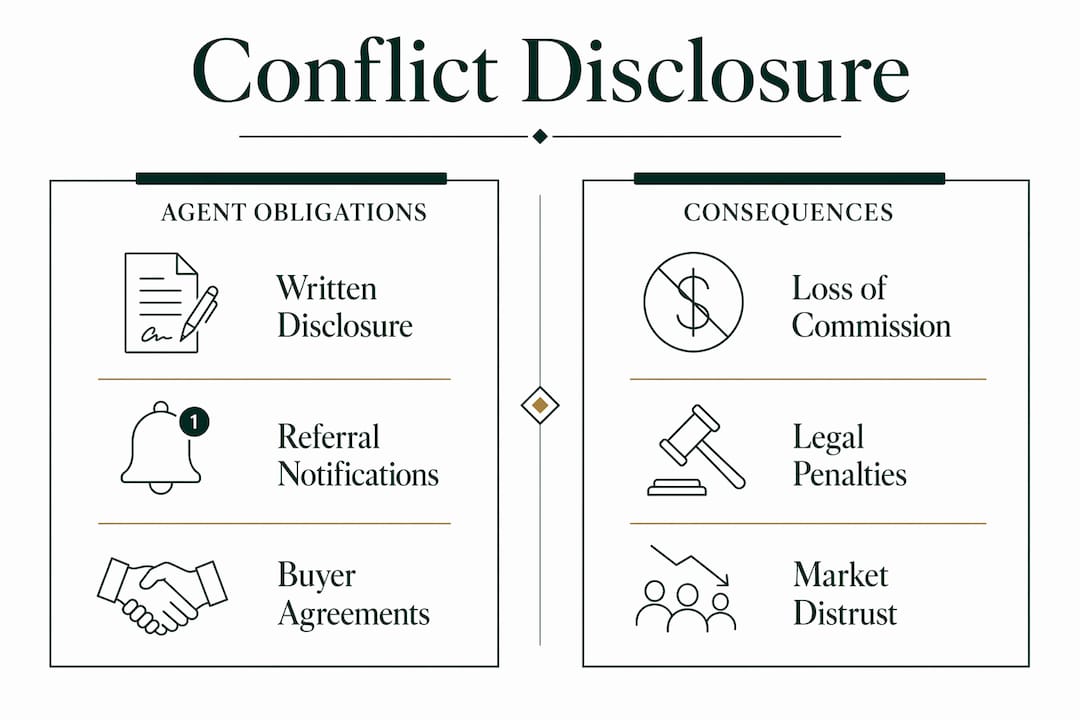
Buyer agency agreements in NSW must also specify all potential conflicts, including any deposits paid on the buyer’s behalf, which must be fully refundable if no contract is signed. This protects buyers from agents who use financial arrangements to create pressure.
How can buyers and sellers identify and manage conflicts of interest?
Protecting yourself from undisclosed conflicts requires a proactive approach. Most buyers assume that if something were wrong, the agent would say so. NSW law actually imposes a proactive duty to disclose on agents, but enforcement depends on clients knowing their rights and asking the right questions.
Practical steps to protect yourself:
- Ask about referral arrangements upfront. Before engaging any agent, ask whether they receive payments from third parties such as conveyancers, inspectors, or lenders. Request this in writing.
- Review the agency agreement carefully. Every agency agreement must identify potential conflicts. Read it before signing, and query any clause that is vague or absent.
- Check the agent’s licence. Verify that your agent holds a current NSW licence through the NSW Fair Trading licence check. An unlicensed agent has no legal standing and no accountability.
- Request written disclosures for all referrals. If an agent recommends any service provider, ask for a Section 47 form before you engage that provider.
- Seek independent advice. A solicitor or conveyancer who works only for you can identify conflicts that an agent may not volunteer. This is especially important in complex transactions.
- Use a licensed buyer’s agent. A buyer’s agent works exclusively for the purchaser. Understanding why a vendor’s agent works against buyers makes clear why independent representation matters so much in Sydney’s competitive market.
Pro Tip: Keep a written record of every conversation with your agent, including verbal disclosures. If a dispute arises, documented evidence of what was and was not disclosed is your strongest protection.
What are the consequences and risks of unresolved conflicts of interest?
Unresolved conflicts of interest cause real financial harm. They are not abstract ethical concerns.
“35% of vendors reported inadequate disclosure of conflicts by agents in 2024–25, and one-third of surveyed vendors felt their agent prioritised buyers over them. These figures show that conflict disclosure remains one of the most significant trust failures in the Australian property industry.”
That statistic reflects a structural problem. When an agent’s financial incentives are not aligned with the client’s goals, the client’s negotiating position is weakened, often without their knowledge. A buyer who overpays because their agent had an undisclosed interest in a faster sale has suffered a direct financial loss.
The risks extend beyond individual transactions:
| Risk category | Impact on client | Impact on agent |
|---|---|---|
| Undisclosed referral commissions | Biased service recommendations | Loss of commission, penalty |
| Dual representation | Compromised negotiation | Regulatory action, liability |
| Failure to disclose material facts | Purchasing a defective property | Civil liability, loss of licence |
| Agent purchasing listed property | Undervalued sale price | Contract invalidity, penalties |
Market confidence also suffers when conflicts go unaddressed. Buyers who feel misled withdraw from transactions, and sellers who discover post-settlement that their agent had competing interests pursue legal remedies. Both outcomes damage the broader property market’s reputation for fairness and transparency.
Key takeaways
A conflict of interest in real estate arises when an agent’s personal or financial interests compromise their legal duty to act in the client’s best interests, and NSW law requires written disclosure of all such conflicts before any transaction proceeds.
| Point | Details |
|---|---|
| Legal duty is clear | The Property and Stock Agents Act 2002 requires agents to disclose all conflicts in writing before transactions proceed. |
| Section 47 and 49 forms matter | These forms are binding disclosure tools; failing to use them correctly can invalidate contracts and trigger penalties. |
| Gifts above $60 must be declared | Agents must maintain a register of all gifts and benefits received to comply with NSW conduct rules. |
| Proactive disclosure is mandatory | Agents must volunteer material facts and conflict information without waiting to be asked. |
| Independent representation protects buyers | A licensed buyer’s agent works exclusively for the purchaser, eliminating the most common sources of agency conflict. |
Conflicts of interest: what I’ve seen working with Sydney buyers
Working with buyers across the Inner West, Eastern Suburbs, and Lower North Shore, I see the same pattern repeat itself. A buyer engages a selling agent’s recommended conveyancer, building inspector, and mortgage broker. They feel looked after. What they do not realise is that the agent may be receiving referral payments from every one of those providers.
The law requires disclosure. The reality is that many buyers never ask, and some agents rely on that silence. I have seen buyers pay above market value for properties where the agent had a financial interest in a quick sale. I have seen vendors receive less than their property was worth because their agent was managing a relationship with the buyer’s side. These are not rare edge cases.
My advice is direct: always insist on written disclosure before you engage any agent or accept any referral. Ask specifically about Section 47 arrangements. If an agent cannot answer clearly, that tells you everything you need to know about how they will handle your transaction.
The most effective protection is structural. A buyer’s agent who works exclusively for you, with no financial relationship to the selling side, removes the conflict at its source. At Sydney Property Buyers, we represent purchasers only. We have no referral arrangements with selling agents, and every potential conflict is disclosed in writing before engagement. That is not a policy. It is the only ethical way to operate.
— Kristan
How Sydney Property Buyers protects you from hidden conflicts
Conflict of interest issues in property transactions are rarely obvious until after the damage is done. Sydney Property Buyers operates as a fully licensed buyer’s agency that represents purchasers exclusively, with no financial ties to selling agents, developers, or referral networks.

Every engagement begins with a written disclosure of any potential conflicts, in full compliance with the Property and Stock Agents Act 2002. Sydney Property Buyers conducts independent property appraisals, manages due diligence, and negotiates without any competing interest in the outcome. With a 5.0 Google rating, 100+ properties secured, and an average saving of approximately 9% on purchase price, the track record speaks for itself. Contact Sydney Property Buyers on 1800 676 177 or at hello@sydneypropertybuyers.com.au to discuss your purchase.
FAQ
What is a conflict of interest in real estate?
A conflict of interest in real estate occurs when an agent’s personal or financial interests compromise their duty to act solely in the client’s best interests. NSW law requires agents to disclose all such conflicts in writing before any transaction proceeds.
Does an agent have to disclose referral commissions in NSW?
Yes. Under the Fair Trading Act 1987, agents must proactively disclose any commissions or financial incentives received from referrals before the transaction occurs, with no exemptions permitted.
What are Section 47 and Section 49 forms?
A Section 47 form notifies clients of an agent’s referral arrangements, while a Section 49 form is required when an agent intends to purchase the property they are selling. Both are legally binding disclosure tools in NSW.
Can an agent represent both the buyer and the seller?
Dual representation creates a direct conflict of interest because the buyer and seller have opposing financial goals. NSW agents must disclose this arrangement in writing and obtain consent from both parties before proceeding.
What happens if an agent fails to disclose a conflict of interest?
An agent who fails to disclose a conflict of interest loses their right to commission and may face civil liability and regulatory penalties from NSW Fair Trading under the Property and Stock Agents Act 2002.
Recommended
- Why a vendor’s agent works against buyers in Sydney
- What does fiduciary duty mean for a buyer’s agent?
- Why a licensed buyer’s agent matters in Sydney