Many buyers assume a buyer’s agent referral network is simply a directory where you sign up and get matched to an agent. The reality is more layered than that, and misunderstanding how these networks operate can leave you working with an agent who was chosen for financial convenience rather than your best interests. This article breaks down what is a buyer’s agent referral network, how the money flows, what different network models mean for you as a buyer, and how to use referrals wisely when searching for the right agent to secure your ideal property.
Table of Contents
- Key takeaways
- What is a buyer’s agent referral network?
- Open networks versus curated networks
- Referral fees, regulations, and what buyers need to know
- How to evaluate a referred agent properly
- Emerging trends reshaping referral networks
- My honest take on referral networks
- Working with Sydneypropertybuyers
- FAQ
Key takeaways
| Point | Details |
|---|---|
| Networks are agent-to-agent systems | Referral networks connect licensed agents to each other, not directly to buyers as a consumer-facing service. |
| Referral fees come from commissions | Fees typically range from 20% to 35% of the receiving agent’s commission and do not add a separate cost to buyers. |
| Network quality varies considerably | Curated, invite-only networks generally produce more reliable agent matches than open-access directories. |
| Transparency protects you | Always ask who is being paid, how much, and who legally represents your interests before signing anything. |
| Referrals are a starting point | Use a referral as the beginning of your due diligence, not the end of it. |
What is a buyer’s agent referral network?
At its core, a buyer’s agent referral network is a structured system where licensed real estate agents refer clients to other agents when they cannot serve those clients themselves. This happens for three main reasons: geography, specialisation, or capacity. An agent who is brilliant in the Inner West of Sydney but has no knowledge of the Lower North Shore, for instance, would refer a client moving to that area to a trusted colleague rather than attempt to serve them poorly.
The buyer agent network explained simply: one agent acts as the referral source, another agent handles the actual work of finding and securing the property. The referring agent steps back entirely from the transaction. They do not conduct inspections, negotiate offers, or manage the settlement process. Their role ends once the introduction is made.
Here is how the mechanics typically work:
- A buyer contacts an agent who cannot assist them directly (wrong area, too busy, or wrong specialisation).
- That agent identifies a suitable active buyer’s agent within their network.
- A referral agreement is signed between the two agents, specifying the fee to be paid upon a successful purchase.
- The active buyer’s agent takes over full representation of the buyer.
- Once the transaction closes, the referral fee is paid from the receiving agent’s commission.
Referral agents do not conduct showings or negotiations themselves. Their value lies in their network relationships and their ability to match buyers with agents who have the right local knowledge. Understanding buyer’s agent referrals means recognising this distinction clearly: the person who referred you is not your agent.
Open networks versus curated networks
Not all referral networks are built the same way, and the difference matters enormously for buyers. The two broad categories are open networks and curated (invite-only) networks, and they produce very different outcomes.
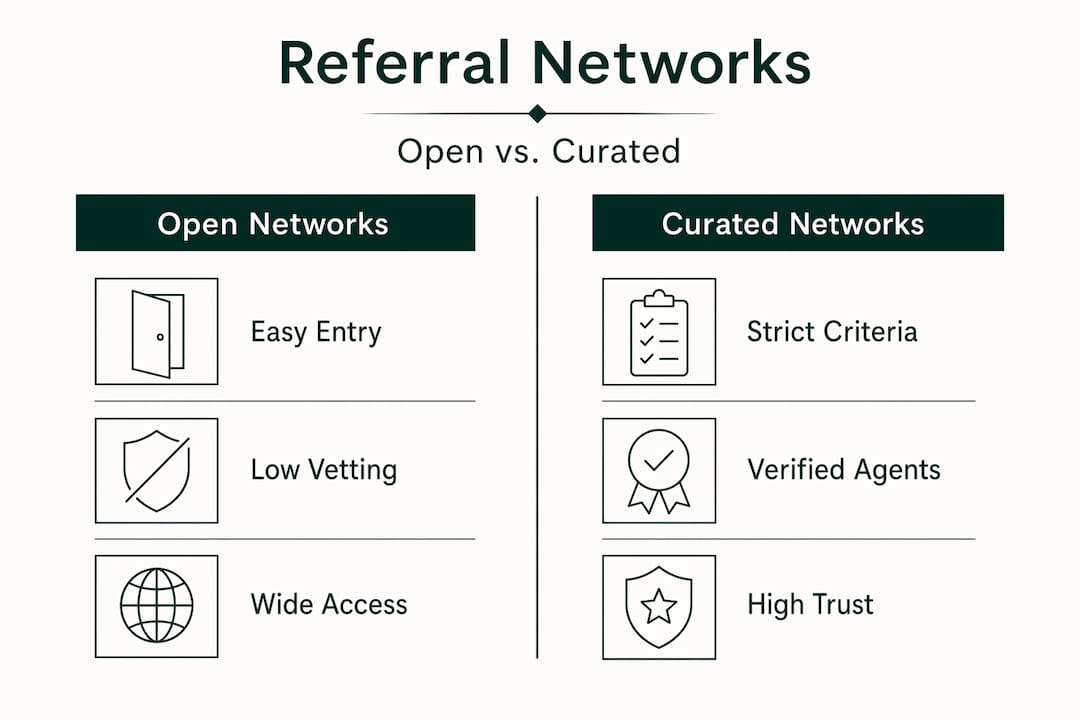
Open networks allow any licensed agent to participate, often with minimal vetting. The barrier to entry is low, which means the quality of agents within the network can vary widely. You might be referred to an excellent agent, or you might be referred to whoever was available and willing to pay a referral fee.
Curated networks operate differently. They set performance thresholds, require demonstrated local expertise, and often limit membership to agents with a proven track record. A well-known example is Howard Hanna’s Luxury Circle, which requires 10 sales over $1M within five years as a condition of membership. That kind of standard filters out agents who lack the experience to handle high-stakes transactions.
| Network type | Entry requirements | Reliability for buyers | Best suited for |
|---|---|---|---|
| Open network | Minimal or none | Variable | General property searches |
| Curated/invite-only | Sales volume or specialty thresholds | Higher | Specialist or premium purchases |
| Brokerage-internal | Employment or franchise affiliation | Moderate | Buyers already within a brokerage ecosystem |
Curated networks with performance thresholds provide higher reliability by ensuring agents meet strict criteria before any referral is made. For buyers, this translates to a greater chance of being matched with someone who genuinely knows their target market.
Pro Tip: When you receive a referral, ask the referring agent directly: “What criteria did you use to select this person?” A vague answer is a red flag. A specific answer, such as local sales volume or years of experience in your target suburb, tells you the referral was made thoughtfully.
Referral fees, regulations, and what buyers need to know
This is the section most buyers skip, and it is the one that matters most. Understanding how referral fees work protects you from surprises and helps you ask the right questions before you commit to any agent.
Referral fees typically range from 20% to 35% of the commission earned by the receiving agent. These fees are paid broker-to-broker, not directly between individual agents. This is a regulatory requirement in most jurisdictions, designed to maintain oversight and prevent undisclosed financial arrangements.
Here is what this means in practice:
- The fee comes from the agent’s commission, not from you. As a buyer, you do not receive a separate invoice for the referral. The receiving agent simply shares a portion of their commission with the referring agent once your purchase settles.
- Brokerages handle the payment. Referral fees paid through sponsoring brokers ensure compliance and structured payments, but you should still ask your agent to confirm how their compensation is structured.
- Disclosure is an ethical obligation. Your agent should tell you upfront if they were referred to you through a network and whether a fee arrangement exists. If they do not volunteer this information, ask.
- Licensing requirements apply. In Texas, for example, regulations restrict direct agent-to-agent fee payments and enforce licensing compliance. Similar frameworks exist across other states and territories to protect buyers from unlicensed referral activity.
- Who represents you matters legally. A referral network connects you to an agent, but your formal representation is established through a buyer agency agreement. Read it carefully and confirm that the agent is working exclusively for you, not for the seller.
Buyers should clarify who is compensated and how before signing any agreement. This is not about distrust. It is about being an informed participant in what is likely the largest financial transaction of your life.
How to evaluate a referred agent properly
Receiving a referral is not the same as receiving a guarantee. The referral network for real estate agents is designed to solve a logistical problem for agents. Your job as a buyer is to ensure the solution it produces is actually right for you.
Here is a practical checklist for evaluating any agent you are referred to:
- Ask about their recent sales in your target area. Not their overall career record. Their activity in the specific suburbs you are interested in, within the last 12 to 24 months.
- Confirm their fiduciary duty to you. A buyer’s agent should be legally and ethically obligated to act in your interests. Ask them to explain what that means in practice.
- Request a copy of the buyer agency agreement before signing. Read every clause. If something is unclear, ask for it to be explained in plain language.
- Ask whether the referral fee affects their availability or motivation. In most cases it does not, but the question itself signals that you are paying attention.
- Consider interviewing more than one agent. A single referral gives you a starting point. Comparing two or three referred agents gives you a genuine basis for choosing.
Referral decisions should prioritise client interests, selecting competent agents with local expertise rather than simply using networks for convenience. That is the standard you should hold any referring agent to.
Pro Tip: Do not let social pressure rush your decision. A good referral source will not mind if you take a few days to interview the referred agent before committing. If anyone pressures you to sign quickly, that is a signal worth taking seriously.
Buyers should use referral networks as a starting point but conduct thorough due diligence by asking about fees, representation, and local expertise before making any commitment.
Emerging trends reshaping referral networks
The referral network for real estate agents is not static. Two significant forces are changing how these networks operate, and both have direct implications for buyers.
The first is brokerage consolidation. As large franchise groups and corporate brokerages grow, they increasingly route buyer leads internally, connecting buyers only to agents within their own affiliated network. Brokerage consolidation and lead routing are reshaping referral dynamics and limiting buyer access to non-affiliated agents who might actually be a better fit. If you are referred through a large brokerage network, it is worth asking whether the agent pool was limited to internal affiliates.
The second trend is the rise of technology platforms that blend referral and lead generation. These platforms use algorithms to match buyers with agents based on search behaviour, location data, and agent performance metrics. On the surface, this sounds like an improvement. In practice, technology increasingly influences how referral networks route buyer leads, and the criteria used by algorithms are not always transparent to buyers.
“The best referral is still a human one, made by someone who knows both the buyer’s situation and the agent’s genuine strengths in that specific market.”
This does not mean technology-driven referrals are bad. It means you should apply the same scrutiny to a platform-generated match as you would to any other referral.
My honest take on referral networks
I have worked in Sydney’s property market long enough to see how referral networks operate at their best and at their worst. At their best, they connect buyers with genuinely skilled agents who know a specific market deeply. At their worst, they are little more than a fee-sharing arrangement dressed up as a service.
What I have learned is this: the branding of a network tells you almost nothing about the quality of the agent you will end up with. I have seen buyers referred through prestigious-sounding networks to agents who had not sold a property in their target suburb in over two years. The network looked credible. The match was not.
The question I always encourage buyers to ask is simple: “Who does this agent actually work for?” Not in theory. Not on paper. In practice, when there is a difficult negotiation or a competing offer, whose interests come first? A genuine buyer’s agent will answer that question without hesitation. If there is any ambiguity, keep looking.
Referral networks are a tool, not a verdict. Use them to open doors, then do the work to make sure the right person is standing on the other side.
— Kristan
Working with Sydneypropertybuyers

If you are searching for a buyer’s agent in Sydney and want to know exactly who is working for you from day one, Sydneypropertybuyers offers transparent, dedicated buyer representation across the Eastern Suburbs, Inner West, Lower North Shore, and the City Ring. There are no referral fee arrangements clouding the relationship. You get a specialist buyers agent focused entirely on finding and securing the right property for you. Whether you need full purchase support from search to settlement or targeted negotiation assistance, the process is clear, the fees are disclosed upfront, and your interests come first. Reach out to Sydneypropertybuyers to discuss your property goals and find out how straightforward buying in Sydney can actually be.
FAQ
What is a buyer’s agent referral network?
A buyer’s agent referral network is a system where licensed real estate agents refer clients to other agents when they cannot serve them directly, typically due to geography, specialisation, or capacity. The referring agent earns a fee from the receiving agent’s commission once the transaction closes.
How does a buyer’s agent referral work?
The referring agent introduces the buyer to an active buyer’s agent, steps back from the transaction, and receives a referral fee (usually 20% to 35% of the commission) paid broker-to-broker once the purchase settles. The active agent handles all representation, negotiation, and settlement work.
Do referral fees cost buyers anything extra?
Referral fees are paid from the receiving agent’s commission and are not a separate charge to the buyer. However, buyers should ask for full disclosure of any fee arrangements to understand how their agent is being compensated.
What is the difference between an open and a curated referral network?
Open networks allow any licensed agent to join with minimal vetting, while curated networks require agents to meet performance standards such as minimum sales volume or specialist credentials. Curated networks generally produce more reliable agent matches for buyers.
How can I protect myself when using a referral network?
Ask the referred agent about their recent sales in your specific target area, confirm they have a fiduciary duty to you, read the buyer agency agreement carefully, and consider interviewing more than one referred agent before committing to representation.
Recommended
- Buyers Agent Eastern Suburbs Sydney | Sydney Property Buyers
- Buyers Agent Lower North Shore Sydney | Sydney Property Buyers
- Buyers Agent Eastern Beaches Sydney | Sydney Property Buyers
- Buyers Agent Inner West Sydney | Sydney Property Buyers
Article generated by BabyLoveGrowth