Sydney ring suburbs are defined as the middle-distance residential zones sitting between the inner city and the urban fringe, and they attract buyers because they offer a mathematically compelling trade-off between affordability and access to established amenity. With inner-city prices placing homeownership beyond the reach of most households on average incomes, demand redistributes outward across the Sydney metro. The NSW Productivity and Equality Commission’s February 2026 research confirms this pattern is structural, not cyclical. Understanding why Sydney ring suburbs attract buyers requires looking at affordability ceilings, infrastructure costs, and the real lifestyle trade-offs involved.
Why Sydney ring suburbs attract buyers: the affordability ceiling
The affordability ceiling is the point at which a buyer’s borrowing capacity simply cannot stretch to inner-city prices, regardless of how desirable the location is. This ceiling is set primarily by mortgage serviceability rules, not interest rates alone. The outward wave of demand into ring suburbs is strongly correlated with these serviceability limits, which means that even when rates fall modestly, the ceiling barely moves for buyers on median incomes.

The human cost of this constraint is measurable. For every person in their 30s who moves to Sydney, two leave. This 2:1 departure-to-arrival ratio among 30 to 40-year-olds reflects the moment in life when households need more space and face the full weight of purchase prices. Ring suburbs absorb many of these buyers before they leave the city entirely, offering a foothold that inner Sydney cannot.
High housing costs in inner Sydney also function as a regressive tax. Lower and middle-income earners spend a disproportionate share of their income on housing or commuting, while higher-income households absorb the same costs with far less strain. Ring suburbs partially correct this imbalance by offering detached homes, townhouses, and larger apartments at price points that leave room in a household budget for everything else.
Heritage protections across inner Sydney further restrict the supply of new housing near the CBD, train stations, and employment centres. With limited land available for infill development close to jobs, buyers who cannot compete at inner-city prices move laterally into ring suburbs rather than accepting the longer commutes of the urban fringe.
- Ring suburbs typically offer detached homes and townhouses at 20 to 40 per cent below comparable inner-city stock.
- Buyers in their 30s represent the dominant cohort making this substitution, driven by family formation and space requirements.
- The affordability ceiling is a structural feature of Sydney’s market, not a temporary condition tied to any single rate cycle.
Pro Tip: When assessing your borrowing capacity, model your repayments at a rate 2 to 3 percentage points above the current rate. If a ring suburb property still works at that stress-tested figure, you have genuine financial headroom.
How infrastructure costs shape ring suburb appeal
Infrastructure cost is one of the least-discussed but most consequential factors in Sydney suburb buyer appeal. The NSW Productivity and Equality Commission found that building closer to the CBD saves up to $75,000 per dwelling in infrastructure costs compared to outer growth areas. That saving spans roads, rail, water, schools, and open space. It means ring suburbs, which already have much of this infrastructure in place, offer buyers a livability dividend that new outer estates cannot yet match.
Infrastructure attractiveness to buyers operates across three distinct layers. The first is transport: access to train lines, bus routes, and motorway connections that determine commute times and job access. The second is education: school enrolment capacity and the proximity of both public and independent schools. The third is community facilities: libraries, pools, health centres, and parks that define daily quality of life. A deficit in any single layer undermines the appeal of an otherwise affordable suburb.
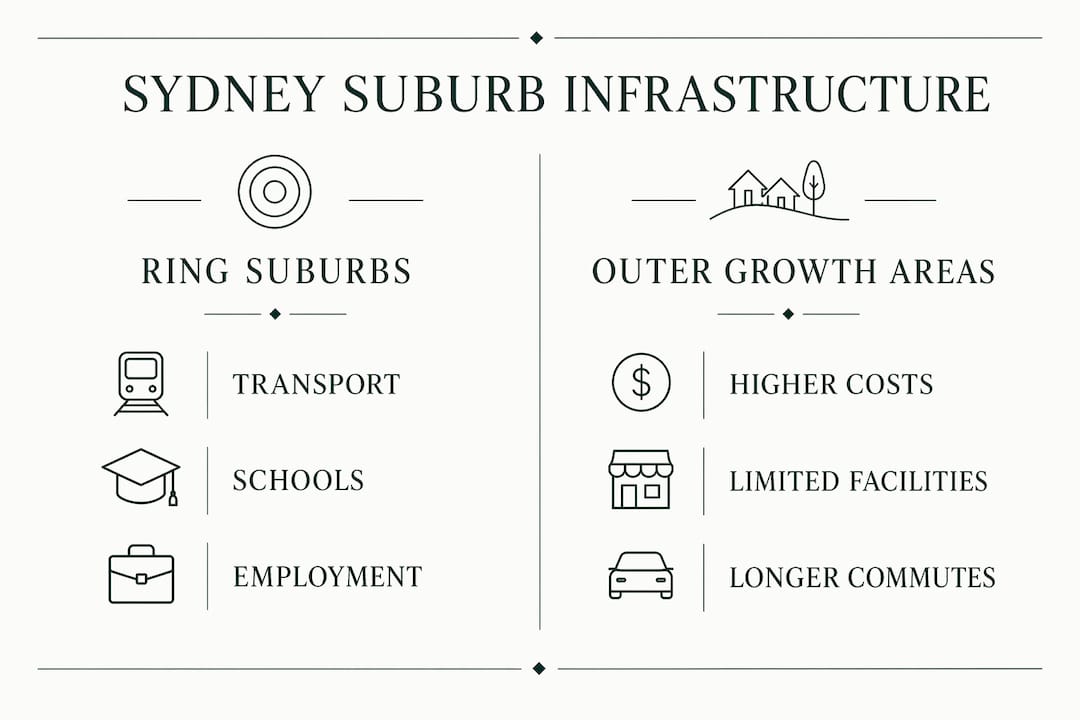
School infrastructure costs illustrate the disparity clearly. Some outer suburbs require over $20,000 per dwelling in additional school infrastructure investment, with areas like Pennant Hills-Epping and Pittwater showing markedly higher costs than established middle-ring areas. For buyers with school-age children, this translates directly into enrolment pressure, temporary classrooms, and longer travel to preferred schools.
| Infrastructure layer | Ring suburb status | Outer growth area status |
|---|---|---|
| Train and bus access | Generally established | Often limited or planned only |
| School enrolment capacity | Mostly adequate | Frequently under pressure |
| Community facilities | Present in most areas | Often delayed or absent |
| Road network | Functional, some congestion | Incomplete in newer estates |
| Open space and parks | Available in most suburbs | Frequently lagging delivery |
Pro Tip: Before committing to any suburb, check the NSW Department of Education’s school capacity data and your local council’s community infrastructure plan. If both show existing capacity rather than future promises, you are buying into a suburb that already works.
Ring suburbs versus inner city and outer areas: what buyers actually gain and give up
Comparing Sydney’s three residential zones reveals that ring suburbs occupy a genuinely advantageous middle position for most buyers, though not without compromise. The comparison below captures the key dimensions that matter to purchasers evaluating their options.
Inner-city suburbs offer unmatched job proximity, walkability, and cultural amenity. The trade-off is price. Median house prices in suburbs like Balmain, Newtown, and Surry Hills sit well above what a household earning the Sydney median income can service. Apartment living is the primary option for buyers who do enter the inner ring, and even that market has tightened considerably since 2022.
Western Sydney ring suburbs offer competitive affordability combined with expanding infrastructure and growing local employment. Areas like Parramatta, Liverpool, and Blacktown now function as genuine sub-centres with their own commercial districts, hospitals, and universities. This reduces the dependency on the CBD that once made ring suburb living feel like a compromise.
Outer growth corridors in areas like Austral, Leppington, and Box Hill present the lowest entry prices but carry the highest infrastructure risk. Greenfield residents often travel far for pools, libraries, and parks, with council funding constraints delaying promised facilities by years. Austral, with over 15,000 residents, was still awaiting basic green space in 2026. That is not a minor inconvenience. It is a daily quality-of-life deficit that affects resale value and buyer satisfaction.
The ring suburb buyer gains:
- A detached home or townhouse at a price that mortgage serviceability can support.
- Access to established schools, transport, and community facilities without waiting for delivery.
- Proximity to employment nodes that have grown beyond the CBD, including Parramatta, Macquarie Park, and Norwest.
- A suburb comparison framework that shows measurable amenity differences across zones.
The ring suburb buyer gives up:
- Walking distance to the CBD and inner-city cultural precincts.
- The prestige premium that inner-ring postcodes carry in some social and professional contexts.
- In some cases, the capital growth trajectory of tightly held inner suburbs, though this varies significantly by location and property type.
Practical considerations when buying in Sydney ring suburbs
Buying in Sydney ring suburbs requires a more deliberate due diligence process than purchasing in the inner city, where infrastructure is already proven. The following steps reflect what experienced buyers and buyer’s agents actually do before committing.
-
Verify infrastructure status, not just plans. Council masterplans and developer brochures describe what a suburb will look like. What matters is what exists today. Check whether the train station, school, and local park are operational, not merely approved or funded.
-
Assess commute times at peak hour, not off-peak. Drive or take public transport from the property to your workplace on a Tuesday morning. Many ring suburbs that appear well-connected on a map add 45 to 60 minutes to a daily commute once congestion is factored in.
-
Research employment nodes within the ring. The strongest ring suburb locations sit within reasonable distance of both the CBD and a secondary employment centre. Parramatta, Macquarie Park, and Norwest each employ tens of thousands of workers and reduce the CBD dependency that drives commute pressure.
-
Evaluate the ‘soft infrastructure’ timeline. Community amenities still in planning stages carry real risk. Councils face funding constraints, and promised parks, libraries, and pools can be delayed by five to ten years. Buyers who purchase based on future amenity sometimes wait a decade for the suburb to deliver on its promise.
-
Model the full cost of living, not just the purchase price. A lower purchase price in a ring suburb can be offset by higher transport costs, private school fees if local public schools are overcrowded, and the time cost of longer commutes. Run the numbers honestly before concluding that a ring suburb is cheaper than an inner-city apartment.
-
Engage a buyer’s agent with specific ring suburb knowledge. The research process for Sydney suburbs in 2026 involves data sources that most buyers do not know exist, including school capacity reports, council infrastructure contribution schedules, and off-market stock. Professional representation closes that information gap.
Key takeaways
Sydney ring suburbs attract buyers because they deliver the affordability that inner-city areas cannot, backed by infrastructure that outer growth corridors have not yet built.
| Point | Details |
|---|---|
| Affordability ceiling drives demand | Mortgage serviceability limits push buyers into ring suburbs where prices fit borrowing capacity. |
| Infrastructure quality is the differentiator | Established transport, schools, and community facilities make ring suburbs livable in ways new estates are not. |
| Outer areas carry delivery risk | Greenfield suburbs like Austral show that low prices can come with years-long waits for basic amenity. |
| Ring suburbs offer genuine sub-centres | Parramatta, Macquarie Park, and Norwest reduce CBD dependency and strengthen ring suburb employment access. |
| Due diligence must go beyond price | Buyers should verify infrastructure status, commute times, and soft infrastructure timelines before purchasing. |
What I have learned watching buyers move through Sydney’s rings
I have worked with buyers across Sydney’s inner west, eastern suburbs, and lower north shore for long enough to see the same pattern repeat. A buyer starts with an inner-city brief, hits the affordability ceiling, and then faces a choice: go further out than they planned, or recalibrate what they actually need from a location.
The buyers who make the best decisions are the ones who separate emotional attachment to a postcode from a clear-eyed assessment of what their daily life actually requires. Most people do not need to be in Newtown or Surry Hills. They need a reliable train line, a decent school within a reasonable distance, and a suburb where they feel safe and connected. Many ring suburbs deliver all three at a price that leaves room in the budget.
What concerns me about the current market is the number of buyers who move to outer growth corridors believing the infrastructure will arrive quickly. The Austral situation is not an anomaly. It is a pattern. Councils are underfunded, developer contributions are contested, and the gap between what is promised and what is delivered can span a decade. I have seen buyers purchase in estates where the nearest park is a 20-minute drive away, and the nearest school is at capacity. That is not a ring suburb trade-off. That is a lifestyle deficit that compounds over time.
The ring suburbs I find most compelling for buyers right now are those with existing train access, schools that are not yet under enrolment pressure, and a local commercial strip that has reached critical mass. Those suburbs have already absorbed the infrastructure investment. You are buying into something that works, not something that might work.
Policy changes around heritage protections and density near train stations will reshape this picture over the next decade. If the NSW Government follows through on its housing supply commitments, some inner-ring suburbs will become more accessible. Until that supply arrives at scale, ring suburbs remain the most rational choice for the majority of Sydney buyers.
— Kristan
How Sydney Property Buyers can help you find the right suburb
Choosing between Sydney’s rings is not a decision that should rest on a weekend of open homes and a few suburb profile pages. Sydney Property Buyers works exclusively for purchasers, never sellers, and that independence matters when you are weighing up infrastructure readiness, school capacity, and long-term capital growth potential across suburbs you may not know well.
The team conducts property inspections seven days per week, accesses off-market and pre-market stock that never reaches the major portals, and provides independent appraisals before you commit. More than 30 per cent of purchases are secured off-market, and the average saving on purchase price sits at approximately nine per cent. If you are ready to move beyond the research phase, explore the full purchase and negotiation services or call 1800 676 177 to speak with Kristan directly.
FAQ
What are Sydney ring suburbs?
Sydney ring suburbs are the middle-distance residential zones between the inner city and the urban fringe, typically 15 to 35 kilometres from the CBD. They include established areas across western, northern, and southern Sydney that offer a mix of housing types and existing infrastructure.
Why do buyers choose ring suburbs over inner-city areas?
The primary reason is affordability. Mortgage serviceability limits prevent most buyers on median incomes from purchasing in the inner city, and ring suburbs offer comparable amenity at prices that fit within borrowing capacity.
Are ring suburbs a good investment in Sydney?
Ring suburbs with established transport, schools, and employment access have historically delivered solid capital growth. The key is distinguishing between suburbs with existing infrastructure and those still waiting for promised amenity to be delivered.
What is the risk of buying in outer growth corridors instead?
Community infrastructure shortfalls in greenfield areas mean buyers may wait years for parks, schools, and community facilities. This affects daily quality of life and can suppress resale values until the suburb matures.
How do I assess whether a ring suburb has sufficient infrastructure?
Check the operational status of local schools, train lines, and community facilities rather than relying on council plans. A buyer’s agent with local knowledge can access school capacity data and council infrastructure contribution schedules to give you an accurate picture before you purchase.
Recommended
- How to research Sydney suburbs property in 2026
- Sydney inner west suburb comparison: 2026 guide
- Inner West Sydney – Welcome