Fiduciary duty is a legal obligation requiring a buyer’s agent to place the buyer’s interests above all others throughout every stage of a property purchase. This is the highest standard of care recognised in agency law, and it governs everything from how your agent handles confidential information to how they manage your deposit. For Sydney homebuyers and investors, understanding this obligation is not a legal formality. It is the foundation of every decision your agent makes on your behalf.
What does fiduciary duty mean for a buyer’s agent?
Fiduciary duty in real estate is defined as a set of legally binding obligations that compel an agent to act exclusively in the best interests of the person they represent. A buyer’s agent takes on fiduciary duties after signing a buyer representation agreement, which legally obligates the agent to the highest standard of care throughout the transaction. This is not a courtesy or a professional norm. It is an enforceable legal standard.
The term “fiduciary” comes from the Latin fiducia, meaning trust. In practice, it means your agent cannot prioritise their own commission, a selling agent’s relationship, or any third-party interest over yours. For Sydney buyers competing in fast-moving markets like the Inner West or the Eastern Suburbs, this protection is not abstract. It shapes every conversation, every offer, and every piece of advice your agent gives you.

Fiduciary duty is often misunderstood as covering only negotiation, but it also governs conflicts of interest and how the agent must behave ethically throughout the entire transaction. That broader scope is what separates a true buyer’s agent from a general real estate agent who may be serving multiple parties at once.
What are the key fiduciary duties a buyer’s agent must uphold?
The six core fiduciary duties are loyalty, confidentiality, disclosure, obedience, reasonable care, and accounting. Each one addresses a specific risk that buyers face when engaging an agent, and each one carries legal weight.
-
Loyalty requires the agent to prioritise the buyer’s interests above their own commissions or any conflicting interests. An agent cannot direct buyers toward properties that pay higher commissions if those properties do not suit the buyer’s needs. In Sydney’s off-market environment, where agents often have relationships with vendors, this duty is particularly significant.
-
Confidentiality prevents the agent from sharing the buyer’s negotiating position, maximum budget, or urgency with the selling agent or vendor. Sharing confidential buyer information can cause direct financial loss. Confidentiality is also the fiduciary duty most commonly breached, often through careless conversation rather than deliberate misconduct.
-
Disclosure means the agent must reveal all material facts they know that could affect the buyer’s decision, including property defects, zoning issues, and transaction risks. Full transparency helps buyers make genuinely informed decisions rather than relying on incomplete information.
-
Obedience requires the agent to act in accordance with lawful instructions from the buyer. Agents must not exceed the buyer’s stated limits, such as offer price ceilings, without explicit authorisation.
-
Reasonable care covers competent handling of transactions, deadlines, documents, and inspections. This duty ensures professionalism and safeguards contractual accuracy throughout the purchase process.
-
Accounting governs the responsible management of client funds, including deposits held in trust. This protects buyers from financial exposure during the period between exchange and settlement.
Pro Tip: Ask any prospective buyer’s agent to walk you through each of these six duties before you sign anything. An agent who can explain them clearly and confidently is far more likely to uphold them in practice.
How does a buyer representation agreement establish fiduciary duty?
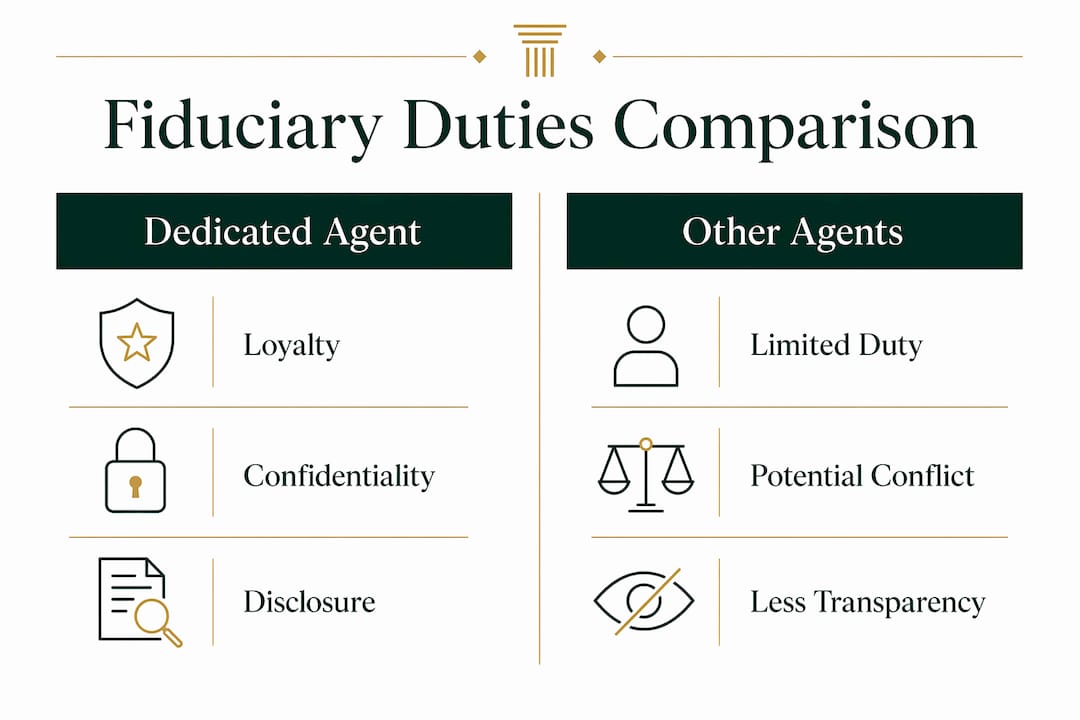
Fiduciary duty does not arise automatically when you start working with an agent. The agency relationship and fiduciary duties only commence after signing a formal buyer representation agreement. Without that document, you may receive assistance, but you do not receive the full legal protection that fiduciary duty provides.
A well-drafted buyer representation agreement should cover the following:
- Scope of services — which tasks the agent is engaged to perform, from property search through to settlement or negotiation only.
- Duration — the period during which the agreement is active, typically tied to a specific search or property type.
- Compensation — how the agent is paid, whether through a retainer, success fee, or a combination, and whether any vendor-paid commission applies.
- Conflict of interest provisions — how the agent will handle situations where their interests or relationships could conflict with yours.
- Termination clauses — the conditions under which either party can end the agreement and what obligations survive termination.
The exact scope of fiduciary duty depends heavily on the written agreement’s scope and the tasks the agent undertakes. A narrowly scoped agreement, such as negotiation only, limits the agent’s fiduciary obligations to that specific task. A full-service agreement extends those obligations across the entire purchase journey, from strategy and search through to settlement.
In Sydney’s market, where retainer fee structures and engagement terms vary between agencies, reading the agreement carefully before signing is not optional. It defines the legal relationship you are entering.
How do fiduciary duties protect buyers during negotiation and settlement?
The practical value of fiduciary duty becomes most visible when money is on the table. Each duty maps directly onto a risk that buyers face at different stages of the transaction.
“Confidentiality in negotiations prevents the buyer’s agent from revealing budget, urgency, or fallback limits, safeguarding the buyer’s leverage even under probing by opposing agents.”
This matters enormously in Sydney auction environments, where selling agents are trained to extract information from buyers and their representatives. A buyer’s agent bound by fiduciary duty cannot disclose your reserve, your timeline pressure, or the fact that you have already missed three other properties. That silence is worth money.
The protective effect of each duty during the transaction process breaks down as follows:
- Confidentiality keeps your maximum budget and urgency out of the vendor’s hands, preserving your negotiating position.
- Loyalty prevents your agent from steering you toward a property that suits their relationships rather than your brief.
- Disclosure means you receive all known material facts before you commit, including building defects, strata issues, or council notices that could affect the property’s value.
- Reasonable care governs the quality of due diligence, including independent valuations, building and pest inspections, and contract review timelines.
- Accounting protects your deposit from the moment it is paid until settlement is complete.
For property investors in Sydney, fiduciary duty-based disclosure and reasonable care are particularly critical. Investors rely on thorough material fact verification that goes well beyond a standard property inspection, covering rental yield assumptions, capital growth data, and zoning constraints.
What risks do buyers face without a fiduciary buyer’s agent?
Not every agent working with a buyer owes them fiduciary duty. The distinction matters significantly in practice.
| Agent type | Fiduciary duty to buyer | Key risk for buyer |
|---|---|---|
| Dedicated buyer’s agent | Full fiduciary duty | Minimal, if agreement is well-drafted |
| Selling agent | No fiduciary duty to buyer | Agent’s loyalty is to the vendor |
| Transaction broker | Limited duty only | No loyalty or confidentiality obligations |
| Dual agent | Compromised duty | Conflicts of interest on both sides |
Using a transaction broker or the seller’s agent reduces or removes fiduciary duty protections for buyers, limiting loyalty and confidentiality obligations entirely. This is a structural conflict, not a matter of individual agent character. A selling agent who is pleasant and helpful is still legally obligated to achieve the best outcome for the vendor, not for you.
Dual agency, where one agent represents both buyer and vendor, creates an inherent conflict that no amount of goodwill can fully resolve. In New South Wales, buyers should confirm in writing whether their agent acts solely for them or for any other party in the transaction.
Pro Tip: Before engaging any agent, ask directly: “Do you represent any other party in this transaction?” The answer to that single question tells you whether you have fiduciary protection or not.
Fiduciary duty scope varies by agency type, and buyers who do not confirm their agent’s obligations in writing are exposed to conflicts of interest they may not discover until after exchange.
What are common fiduciary breaches and how can buyers respond?
Fiduciary breaches are more common than most buyers realise, and they rarely involve outright fraud. The most frequent violations are subtler.
- Confidentiality breaches occur when an agent casually mentions a buyer’s budget or timeline to a selling agent during a property inspection or phone call.
- Loyalty breaches happen when an agent steers a buyer toward a property because of a referral relationship or a higher commission structure, rather than because the property suits the buyer’s needs.
- Disclosure failures arise when an agent knows about a material defect or risk and does not pass that information to the buyer before exchange.
- Obedience violations occur when an agent submits an offer above the buyer’s stated ceiling without explicit authorisation, or fails to act on clear instructions.
Breach of fiduciary duty can lead to monetary damages, licence suspension or revocation, and in some cases reversal of the property transaction. These consequences act as a genuine deterrent, but they require the buyer to take action.
If you suspect a breach, document everything in writing immediately. Gather emails, text messages, and any records of verbal instructions. Complaints regarding licensed agents in New South Wales can be lodged with NSW Fair Trading, which has the authority to investigate and impose penalties. Your written buyer representation agreement is your primary evidence, which is another reason why its terms must be clear before you sign.
Key takeaways
A buyer’s agent’s fiduciary duty is the legal foundation that makes genuine buyer advocacy possible, and it only takes effect once a formal written agreement is signed.
| Point | Details |
|---|---|
| Fiduciary duty defined | A legal obligation requiring the buyer’s agent to act exclusively in the buyer’s best interests throughout the transaction. |
| Six core duties | Loyalty, confidentiality, disclosure, obedience, reasonable care, and accounting each address a specific buyer risk. |
| Agreement activates duty | Fiduciary protections only commence after signing a formal buyer representation agreement. |
| Confidentiality protects leverage | Agents cannot reveal your budget or urgency to vendors or selling agents, preserving your negotiating position. |
| Breach has consequences | Violations can result in monetary damages, licence suspension, or transaction reversal under NSW law. |
Why fiduciary duty is the most undervalued protection in Sydney property
Most buyers I speak with have heard the phrase “fiduciary duty” but very few can tell me what it actually requires of their agent. That gap is a problem, because understanding it changes how you engage with every agent you meet.
What I have observed over years of working in Sydney’s Inner West, Eastern Suburbs, and Lower North Shore markets is that fiduciary duty is not just a legal formality. It is the difference between an agent who tells you what you want to hear and one who tells you what you need to know. I have seen buyers pay above market value because their agent failed to disclose comparable sales data. I have seen negotiation positions leaked in casual conversation at open homes. These are not rare events.
The written agreement is where most buyers lose their protection before the search even begins. A vague or unsigned arrangement gives you access to an agent’s time but not their legal loyalty. When I work with clients at Sydney Property Buyers, the agreement is the starting point, not a formality at the end of the onboarding conversation. It defines what I owe you and what you can hold me to.
My honest advice: treat the buyer representation agreement the way you would treat a contract of employment. Read every clause. Ask about conflict of interest provisions. Confirm that the agent works exclusively for buyers and never for vendors. An agent who is reluctant to discuss these terms in detail is telling you something important before the search has started.
— Kristan
How Sydney Property Buyers puts fiduciary duty into practice
Sydney Property Buyers operates on a single principle: we represent buyers, never sellers. Every engagement, whether a full purchase service or a negotiation-only brief, is governed by a formal written agreement that activates full fiduciary duty from day one.

Kristan Johnson and the Sydney Property Buyers team have secured 100+ properties for clients across the Inner West, Eastern Suburbs, Lower North Shore, and Eastern Beaches, with an average saving of approximately 9% on purchase price and more than 30% of purchases secured off-market. Every step of the search to settlement process is built around loyalty, confidentiality, and full disclosure. To discuss how fiduciary representation works in practice for your purchase, call 1800 676 177 or email hello@sydneypropertybuyers.com.au.
FAQ
What does fiduciary duty mean for a buyer’s agent?
Fiduciary duty is a legal obligation requiring a buyer’s agent to act exclusively in the buyer’s best interests, covering loyalty, confidentiality, disclosure, obedience, reasonable care, and accounting throughout the transaction.
When does fiduciary duty begin with a buyer’s agent?
Fiduciary duty commences only after a formal buyer representation agreement is signed. Without a written agreement, the buyer does not receive full fiduciary protections.
Can a selling agent owe fiduciary duty to a buyer?
No. A selling agent owes fiduciary duty to the vendor, not the buyer. Buyers who deal directly with a selling agent have no loyalty or confidentiality protections under agency law.
What happens if a buyer’s agent breaches fiduciary duty?
Breach of fiduciary duty can result in monetary damages for the buyer, licence suspension or revocation for the agent, and in some cases reversal of the property transaction under NSW law.
How do I know if my buyer’s agent has full fiduciary obligations?
Ask the agent directly whether they represent any other party in the transaction, and confirm that your written agreement specifies exclusive buyer representation. Agents who cannot answer clearly or who resist signing a formal agreement should be treated with caution.
Recommended
- What is a full service buyer’s agent?
- Buyers agent for North Shore property: 2026 guide
- What does a retainer fee mean for a buyer’s agent?